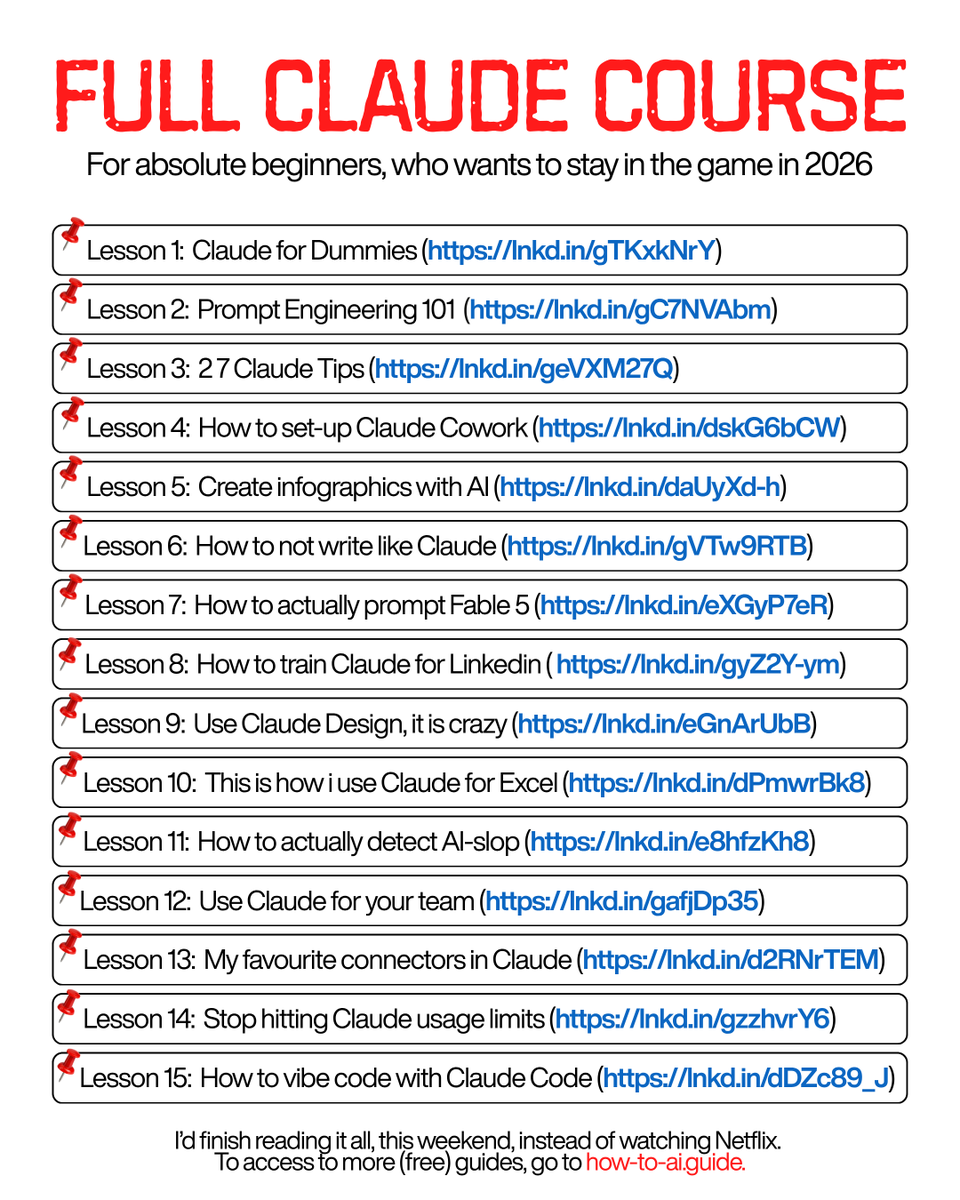
Before you open Netflix tonight:
• Create a Claude account
• Do not open a random YouTube tutorial
• Go through these guides one-by-one
You can learn Claude (entirely) over a weekend.
Here are the 15 guides to get you started:
1. Claude for Dummies (https://t.co/HNa5MrCLVU)
2. Prompt Engineering 101 (https://t.co/BhdLRaCgvy)
3. 27 Claude Tips (https://t.co/Uk66CN3rj5)
4. How to set up Cowork (https://t.co/AvO8fCLTrL)
5. Create infographics with AI (https://t.co/gj8asrU2Vl)
6. How to not write like Claude (https://t.co/FLZzLgwroE)
7. How to prompt Fable 5 (https://t.co/682TA10gmu)
8. Claude for Linkedin (https://t.co/9d5stC6grm)
9. Use Claude Design (https://t.co/q1zjMfeAyg)
10. Claude for Excel (https://t.co/7g3CFNcKrs)
11. Detect AI-slop (https://t.co/Tcc7YTTf1D)
12. Claude for your team (https://t.co/U1JsBVCzYH)
13. Connectors in Claude (https://t.co/TSAQqOpDeV)
14. Vibecode with Claude Code (https://t.co/O2kJvFkgan)
15. Stop hitting Claude limits (https://t.co/j5fEzSH5br)
--
1. Save this list for later (three dots, top right).
2. Share it with a friend by ♻️ reposting this image.
3. Subscribe to my free newsletter: https://t.co/psB7XxB2Y4.
If Shoulders were my TOP priority, I’d probably do something like this:
2 Upper workouts per week 3-4ish days apart
Upper 1 I’m prioritizing
- Seated Machine OHP
- Cable or Machine Lateral Raises
- Chest Supported Rows @ 45° Shoulder Abduction (Driving elbows past torso)
Upper 2 I’m prioritizing
- Seated Machine OHP
- Smith Upright Rows
- Rear Delt Flys
2-3ish sets of each exercise
5ish to 10ish rep range
1 RIR preferred but 0 RIR/Failure is just fine if you don’t trust your ability to accurately gauge RIR
I don’t mind bumping rep range slightly for exercises like Upright Rows/Laterals if it improves rep quality
And as always:
3+ MINUTES REST BETWEEN SETS
Women are missing out on the one hormone that runs their energy, their libido, and their strength.
Here's the reset that changed everything at almost 55:🧵
1. Testosterone. The one men get and women are denied.
Carl Sagan filmed a free seven-minute explanation of the fourth dimension that has now been watched more than five million times.
Universities charge tens of thousands of dollars a year for cosmology and geometry courses that never reach this material with the same clarity.
He posted the entire sequence for nothing.
Almost no one who casually debates higher dimensions has watched it to the end.
The clip comes from Episode 10 of Cosmos, “The Edge of Forever,” recorded in 1980. Sagan begins by placing the viewer inside Flatland, a two-dimensional world inhabited by squares and circles who can move left-right and forward-back but have never heard of up or down.
Into that plane he lowers a three-dimensional apple. The Flatlanders experience only a series of expanding and shrinking circles as the apple passes through their world. They never see the whole fruit, only successive slices, and they invent elaborate theories to explain the changing shapes that appear and vanish without cause.
Sagan then constructs a cube by moving a square through a third dimension at right angles to itself, and asks what happens if the same operation is performed once more: take the cube and move it at right angles to all three existing directions. The result is a four-dimensional hypercube, a tesseract.
He cannot show a true tesseract because both he and the viewer remain trapped in three dimensions, but he can display its three-dimensional shadow: two nested cubes with every vertex connected by lines. In the real four-dimensional object every edge would be equal and every angle a right angle; the distorted projection is simply the cost of losing a dimension.
Every modern discussion of curved spacetime, finite but unbounded universes, and higher-dimensional geometry rests on the same progression he lays out with an apple and a cube.
The sequence is free on YouTube. The willingness to sit through those seven minutes before speaking about the fourth dimension is a much rarer commodity than the confidence to argue without having watched it.
1️⃣ Holbox Island 🇲🇽 (instead of Tulum)
Car-free island with sandy roads, bioluminescent water, pink flamingos, authentic street food tacos for $3, and zero fake influencer beach clubs.
So friedrich nietzsche has a quote, and it's arguably one of the most brilliant things I've ever heard. And I think you need to hear it. It goes like this, "most people do not think, they repeat, they adopt the opinions of those around them, wear them like borrowed clothes and call it a worldview. And when you dare to think for yourself, really think, they will not admire you for it, they will resent you because your refusal to conform is a mirror they did not ask to look into. The unexamined man does not hate you because you are wrong. He hates you because somewhere beneath the noise he suspects you might be right."
⚽ Duelos 1x1 + transición
🔥 Gana el duelo individual
⚡ Reacciona tras pérdida o recuperación
🧠 Toma decisiones a máxima intensidad
🎯 Entrena situaciones reales de partido.
👉 https://t.co/XH6JANUQnT
As I’ve told you guys on numerous occasions:
2 sets is the answer MOST of the time
3 sets is the answer SOME of the time
1 set is the answer on OCCASION
4+ sets is almost NEVER the answer
(This is sets per exercise per session)
S/O Sean Naewanyj and Jeff Nippard
10 COMPANIES THAT BEAT THE S&P FOR DECADES!!!
Save this and send it to whoever is not sure which stocks to buy.
First, so you understand what’s actually at stake here.
$10,000 compounding at 10% for 30 years becomes $174,000.
The same $10,000 at 20% becomes $2.37 million.
Twice the return. BUT 13 TIMES THE MONEY. That’s why this matters so much more than people realise.
Now the list.
1️⃣ Monster Beverage
The best performing US stock of the last 3 decades. Roughly 25% a year for 36 years.
$10,000 in the early 90s turned into over $30 million. They sell caffeine in a can.
2️⃣ O'Reilly Automotive
Auto parts. Around 20% a year since the early 90s, and they have bought back over half the company along the way.
Nobody has ever posted a thread about auto parts.
3️⃣ Copart
They run online auctions for wrecked cars.
Compounded at roughly 20% a year for 3 decades because they own the land, the logistics and the buyer network, and nobody can rebuild that.
4️⃣ Constellation Software
Buys tiny vertical software companies nobody has heard of and never sells them. Around 30% a year since 2006.
The most impressive capital allocation record of the last 20 years and most investors can’t even name the CEO.
5️⃣ Fastenal
Screws, bolts and industrial fasteners.
Decades of double digit compounding from a business that is genuinely as unglamorous as it sounds.
6️⃣ Cintas
Uniform rental. They wash your work clothes.
Beat the market for 30 years because once a company outsources uniforms, they basically never switch.
7️⃣ TJX
Off price retail. Bought the inventory nobody else could sell and beat the S&P through the entire death of retail narrative.
8️⃣ Old Dominion Freight Line
Trucking. Actual trucks on actual roads.
One of the best performing stocks in the entire market since its IPO, in the most competitive industry imaginable.
9️⃣ Sherwin-Williams
Paint. Over a century old.
Compounded relentlessly because contractors do not switch paint suppliers and the company kept buying its own stock.
🔟 Berkshire Hathaway
19.9% a year for 60 years against the S&P's 10.4%.
That gap turned $100 into over $5 million instead of $37,000.
So what do they all have in common?
➡️ Almost none of them are technology
➡️ All of them have pricing power in something people rarely switch away from
➡️ Most of them had somewhere to reinvest for decades, whether that was new stores, new locations or acquisitions
➡️ Most of them bought back enormous amounts of their own stock
➡️ Every single one was available cheap at multiple points, and nobody wanted them at the time
That last one is the actual lesson.
None of these were secrets. You could have bought any of them in almost any year of the last 20 and done extremely well.
The reason people did not is that they were busy looking for something more exciting.
One honest caveat, because most lists like this leave it out.
This is a list of survivors. For every O'Reilly there were auto parts retailers that went bankrupt, and picking the winner in advance was much harder than it looks from here.
That’s exactly why the pattern matters more than the names. High returns on capital, a durable reason customers stay, and somewhere to keep reinvesting.
Final thought: nobody gets rich from the stock everybody is talking about.
They get rich from the boring one they held for 20 years while everyone else rotated through 6 different ones.
If you’re serious about investing, follow me with notifications so you don’t miss the next alert. This is EXTREMELY important because the market moves fast.
A lot of people are going to wish they followed me sooner.
Un ingeniero de Google Cloud acaba de mostrar cómo construir una aplicación completa con Claude desde cero.
Pasó 26 minutos en vivo en el escenario haciendo lo que la mayoría de los equipos tardan semanas en hacer.
Vale más que cualquier curso de codificación por vibras de $500, sin equipo, sin configuración, solo Claude y un objetivo.
Los que aprenden lo que Claude realmente hace están lanzando lo que todos los demás subcontratan a un equipo.
🚨 Anthropic just showed a 27-minute workshop on how to actually write prompts for Claude.
Taught by the people who built it.
Free. No registration. No paywall.
I've seen $300 courses that don't cover what they teach in the first 8 minutes.
Watch the session