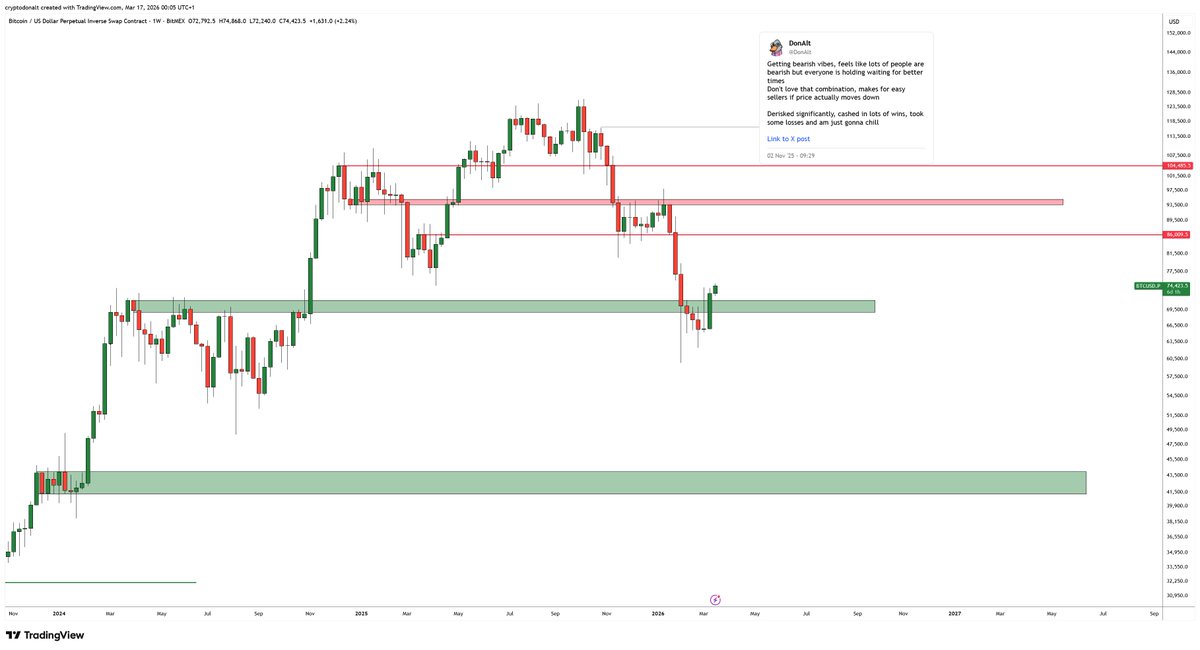
I held this short position for a total of 240 days.
240 days ago was $BTC all time high. I opened a short position exactly where I believed the ATH was going to be.
Then I simply followed my own trading method, waiting patiently for months for the pattern I trade to fully play out. I took partial profits after each drop and added those profits back in after each false rally.
My original entry was $124,600, my final average entry was around 91k.
This position is now closed.
That doesn't mean I think the bottom is in. It simply means I reached my goals and locked in the reward.
The Most Important Realization for a Technical Trader is this
If you get this one truth, your entire trading career changes overnight.
Technical analysis doesn’t predict the market, it frames your behavior within it.
Most traders spend years trying to use charts to forecast the future. They draw levels, patterns, fibs, and divergences thinking they’ll “know” what comes next.
But the market isn’t a puzzle to be solved, it’s a dynamic auction that constantly reprices information.
The true power of technical analysis is not prediction, it’s context. It helps you define:
Where your thesis is valid or invalid.
Where risk and opportunity are asymmetrical.
Where others are trapped and where you can act objectively.
Once you realize this, your charts stop being prophecy tools and become decision frameworks.
Your trades stop being about being right and start being about executing your edge
The shift looks like this…
From “What will happen?” to “What will I do if it happens?”
From “I think price will go up.” to “If this level reclaims, I’ll look for confirmation and risk 1R.”
From prediction to probability.
The moment a trader stops using charts to predict and starts using them to prepare, is the moment they cross from amateur to professional.
Do 4 hours of deep work per day
Walk 10,000 steps per day
Exercise 3x/week
Save 20% of your income
Sleep 8 hours
Read 10 pages per day
Do this consistently and you will be ahead of 99% of the population.
Most traders don’t fail because they never find a strategy.
They fail because they never stop searching.
At the start everything looks like the answer.
Indicators. Tools. New systems.
So they keep adding more.
Eventually something starts to work.
And that is where most people stop.
But traders who last do the opposite.
They remove what’s unnecessary.
They simplify.
They focus on what actually moves prices.
Over time, complexity disappears.
Not because the market got easier
but because their understanding got clearer.
It was never about more indicators.
It was about clarity.
If your system keeps getting more complex
you are probably not improving it.
You are avoiding simplicity.
💪Become an expert at identifying key levels of interest. Once you get really good at that, you'll find that most of your trigger techniques will have much more edge. Then make sure your risk management discipline is second to none.
Congrats, you are on your way to becoming a Pro!
Cred and I have partnered with @krakenfx
They'll be sponsoring our Youtube channel from now on
We've assured them we'd do one video a week and they've assured us they'll keep us to the promise
Good way to make the show more regular
Thanks Kraken ❤️
https://t.co/1t8Kfxbtvd
0 - Consistently Profitable in 30 seconds:
● Get off social media.
● Develop a simple set of mechanical rules.
● Back-test them for 100 trades.
● If profitable, start trading with real money.
If not profitable, change the rules and repeat the process.
● Don't stop till you find a profitable strategy that fits you.
Then make disgusting amounts of money.
It's that simple, bro.
Met a trader in a quiet café at 9:30 AM.
Saw him trading, so I went over and talked to him.
He managed $12.5 million.
Personal account: $480,000.
Average monthly return: 3.2%.
Worst drawdown: -6.8%.
He spoke in short sentences.
“No edge. No trade.”
“Risk first. Always.”
He risks 0.5% per trade.
Wins 54% of the time.
Cuts losses fast.
Lets winners run.
Makes about $42,000/month.
Some months less.
Some more.
Never forced.
He showed me one chart.
“One setup. One focus. One life.”
Then he left.
No course.
No flex.
Just discipline.
After having sold at $110k and largely sitting on my hands since avoiding a 40% drawdown I finally see some price action I like
Not guaranteed this is the bottom but I don't think BTC drops more than 50% from here
Good enough for me, bought back a HODL stack
Professional traders usually start with the downside.
In many conversations with experienced traders on Words of Rizdom, the same habit keeps coming up. Before they think about profit, they define the risk.
Early on, most traders do the opposite. The focus is on how much the trade could make, how far price might move.
But over time the approach changes.
The first question becomes simple: what happens if this trade is wrong?
Position size is decided.
The stop is defined.
Exposure to the account is clear.
Only then does the entry make sense.
Once the risk is accepted beforehand, the trade becomes easier to manage. If it works, it follows the plan. If it fails, the loss is already controlled.
That mindset is what helps professionals stay in the game longer.
Before your next trade, have you defined the exact loss you’re willing to accept?
Naval Ravikant: "You're going to die. It's all going to zero. What's there to stress about?"
"Stress is when your mind has two conflicting desires at once. You want to be liked, but you want to do something selfish. You don't want to go to work, but you want to make money. You have two conflicting desires, and that's stress."
Naval explains the difference between stress and anxiety:
"Anxiety is this pervasive, unidentifiable stress where you're stressed out all the time and you're not even sure why. The reason is you have so many unresolved problems that have piled up in your life, you can no longer identify what the problems are. There's this mountain of garbage in your mind. A little bit is poking out the top like an iceberg; that's anxiety. But underneath, there's a lot of unresolved things."
He shares his personal anxiety resolver:
"One big anxiety resolver for me is just ruminating on death. You're going to die. It's all going to zero. You cannot take anything with you. If you can keep that idea in front of you at all times, what's there to stress about?"
Naval reframes what "wasted time" really means:
"What is wasted time? Everything is wasted time in a sense because nothing matters in the ultimate. But in each moment, it's the only thing that matters. So if you're doing something you want to do and you're fully there for it it's not wasted time. If your mind is running away, wishing you were somewhere else, anticipating the future, regretting the past, that's wasted time. That's time you're not present for."
He concludes:
"People get worried about dying and no longer being here. But they don't realize that so much of their life is spent not being here in any case."
The future of trading isn’t AI, It’s traders who know how to use it 🚨
U.S. Investing Championship trader Marios Stamatoudis (290% return) explains why the next generation of elite traders will be hybrid, combining AI with discretionary decision making.
Full episode 👇
It’s easy to get pulled into global drama, especially when the internet serves it to us all day. But most of us forget that
Not everything that happens in the world is your assignment.
Some people are personally connected to these events, they have family involved, friends at risk, real ties. For them, it’s close. It’s raw. It’s understandable.
But for the rest of us, getting emotionally entangled in every geopolitical conflict doesn’t make us more informed, it just drains the energy we’re supposed to use on the things we can actually shape.
That’s the psychological trap, the mind gravitates toward problems it has zero power over because it’s easier than facing the responsibilities we do control.
Meanwhile, the responsibilities that are ours never change. Protect your family, build stability, guard your mind, grow spiritually, help your community, be a force for good in the small spaces where your actions actually matter.
The world will always offer you a new outrage, a new enemy, a new debate that leads nowhere. It’s a distraction loop designed to keep your attention on what’s distant and your hands off what’s real.
You can care about human suffering without letting your life get hijacked by every headline. Empathy doesn’t require obsession.
If you want to make a difference, start where your influence is strongest, your home, your people, your character, your daily choices.
That’s how you change a life. That’s how you change a community. And that’s the only part of the world you were ever meant to carry.