Navy SEALS use box breathing to stay calm & intensely focused during stressful situations.
3 times per day for 5 minutes each will exponentially reduce your cortisol / stress levels.
Come back to this tweet to practice daily
pinealon, epitalon, vilon, vesugen, the list goes on. bioregulators are the future.
they took time to gain fame, but i'd argue they're on track to become the 2nd most important class of peptides after GLP1's. READ THIS.
if you give a fuck about your health, you owe it to yourself.
This takes like 2 min to read and is the simplest explanation of the “loops” everyone is talking about.
Why can’t we all just speak in plain English instead of trying to make every single ai coding concept seem bigger than life?
I think we know why but still
the audit is the product.
it's not free pre-work.
a great AI audit gives the client clarity before you build anything.
It should show:
1. where they are losing time
2. where they are losing revenue
3. which workflows to fix first
4. which tools actually fit
5. what should stay human
6. what can be automated now
7. what needs to be cleaned up first
the main audit I've sold is an AI Tools audit where we inspect their workflows and prescribe 3-7 off the shelf AI tools they can implement immediately.
but there are multiple types of niche AI audits you can sell, including:
1. speed-to-lead audit
You inspect:
- where leads come from
- response time
- routing
- follow-up
- missed calls
Deliverable:
A 3-step plan to respond faster and stop losing leads.
2. Sales workflow audit
You inspect:
- sales calls
- proposal process
- objections
- follow-up
- CRM hygiene
Deliverable:
Follow-up system + call summary + proposal draft workflow.
3. Support audit
You inspect:
- ticket categories
- repeated questions
- refund reasons
- angry customer patterns
- escalation rules
Deliverable:
Support triage + draft reply system.
4. Ops/admin audit
You inspect:
- weekly admin tasks
- handoffs
- docs
- reminders
- approvals
Deliverable:
Automate/assist/keep-human map.
5. Content/research audit
You inspect:
- old posts
- sales calls
- customer language
- newsletters
- notes
Deliverable:
Content brain + idea system.
Charge $999-2,500 for these audits then upsell the implementation at $3,000-10,000+ plus monthly maintenance fees to keep the systems running and updated.
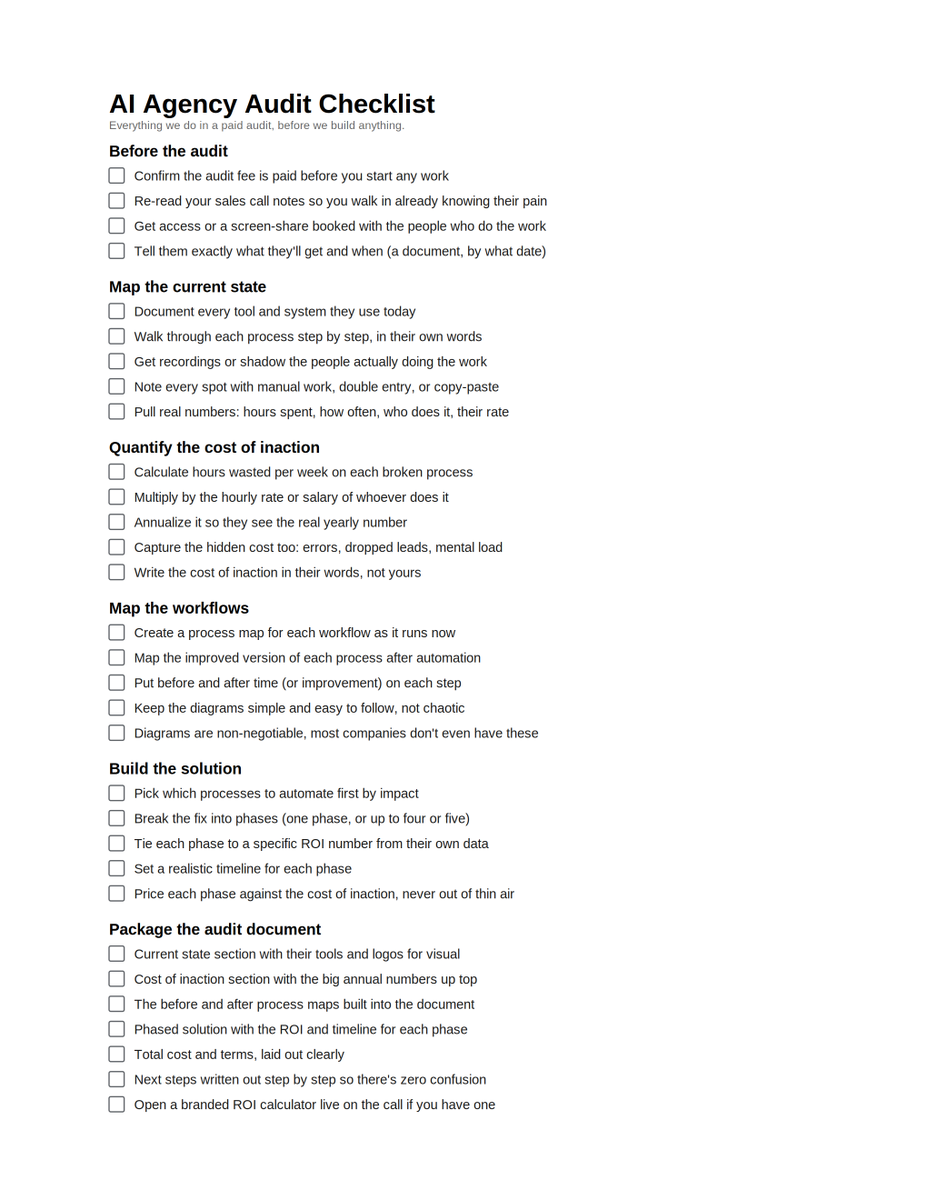
Before we build anything for a client, we run a paid audit. 3k to 5k, or baked into the contract price.
(Bookmark the full checklist below and run it on your next one.)
Sometimes you bake this cost into the project if you can scope it out early enough. Sometimes you charge for it on its own.
Either way, you run it. This part is separate from the build. Before you start building for any client, you go through this process with them first. Then you propose the project, or you sign them and start building. There's no skipping it.
The audit is where you stop guessing on what to build.
You map every process they run today. You pull the real numbers, hours wasted, how often, who does it, what they get paid. Then you annualize it so they see what the problem actually costs them every year.
You build before-and-after process maps so they can see the fix, not just hear about it. Companies love diagrams. Half of them have never seen their own workflow on paper.
Then you break the solution into phases and tie each one to an ROI number from their own data. The price isn't coming from you. It's coming from the cost of doing nothing.
By the time they read the audit, the build isn't a question of if because the numbers already made the call.
Full checklist below.
We’ve been able to send 200 LinkedIn inmails a day per account without getting banned
Clients booking 100+ calls per month with this as you read this
Agents take care of the entire process and we don’t see touch anything besides calls on the calendar
Personalizing off intent signals, account warming and maintaining limits, stacking multiple accounts safely
Each client running it is booking 50-100+ calls per month
RT, follow + comment "INMAILS" and I'll show you how we do it
THIS ONES WORTH 100 BOOKMARKS IF YOU SELL B2B.
I’m about to give you a node you can install into your sales process that has consistently given me the best discovery calls possible.
Not some objection-handling trick.
I have a joke I always use which is most of agencies don't do Discovery, they do Recovery - keep reading, you'll understand this inside joke shortly.
A simple node that makes prospects show up warmer, sharper, more bought in, more open, and far easier to actually run discovery with. This will also filter out the low intent leads that shouldn't be on the calendar.
By the time the prospect joins the meeting, a huge part of the sale has already happened If you do this right.
That is the part most B2B sales processes miss or hand off to a third world setter.
They spend all their time trying to get the meeting booked, but they do almost nothing to protect the quality of the meeting after it gets booked.
-So the prospect books the call.
-Calendly sends the invite.
-Maybe 1-3 reminders go out.
-Maybe a deck gets attached somewhere.
-Then everyone just waits for the meeting to happen.
That sounds normal.
Its also why so many discovery calls feel colder than they should.
Because a booked call does not mean the prospect is ready.
It just means they were interested enough, in one specific moment, to click a link and put time on their calendar.
That is not the same as being prepared.
That is not the same as being bought in.
That is not the same as remembering the reason they booked.
That is not the same as trusting you.
That is not the same as showing up with context.
That is not the same as entering the call like the conversation has already started.
And in high-ticket B2B sales, that difference matters a lot.
You can feel it immediately when the prospect joins.
Some calls feel like you are starting from absolute zero.
The prospect is technically there, but they are not really there yet. They are mentally coming from another meeting, another problem, another email, another fire. They vaguely remember booking, but they need to be re-oriented. You have to remind them who you are, what the context is, why the call exists, and what they were interested in.
That is a weak frame to start from.
Now the first 10 minutes of discovery are not really discovery. They are recovery.
You are trying to recover context.
Recover attention.
Recover the reason they booked.
Recover the emotional state they were in when they originally showed interest.
And by the time you finally get them present, you have already spent the most important part of the call warming them up.
Most sellers do not notice this.
They think the call was just “a little slow.”
They think the prospect was low energy.
They think the lead quality was off.
They think they need a better opener, better questions, better tonality, better slides, or a better pitch.
Maybe they do.
But a lot of the time, the problem happened before the call.
The prospect cooled down.
That is one of the silent killers in B2B sales.
-Interest decays.
-Urgency decays.
-Context decays.
-Memory decays.
-Excitement decays.
The longer the gap between booking and the meeting, the more the prospect drifts away from the reason they booked in the first place.
And if you are selling something high-ticket, complicated, consultative, or problem-driven, you cannot afford to let that happen.
Because discovery is only powerful when the prospect is actually engaged.
If they show up cold, guarded, distracted, or under-contextualized, you are already fighting uphill.
You ask questions, but the answers are shallow.
You try to diagnose, but they are still trying to remember the context.
You try to build urgency, but they are not emotionally connected to the problem yet.
You try to move the deal forward, but they are still treating the call like a random meeting on their calendar.
That is why so many sellers have calls that look good on paper but feel terrible in reality.
-The call was booked.
-The prospect matched the ICP.
-The problem seemed relevant.
-The offer made sense.
-But the actual conversation had no heat.
-No momentum.
-No continuity.
No feeling that the prospect had been pulled into the conversation before the meeting started.
And that is a massive problem.
Because the best discovery calls do not feel like first interactions.
They feel like continuations.
They feel like the prospect already knows why they are there.
They feel like there is already a thread between you and them.
They feel like you are picking up where you left off, not trying to create the entire frame from scratch.
That one difference changes the whole call.
When the prospect enters cold, you have to create everything live.
When the prospect enters warm, you get to build on what already exists.
That is why most people are putting way too much pressure on the discovery call itself.
They expect one meeting to do everything.
-Build trust.
-Create context.
-Educate the buyer.
-Explain the mechanism.
-Diagnose the problem.
-Create urgency.
-Handle skepticism.
-Move the deal forward.
That is too much weight for one call to carry.
The sales process should be doing some of that work before the call ever starts.
And I do not mean sending some generic automated reminder that says, “Looking forward to our meeting.”
That does almost nothing.
I do not mean blasting them with a 20-page deck and hoping they read it.
They probably will not.
There is a big difference between a prospect who has a meeting on their calendar and a prospect who feels personally connected to the meeting.
Most people confuse the two.
A calendar invite confirms a time.
It does not create buy-in.
An automated reminder confirms a meeting.
It does not create warmth.
A deck in their inbox gives them material.
It does not mean they consumed it.
A booked call gives you access.
It does not mean you have momentum.
That is the hidden gap.
And if you are taking high-ticket B2B calls, that gap is costing you money.
Because every cold discovery call requires more effort, more explanation, more trust-building, more framing, and more recovery.
Every warm discovery call gives you a better starting point.
-The prospect talks more.
-They answer with more detail.
-They are less guarded.
-They understand the context faster.
-They are more open to being led.
-They feel like they already know you a little bit.
And that changes how the entire conversation unfolds.
When I have a real human touchpoint with a prospect before discovery, the actual discovery call is almost always better.
-Not slightly better.
-Noticeably better.
-They show up more prepared.
-They show up more engaged.
-They show up with more trust.
They show up like we are continuing a conversation instead of starting one.
That is the entire game.
Because the goal before discovery is not to sell them.
It is to make sure they do not show up cold.
That is the part most people miss.
They think pre-call communication is only about reminders.
It is not.
It is about temperature.
You are trying to raise the temperature of the prospect before the meeting starts so the first 10 minutes of the call are not wasted creating context that should have already existed.
And the mechanism for doing this is stupidly simple.
After they book, you make them confirm the meeting properly.
You push them to accept the Google invite.
You make sure they confirm they received the Google Meet link.
You send them a short asset that frames the mechanism and gives them something useful to skim before the call.
Then, a few hours before the meeting, you personally call them from your actual iPhone.
Not a dialer.
Not some automated reminder.
Not a VA pretending to be you.
You.
Your real phone.
The move is not just to remind them that the meeting exists.
The move is to use the window before the meeting to create a small, controlled pre-discovery conversation that does three things at once: warms them up, gives you context, and quietly qualifies whether this person is actually worth taking seriously.
This should not be a 30-minute call. It should be 5 to 10 minutes. Short enough that it does not feel like you are trying to run the meeting early, but long enough that you get a real read on the person before they ever enter your calendar.
You call from your actual phone and say:
“Hi {{firstName}}, this is {{yourName}} from {{company}}.
We spoke through email and scheduled a meeting for {{time}} on {{date}} if that rings a bell?
(Wait for response, make sure they confirm they know who you are and that you have a meeting set)
Great, I wanted to personally reach out ahead of the call. I actually have another meeting to attend in a few minutes, so I won’t take much of your time, but I wanted to make sure this was your personal line and that you’re all set to join later.”
(That line matters because it lowers resistance.
You are not calling to trap them in a sales call. You are not calling to pitch them. You are not calling to pressure them. You are calling with a time constraint, which makes the conversation feel light, professional, and easy to engage with.
Then you open the pre-frame.)
“I spent some time on your website and gathered more intel through publicly available information, so I’m already up to speed on a few ways we may be able to help. But I’d like to come into the conversation even more prepared than I already am.”
Then you ask the first real question:
“Relative to {{insert offer}}, what would you say are the two biggest problems that exist inside the business today?”
“From the outside looking in, I can see a few possible areas where we may be useful, but I don’t want to assume.
Relative to {{insert your offer}}, what would be most valuable for us to focus when we speak about {{insert either benefits or mechanism}}?”
(Then shut up.
This is where you get the gold.
Because now, before the discovery call even starts, they are telling you the problems, concerns, bottlenecks, objections, limiting beliefs, and priorities that are probably going to shape the entire sales conversation.
They are giving you the map before you walk into the room.)
If they give you a lazy answer, that tells you something too.
And if they say, “There are no real problems right now,” you use the save button.
“Totally fair. Then let me ask it a different way. If there was one thing related to {{insert offer}} that could be made more efficient, save the company time, reduce friction, or help you get to where you’re trying to go faster, what would probably be the most useful thing for us to focus on?”
That question keeps the conversation alive without forcing them to admit a problem they do not want to admit yet.
Some prospects do not like saying, “We have a problem.”
But they will tell you what could be faster, cleaner, easier, more efficient, less manual, less expensive, or less frustrating.
That is often the same thing.
Then, before you end the call, you ask the money question.
Not in a weird way.
Not in a desperate way.
Not like, “Can you afford this?”
You ask it like a professional who does not want to waste anyone’s time.
“I know budget matters, and I’d rather make sure we come into the call prepared for that conversation as well.
Our typical engagements usually run between {{low price}} and {{high price}}, depending on the problem we're solving for.
Assuming we find a real problem and it becomes obvious that we can solve it, would that range be completely outside what the company could consider, or is it at least in range if the business case is strong enough?”
That is the cleanest way to ask the question.
You are not asking them to buy.
You are not asking them to commit.
You are not asking them to make a decision on the spot.
You are simply finding out whether the conversation has economic reality behind it.
If they say, “Yeah, that range is fine if the value is there,” you now walk into the call with confidence.
If they say, “That is miles away from what we could do,” you know that too.
And if they get weird, short, dismissive, or annoyed during a simple 5-minute pre-frame, that is also valuable information.
Because now you have a read on the call before you waste 45 minutes trying to create something that was never there.
Some people will be terrible on that pre-call.
Good.
Now you know.
You can still take the meeting if you want. You can use the discovery call to see if they open up. But you are no longer walking in blind.
Other people will give you everything.
They will tell you the two main problems. They will tell you what they care about. They will confirm the price range is realistic. They will accept the asset. They will thank you for calling. And when they join the meeting later, the call will feel completely different.
Because it is no longer a cold discovery call.
It is the second conversation.
Then you close the pre-call like this:
“Perfect. I’m going to text you a short {{insert consumption asset name}} before our meeting.
It goes over the {{mechanism}} we use and the results it has produced, so it would be great if you could skim through as much as you can.
Based on what you just told me, I’ll come prepared around those points specifically so we can hit the ground running.”
-That is the whole play.
-You confirm the meeting.
-You make it human.
-You extract the two problems.
You use the save button if they say there are no problems.
You lightly qualify budget.
You send the asset.
Then you walk into the actual discovery call with context, temperature, and a much better shot at closing.
Most people will never do this because they are obsessed with scale.
Let them keep automating reminders to cold prospects.
You pick up the phone and make the call warmer before it starts.
That is it.
-You are not pitching.
-You are not discovering.
-You are not trying to close early.
-You are creating continuity.
You are turning a booked call into a human interaction before the call starts.
And in high-ticket B2B sales, that tiny move can completely change the temperature of the meeting.
Most people will never do this because it is not scalable enough for their fantasy automation machine.
Good.
That is why it works.
-
Here is the full process from the prospect booking the call to the prospect showing up warm.
The second they book, your confirmation sequence should fire. That message should confirm that the meeting was successfully scheduled, give them the Google Meet link they will use on the day of the call, and clearly tell them that Google also sent a separate calendar invite where they need to click “Yes” to confirm attendance.
Do not assume the booked call means the meeting is actually confirmed.
You want them to take a small commitment action immediately after booking.
Tell them directly: “Google also sent you a separate calendar invite. Please click ‘Yes’ on that invite to confirm you’ll be attending, then reply to this email letting us know you received the meeting details.”
That small step matters because it creates engagement before the call. They are no longer just a passive booked lead sitting on your calendar. They have now accepted the invite, confirmed the meeting, and replied to you. That is already a warmer prospect than someone who clicked a Calendly link and disappeared until the meeting.
This is also why your Calendly reminders should not be sent from some dead inbox they cannot reply to. Do not let everything come from [email protected] if the goal is to create interaction. Whether the sequence is sent through Calendly, your email, or another tool, the prospect should be able to reply, and you should be able to see that reply.
At the same time, you should have a short text message go out that reinforces the same thing. Nothing long. Just a simple confirmation that the meeting is booked, the invite was sent, and they should accept the calendar invite so everything is locked in.
Inside the upon-booking confirmation, you should also include a micro asset.
Not a giant deck.
Not a 40-page homework assignment.
A short asset that warms them up before the call. This could be a micro deck, a case study, a breakdown of the mechanism, a short client result, or a simple explainer that gives them just enough context to make the meeting more valuable.
Then, leading up to the call, you send one reminder per day.
Each reminder should have a purpose.
Do not send the same “looking forward to our call” reminder five times. That is useless. Every reminder should increase consumption, context, and conviction.
-One reminder can show the mechanism.
-One can show the result the mechanism produces.
-One can show the problem the mechanism solves.
-One can show a case study.
-One can break down one step of the mechanism.
You can fragment the mechanism into small pieces and turn each piece into a micro asset. This keeps them consuming without overwhelming them. The goal is not to educate them into becoming experts. The goal is to make sure they do not show up cold.
Consumption is the game.
The more they consume before the call, the less work you have to do live. The call starts warmer. The prospect understands more. They ask better questions. They are easier to lead. They are more likely to connect their own situation to the thing you solve.
Then, one day before the meeting, you call them.
This is the key touchpoint.
In regards to the phone script I gave you above..
You can test calling immediately after they book, but I prefer calling the day before because the warmth carries directly into the call. If you call too early, the effect can decay. If you call one day before, the conversation is still fresh when they show up.
This is not a reminder call.
This is a pre-discovery call.
You are spending 10 minutes warming them up, confirming they are real, understanding what they care about, and qualifying whether this call is actually worth taking seriously.
On the day of the meeting, you want reminders firing at 24 hours, 4 hours, 1 hour, and 15 minutes before the call.
Every reminder should point them back to the meeting, but the cadence can change depending on your audience. Some markets need more handholding. Some markets will get annoyed if you overdo it. You have to test the pressure. Dial it up or down based on who you sell to.
The point is not to spam people.
The point is to make sure the right people show up prepared, engaged, and warmed up.
This process gives you a higher show rate, filters out weaker leads, increases pre-call consumption, surfaces the areas of concern before discovery, and financially qualifies the prospect before you spend 45 minutes with them.
Most people think the sales process is:
Booked call → discovery call.
That is why their calls start cold.
The real process is:
Booked call → confirmation → calendar acceptance → reply confirmation → text confirmation → micro asset → daily consumption reminders → pre-discovery phone call → financial qualification → day-of reminders → warm discovery call.
Go set this up today.