Hiyo story ya Nyaga stock brokers was extremely painful. Owned by Patrick Ndwiga Gakiavih, the firm collapsed in 2008 and Investors lost upto Ksh 1.3 Billion due to misappropristion of clients' money by the broker. Yaani walikuwa wanatumia pesa ya investors illegally. At one point they transfered close to 600Million of clients' funds to their account.
Investor compensation fund ( ICF) covered only Ksh 50k per investor so anything above that was lost.
About 90% of the 27,000+ claimants were small-scale investors whose total exposure was under KSh 50,000 each. They were fully compensated for their losses
High-net-worth individuals and institutional investors who had exposure well above the KSh 50,000 threshold absorbed the remaining brunt of the collapse, losing millions of shillings that the compensation fund could not legally cover.
Total Payout: The ICF ultimately paid out roughly KSh 281 million to KSh 302 million to resolve the genuine claims, leaving hundreds of millions in unrecoverable market value.
KSh 251 million was raised from the high-profile auction associated with the collapse of Nyaga Stockbrokers.
In total, Ksh 532 Million was paid to clients who lost money leaving the rest counting losses.
CMA has failed in their mandate as a regulatory authority especially in continuous oversight, reporting, practices and making sure that those who malpractice face dire consequences of their actions. They still do to date. They have known all along of Nyaga's ownership NSE stake highlighted by @BoardLotSultan but have done nothing to recover the funds and compensate those who lost their hard earned money.
From information that's available online ( including legal pages) Ksh 768 Million remain uncompensated and I urge all those who lost money to pursue Nyaga Stock brokers afresh.
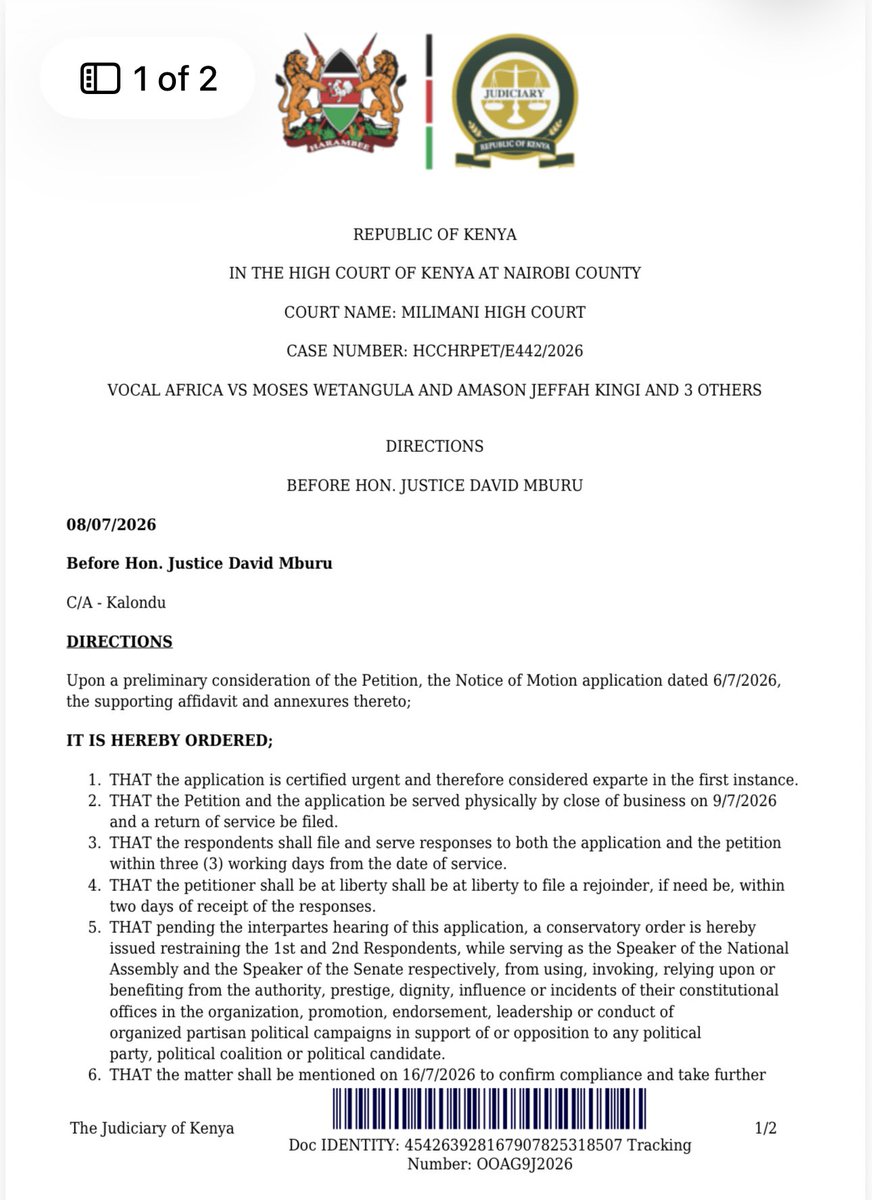
We at @VOCALAfrica_ wish to inform Kenyans that we have secured conservatory orders restraining the two speakers, @HonWetangula and @HonAmasonKingi, while serving as Speakers, from engaging in partisan political campaigns.
Rusya’da Instagram fenomeni Ekaterina Didenko’nun havuz partisinde, kimsenin beklemediği bir facia yaşandı.
Partide havuzun üzerinde sis efekti oluşturmak isteyen fenomen ve arkadaşları, onlarca kilogram kuru buzu suya döktü. Ancak eğlenceye dönüşmesini bekledikleri o anlar, saniyeler içinde dehşete dönüştü.
Çünkü kapalı alanda suyla temas eden kuru buz hızla süblimleşerek yoğun miktarda karbondioksit gazı açığa çıkardı. Oksijenin yerini alan gaz nedeniyle havuza giren 3 kişi bilincini kaybetti ve tüm müdahalelere rağmen hayatını kaybetti.
🚨🚨 BREAKING: THE BIGGEST MISTAKE PEOPLE MAKE IN LAND CASES.
Thousands of Kenyans genuinely believe their land was grabbed. Many are even right. But there is one mistake that continues to defeat otherwise arguable claims in court: confusing suspicion with proof. The Environment and Land Court at Narok has reaffirmed this principle in Seketo Ene Koilel (Suing as the Legal Representative of the Estate of Parameres Ole Koilel) v Moshoro Group Ranch & 12 Others. The Plaintiff alleged that Group Ranch officials unlawfully admitted new members, subdivided land allocated to the deceased and caused titles to be issued to third parties. Yet despite the seriousness of those allegations, the Court declined to cancel the titles after finding that the evidence presented fell short of the standard required by law.
The Court emphasized that fraud, illegality and procedural impropriety are not established by allegations alone. Critical witnesses were never called. Key documents were not properly authenticated. The alleged irregular meetings were never independently proved. While the law allows courts to impeach titles obtained unlawfully under Section 26 of the Land Registration Act, Justice L. Gacheru held that such a drastic remedy can only issue where illegality is demonstrated through cogent and credible evidence-not through suspicion, assumptions or unanswered questions.
The decision is a powerful reminder for anyone involved in a land dispute. Winning a land case is not just about believing you were wronged, it is about proving, document by document and witness by witness, exactly how the law was violated. The strongest story will still fail without evidence, while a well-prepared case built on proof can withstand even the protection ordinarily afforded to a registered title.
Kindly repost widely 🙏
If you are a scrap metal dealer,
Finance Act 2026 has not forgotten you.
Starting 1st July 2026, it has introduced a 1.5% withholding tax on scrap metal.
Here is how it works.
Every time you buy scrap metal, you are now required to deduct 1.5% from the purchase price and remit it to KRA.
• Example.
Say a street boy spends the whole week collecting scrap metal.
On Saturday, he brings it to your yard and sells it to you for Ksh 3,000.
You are now required to:
• Pay him Ksh 2,955.
• Confiscate Ksh 45. (1.5% of 3000)
• And remit the Kh 45 to KRA.
When you later sell that same scrap metal to a manufacturer in Industrial Area,
They too shall deduct 1.5% from your invoice and remit it to KRA.
The withholding tax now follows the scrap metal up the supply chain.
Lessons.
• Formalize your business.
• Keep proper records.
• This industry is now firmly on KRA's radar.
Hello Cyprian,
My name is Shady Okeri Mang'are. I am an online taxi driver in Nairobi, working with Uber, Bolt and Little Cab. I am reaching out because I feel abandoned by the very institutions that are supposed to protect ordinary Kenyans.
About eight months ago, I was carjacked in Kitengela after picking up people who posed as genuine customers. Instead, they turned out to be armed criminals. They attacked me, assaulted me severely, stole my vehicle and other valuables, and dumped me in a forest in Isinya, believing I would not survive. Fortunately, boda boda riders rescued me and rushed me to hospital, saving my life.
After the incident, preliminary investigations, including information obtained through a friend at Safaricom, led us to individuals we strongly believe were involved in the crime. We handed all the information to detectives at the DCI office in Isinya to assist with the investigation.
Sadly, nearly eight months later, nothing meaningful has happened. Despite the information we provided, no arrests have been made and I have been taken from one office to another with no clear answers. It feels as though the suspects are being protected while I, the victim, continue to suffer the consequences of losing both my livelihood and my peace of mind.
The stolen vehicle was my only source of income. Since the attack, I have struggled financially while those responsible continue to walk free. It is heartbreaking to see such a serious case seemingly ignored despite investigators having leads.
I am appealing to the Directorate of Criminal Investigations, the Inspector General of Police and the Ministry of Interior to intervene, review this case and ensure those responsible are arrested and prosecuted. Crime victims deserve justice, not endless promises and inaction.
I am ready to provide all the details and evidence in my possession if it will help move this case forward.
Please help me find justice.
Sometimes I complain about my job.
Then I remember the version of me who printed 40 CVs with borrowed money and walked Nairobi streets until his shoes told the story.
The one who was told “we’ll call you” so many times he started flinching at kindness.
The one who fasted before every interview, and paid tithe daily because there was nothing to eat anyway.
The one who read the offer letter three times because he couldn’t believe it, then went to a quiet place and cried like a child.
That man would slap me for complaining.
Sometimes I complain about fuel prices.
Fuel prices. For a car. A car.
I once stood at Khoja stage in the rain, watching matatus I couldn’t afford leave without me and swore to God one day.
Some nights I’m exhausted and the kids are screaming all over the house and I just want silence.
Then I remember the corridor at Pumwani Maternity. Pacing. Bargaining with God like a man with nothing left to offer. “Just let them be okay, Lord, and I will never ask for anything again.”
I signed that contract with heaven. The noise in my house is God keeping His end.
Sometimes I feel like a failure when friends build bigger houses than mine.
Then I remember the single room in Kingeero where my wife and I started.
One melamine plate. She ate after I ate, and told me she wasn’t hungry. She was hungry.
I repent of the lament.
Here’s the truth: almost everything you complained about this week was once a prayer that kept you up at night.
You are living inside your own answered prayers and calling it a burden.
Never forget where God has brought you from.
Former NTV Journalist Kennedy Mureithi narrates how someone is running a fake SGR website and stealing large sums of money from unsuspecting Kenyans who can't differentiate between the genuine and fake Madaraka Express websites.
Sasa ndio natoka kwa maofakado.
Today, I was training hass avocado farmers on eTIMS.
Their good export dealer had organized this crucial training for them.
If there are people who genuinely need to understand eTIMS implications, it is our great farmers.
Why?
The produce buyers simply tell them. Sishabula tuletee eTIMS invoice ndio tukulipe pesa yako.
So the farmers run to cyber and comply. But very few understand what happens next.
At the end of the year, KRA can clearly see, through eTIMS, that you sold avocados worth 1 million.
But because no one taught the farmer bookkeeping, they never ask for eTIMS invoices when buying:
• Fertilizer.
• Seedlings.
• Farm chemicals.
• Farm equipment.
• Labour.
• Transport.
Their costs remain invisible. But their sales are fully visible.
Then trouble begins.
KRA sees the 1 million in sales. But sees almost zero deductible costs.
It is almost as if the avocados fell from heaven.
So KRA treats your profit as 1 million.
Then demands about 30% income tax.
That is a whopping Kh 300,000 tax.
But the farmer does not have that kind of money. The money already went into fertilizer, workers, transport and preparing crops.
The farmer is then left in the harassing hands of KRA.
If there is one group of people that deserves intensive training on eTIMS and bookkeeping, it is our farmers.
Please enlighten the farmers in your community.
They feed us all.
The Asymmetry of Rights: There in no Equality Before the Law for the IMF
1. Section 5 of the Bretton Woods Agreements Act of 1963, as read with the Schedule to the Act, creates an impermissible asymmetry before the law. Fund Agreement Article IX, Section 2 gives the IMF full juridical personality, including the capacity “to contract,” “to acquire and dispose of immovable and movable property,” and “to institute legal proceedings.”
2. However, Article IX, Section 3 then provides that the Fund, its property and assets enjoy “immunity from every form of judicial process,” except where the Fund expressly waives immunity.
3. The result is a one-sided legal relationship:
-The IMF can sue Kenyans in Kenyan courts.
-Kenyans cannot sue the IMF.
-The IMF can contract, own property, and enforce rights in Kenya.
-Kenyans cannot enforce rights against the IMF.
4. This asymmetry offends the constitutional principle of equality before the law. Article 27(1) provides that “Every person is equal before the law and has the right to equal protection and equal benefit of the law.”
5. Equality before the law is not satisfied where one legal person may invoke the protection of Kenyan law but is placed, by ordinary legislation, beyond the reach of constitutional scrutiny.
6. A statutory regime that allows an international institution to sue, contract, own property, and enforce rights in Kenya, while denying affected persons and constitutional organs effective access to judicial process, creates a one-sided legal relationship that cannot be justified under the Constitution.
#DeniBandia #OdiousDebt
The ninja below was a young, energetic man who believed life was meant to be lived at full throttle. Over the weekend, he decided to go and irrigate his throat with premium Kanamba Specioo at Alfakir in Mirema. According to CCTV footage, two ladies pulled up, joined his table, and even offered to buy him a drink.
That's where the first red flag was raised bcoz this Nairobi, a woman can NEVER buy you drinks without an intention. But our boy thought he'd finally joined the exclusive club of men who have successfully consumed a woman's money.
What he didn't know was that the ladies weren't on a date,,, they were conducting an illegal assets recovery mission targeting his pockets. Their shopping list included his phone, his money, and anything else not nailed to the floor.
They allegedly spiced up his drink with the famous Pishori,, not the one from Mwea, but the premium KEMSA edition,, Chesaa! To the suspects, it was just another clearing and forwarding mission. To our guy, it became an unexpected one-way ticket to Sayuni.
The nap that was supposed to help them empty his pockets ended up costing him his life. He later died while receiving treatment after the drug reportedly caused fatal complications. The two suspects have since been arrested by DCI Kasarani, and investigations are ongoing as they await murder charges.
Our boy is currently cooling his heels in Paradiso State lodge while the two Mikoras are enjoying a very long staycation at the govt owned Airbnb located in a gated community along Kamiti Rd. May our boy's soul rest in Eternal peace. Kama kawa sisi walala hoii hatuna maoni, Letu Jicho tu.👀
Kenyan tea farmers are being punished by bad policy. When taxes make Kenyan tea more expensive than tea from our neighbours at the Mombasa auction, we are taxing ourselves out of the market.
The export levy should be suspended immediately. Government must stop treating farmers as a source of revenue and start treating them as the backbone of our economy. A nation cannot tax production and expect prosperity.
The question is not whether Kenya may belong to the IMF or the World Bank. The question is whether the Bretton Woods Agreements Act, a statute enacted at independence in 1963 may continue, after the promulgation of the Constitution of Kenya, 2010, to authorise treaty implementation, borrowing, public expenditure, tax exemptions, and institutional immunities in a manner that weakens judicial control of public power, limits access to justice and information, and displaces the constitutional architecture of accountable public finance.
While the Act may have served a lawful purpose at the time of its enactment in 1963, its continued operation must now be assessed against the normative framework of the Constitution of Kenya, 2010.
To the extent that its purpose or effect is inconsistent with the Constitution, the provisions must be read down, adapted, or declared invalid.
Accordingly, even if the Act was constitutionally unobjectionable at independence, its continued effect in the post 2010 constitutional order cannot be sustained where it undermines or derogates from constitutional requirements.
Bilhah Njoki Mwangi was a co director in a thriving electronics business on Luthuli Avenue. She ran it together with her husband, Joseph Muraya Mwangi. Joseph worked as a ground traffic controller at KAA, Jomo Kenyatta International Airport. Between his airport salary and their retail empire, the man had built serious wealth.
They lived comfortably in Buruburu Phase 5, one of Nairobi's most prestigious Eastlands estates. Bilhah drove a black Toyota Harrier. The kind of car that screamed corporate elite.On the outside, this was a power couple. A good home, a profitable business, two young children.
But behind closed doors, things were falling apart. Nine years of marriage had turned into mistrust, money fights, and accusations of infidelity. In March 2016, Bilhah walked out. She left her two young children, ages five and eight, in Joseph's care. She moved to Umoja, straight into the arms of her lover, Jimmy Ndung'u Waititu.
But leaving wasn't enough. She wanted everything: the house, the shop, the benefits. And divorce would give her none of that. So she made a decision that would change everything. Joseph had to die. Bilhah roped in her lover Jimmy. Then her own siblings, Lucy Waitherero and Peter Mwangi Gakungi, joined the plan.
A family turned into a hit squad. They put a KSh 500,000 bounty on Joseph's head. A KSh 100,000 deposit, with the balance of 400,000 to be paid once there was proof the job was done. They tracked his routine, his car, his route to work. Everything.
But somebody talked. An informant tipped off Buruburu DCI boss Jeremiah Ikiao about the plot. Instead of arresting Bilhah on the spot, the DCI played it smart. Weak conspiracy charges wouldn't stick in court. They needed her caught red handed.
So detectives found Joseph at work and told him the truth. His wife wanted him dead. Joseph didn't run. He agreed to become bait. He handed over his car, his schedule, his phone. Complete cooperation. The hit was planned for June 22, 2016, along his usual commute.
But DCI struck a day early, June 21, and grabbed the hired killers before they even moved. Then came the genius part. Detectives kept the killers' phones active and texted Bilhah. Job done, body dumped in Dandora, come with the balance. They staged a fake crime scene. A dummy dressed in Joseph's own clothes, lying face down in the dirt in Dandora.
Photos of the "body" were sent directly to Bilhah's phone. She believed it. Completely. No grief, no shock. Just celebration. She packed a bottle of wine in her Harrier, withdrew the KSh 400,000, and headed to Umoja to pay the "hitmen." Her sister Lucy rode with her.
Near Mama Lucy Hospital, DCI officers were already waiting, guns ready, exits blocked. The moment her car stopped, they swarmed it. Bilhah was found sitting there, cash on her lap, wine in the back seat. Caught red handed.
Within a day, the rest of the syndicate, her lover Jimmy and her brother Peter, were also in custody. All four were arraigned at Makadara Law Courts on June 29, 2016. Joseph testified his life was in "mortal danger." Courts still granted bail.
Big mistake. While out on bond, Bilhah broke into Joseph's house to steal marital property. She was arrested again on July 13, 2016. Prosecutors moved fast. They petitioned the High Court to cancel her bail entirely.
Today, Bilhah Njoki Mwangi remains a free woman. The case against her is still active in court, moving slowly, years after the plot to kill her own husband unraveled. A woman who plotted to kill her husband for his money, betrayed by her own greed twice over, and still waiting for justice to catch up with her.
This is a sad incident, but we have forwarded as received:
Hello good morning,
I am a cab driver and the worst happened yesterday to me.
I got a trip request, a lady from mirema syndicate said she was going to kitengela.
She said her phone was off and yes I didn't see any red flags.
I started the trip and she said she was going to pick something then return, so it was a sort of a round trip.
Little did I know that it was a trap.
The moment we reached her destination I don't know what happened I lost my consciousness immediately and it was around 11 pm.
Luckily I woke up safe where I had parked the vehicle but all valuables that I had were gone.
I was feeling dizzy more than a drunkard but I said to my self let me try and get home.
It was the day of the devil, I caused an accident, luckily I wasn't hurt.
Plot twist is that, one of my phone's has the feature that, when you try to unlock it, it takes a selfie.
She got away with my Samsung A17 and iphone 14pro max.
My brothers and sisters from the @DCI_Kenya and @NPSOfficial_KE please help this Kenyan.
Today I stand vindicated on the Ruaraka land saga after 8 years of being dragged to court, arrested, abused, threatened and painted as reckless for publishing what powerful people did not want Kenyans to discuss openly.
The Court of Appeal has now confirmed what we said from the beginning, that the land occupied by Drive In Primary School and Ruaraka High School was public land, and that the government had no legal basis to compulsorily acquire land it already owned.
The same Sh1.5 billion payment that some people wanted us to treat as normal government business has now been declared illegal, null and void, and the fresh attempt to squeeze another Sh1.769 billion from taxpayers has been thrown out completely.
When I exposed this matter, they did not answer the facts, they ran to court, used police, tried to intimidate me and hoped that fear would bury the truth, but time has once again proved that journalism is not a crime when it exposes theft of public resources.
Those who mocked, prosecuted, harassed and lectured me should now read the judgment slowly, because the courts have confirmed that taxpayers were made to pay for land that already belonged to the public.
Now this case against me must be dismissed
A sharp decline in student numbers has hit universities four years after President William Ruto’s new funding model was introduced, exposing deep cracks in the system.
Data from the Ministry of Education shows that university enrolment has fallen to a seven-year low.
https://t.co/hvyjXUewCv
Nearly 20 years after his death, the body of Ugandan musician Paul Job Kafeero was dug up from the grave for DNA testing to determine which of the 25 children he had were biologically his.
The legendary Ugandan musician died in 2007 at the age of 36.
For nearly 20 years, his 25 children and their mothers fought over his multi-billion Ugandan shilling estate, including land, houses, and music royalties.
The long standing dispute eventually led the court to order that his body be dug up and his bone and tissue samples were collected for DNA tests.
1st June 2026, it was dug up for test and 25th June 2026, the results were released.
Only 4 out of his 25 children were confirmed to be his biological children. The other 21 children were not his.