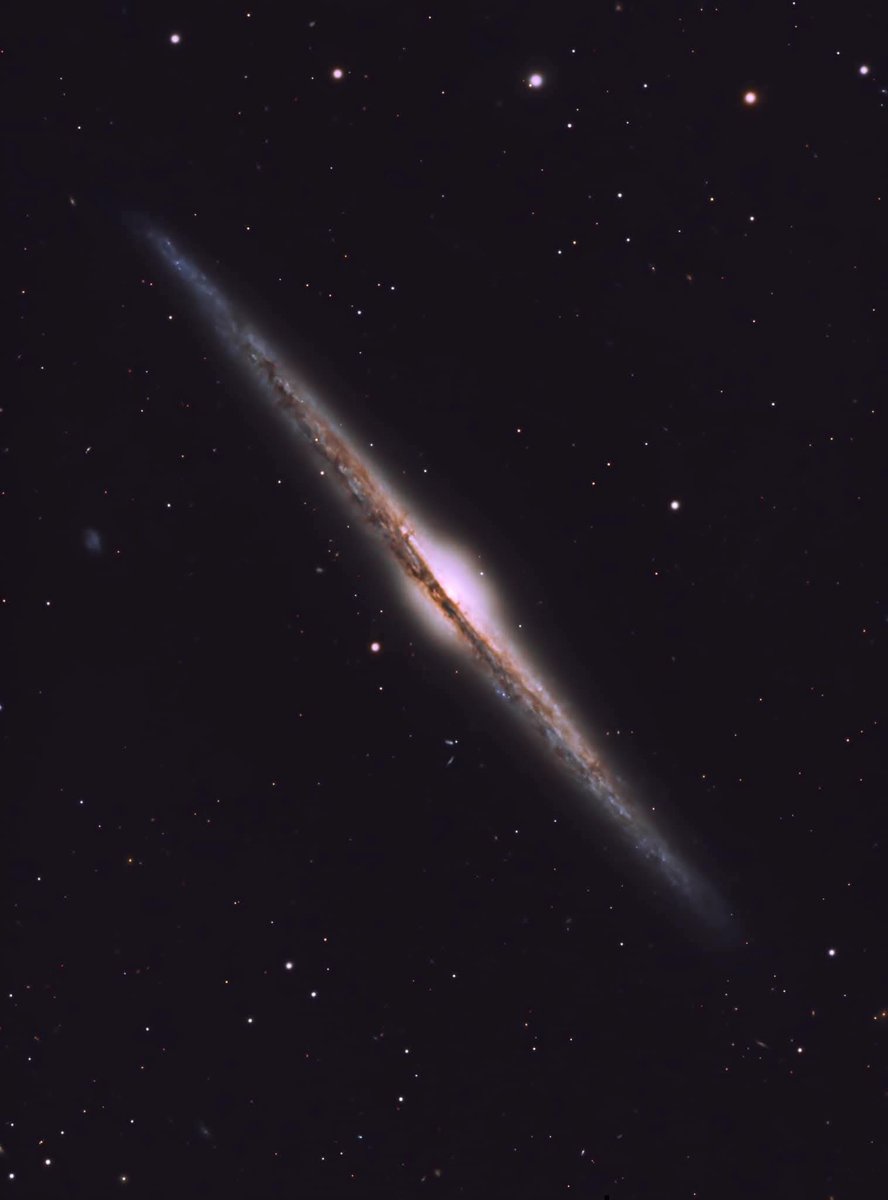
From the side, a spiral galaxy becomes a blade of light. NGC 4565—the Needle Galaxy—is one of the cleanest edge-on views we have of a large spiral, lying 30 to 50 million light-years away in Coma Berenices. Seen nearly perfectly edge-on, it appears as a razor-thin streak of starlight sliced by dark, winding dust lanes that cut across a bright central bulge.
That orientation is a gift. Instead of looking down into the face of a spiral, we look along its plane, so the thinness of the stellar disk, the vertical reach of its dust, and the structure of its bulge are laid out in profile. Long stacked exposures bring out the faint outer envelope and the subtle contrasts that remain invisible to the eye, revealing how little vertical thickness separates the billions of stars orbiting in the disk from the emptier space above and below it.
The Needle is often held up as a proxy for how the Milky Way itself might look from outside. A dense central region—almost certainly dominated by a supermassive black hole—anchors the system, while the dark lanes that cross the disk are made of cold gas and fine dust that absorb the light of the stars behind them. Studying galaxies like NGC 4565 helps astronomers measure how thin a stellar disk can remain, how dust is distributed through the interstellar medium, and how such fragile structures persist and continue forming stars for billions of years.
Image credit: Brandon O’Meal.
@Myntad_com True. Having a strong opposing view is better than zero opinion — at least there’s something real to push against. Bitcoin debates like this are exactly the kind of pure conviction talks that feel most natural on VOICE.
Sixty-seven million years ago, light left a quiet spiral in Cancer and began the long crossing that ends, tonight, in a telescope. NGC 2775—Caldwell 48—still looks almost serene when it arrives: a pale, swollen core wrapped in tightly coiled, feathery arms, more silk than fireworks.
William Herschel found it on December 19, 1783. It is the dominant member of the NGC 2775 Group, itself a small knot in the vast Virgo Supercluster. What sets it apart is the architecture. The arms are flocculent, broken into soft patches rather than grand, continuous sweeps, and a distinct ring of young stars circles the bulge. Star formation is underway there, but not in the frantic mode of a starburst—more a steady, luminous seam than a blaze.
The calm is recent. A gaseous tidal tail trails from the galaxy, the scar of a gravitational encounter with a smaller companion. Nearby NGC 2777 carries matching tidal debris, evidence that the two once brushed past each other and rearranged each other’s outer gas. In 1993 the galaxy also flared with SN 1993Z, a brief stellar death that astronomers used as one more rung on the distance ladder.
The Hubble view, built from ultraviolet and visible light by the PHANGS-HST team, holds both stories at once: the elegant spiral we see now, and the faint marks of the collision that shaped it.
Image credit: ESA/Hubble & NASA, J. Lee, PHANGS-HST Team
The Lagoon Nebula, also known as Messier 8, is a vast cloud of gas and dust in Sagittarius, about 4,000 to 6,000 light-years away. Newborn stars light it from within, carving glowing walls and dark lanes into the cloud. Close on a cosmic map, impossibly far for a day trip. Credit: NASA/ESA/HST/STScI.
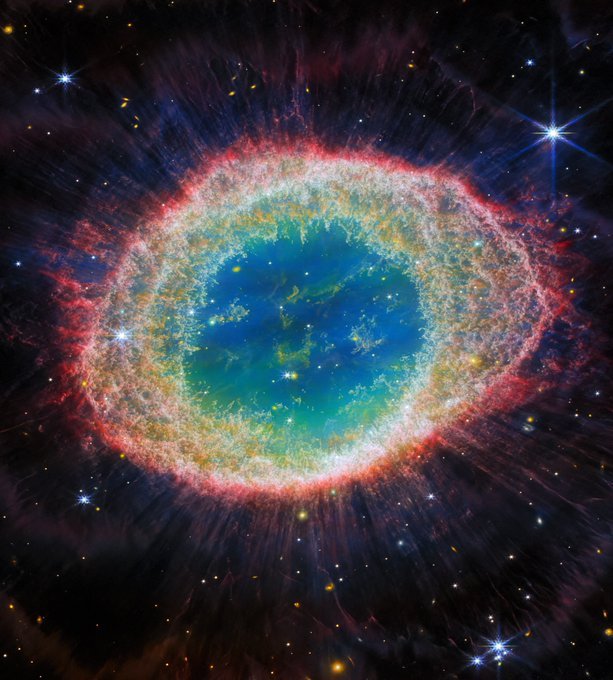
An infrared portrait of the Ring Nebula (M57) from the James Webb Telescope! 💫
It is estimated to be 4,000 years old and lies just over 2,000 light-years from Earth in the constellation Lyra. It represents the final stage in the life of a star similar to the Sun, though more massive. It features a complex structure of expanding gas shells shed by the dying star, with a white dwarf at its center.
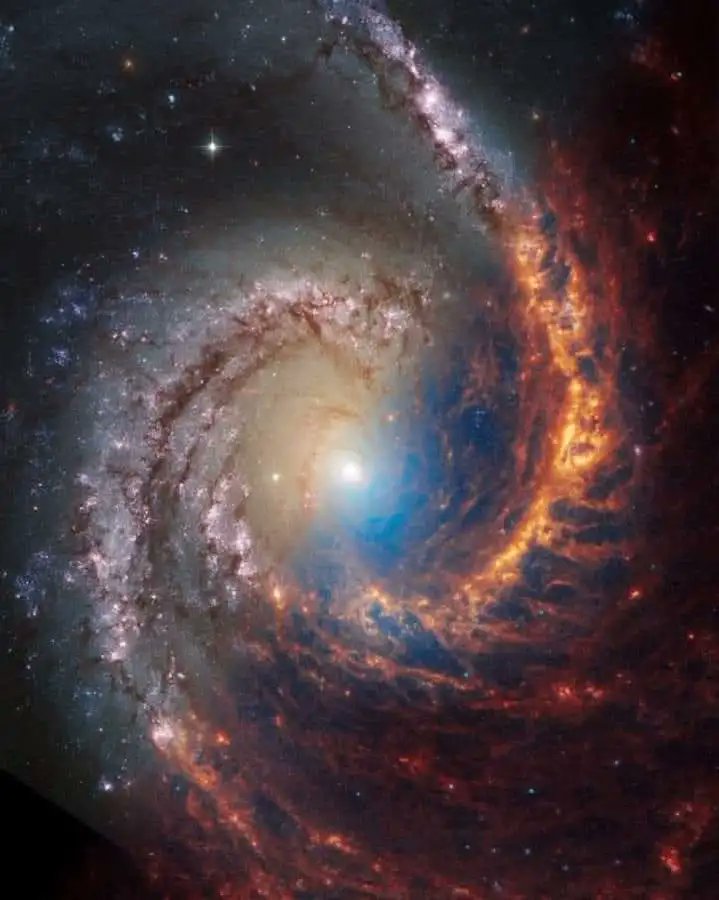
А single spiral is split in two realities. Across the diagonal, NGC 1566 becomes a study in opposites: Hubble’s ultraviolet and visible light at upper left, Webb’s near- and mid-infrared at lower right.
Where Hubble sees darkness, Webb sees fire. Dust that swallows starlight in Hubble’s view glows instead in Webb’s infrared, turning hidden lanes into molten orange and red. The same spiral arms that look veiled and shadowed on one side blaze with structure on the other—an inverse of light and night.
Together the telescopes map the full cycle of star birth: the dust that hides it, and the dust that reveals it.
Credits: NASA, ESA, CSA, STScI, Janice Lee (STScI), Thomas Williams (Oxford), Rupali Chandar (UToledo), Daniela Calzetti (UMass), PHANGS Team
Trump’s accounts bought COIN and MSTR. Sold the miners.
Trump’s investment accounts just showed their crypto stock tape.
OGE filing. July trades. 37 pages.
About 1,150 transactions that month.
Crypto-linked moves:
Bought Coinbase (COIN) on July 24
range: $1,001–$15,000
Sold Strategy (MSTR) on July 8
then bought it back July 24
then added more July 27
largest ticket: $50,001–$100,000
Sold miners on July 29
MARA
CleanSpark
each in the $15,001–$50,000 range
White House line: third-party managers run the book.
Trump does not pick the tickets.
Still, the mix is clear:
less miner equity
more exchange + Bitcoin treasury stock
Not a $TRUMP memecoin headline.
A rotation inside public crypto stocks.
Would you rather hold the miners — or COIN and MSTR? 👇
#Crypto #Bitcoin #MSTR
Billions in stablecoins are sitting dead on exchanges.
KuCoin just launched a product to squeeze yield out of that idle cash.
The new token is KCUSD.
Hold it, earn yield.
Base APR up to 4%.
Launch promo up to 6% on qualifying new funds.
Minimum: 1 USDT, USDC, or USDG.
No subscription fee.
Same-asset redemption.
The real pitch is not the APY.
It’s this: traders park stables for margin and miss yield, or chase yield and lose trading power.
KuCoin says KCUSD is step one.
Next step: use it as margin collateral, so capital can earn and trade at the same time.
Stablecoins started as digital dollars.
Now exchanges want them to work like productive capital.
Would you park funds in an exchange yield product — or keep dry powder idle on purpose?
#Crypto #Stablecoins #KuCoin
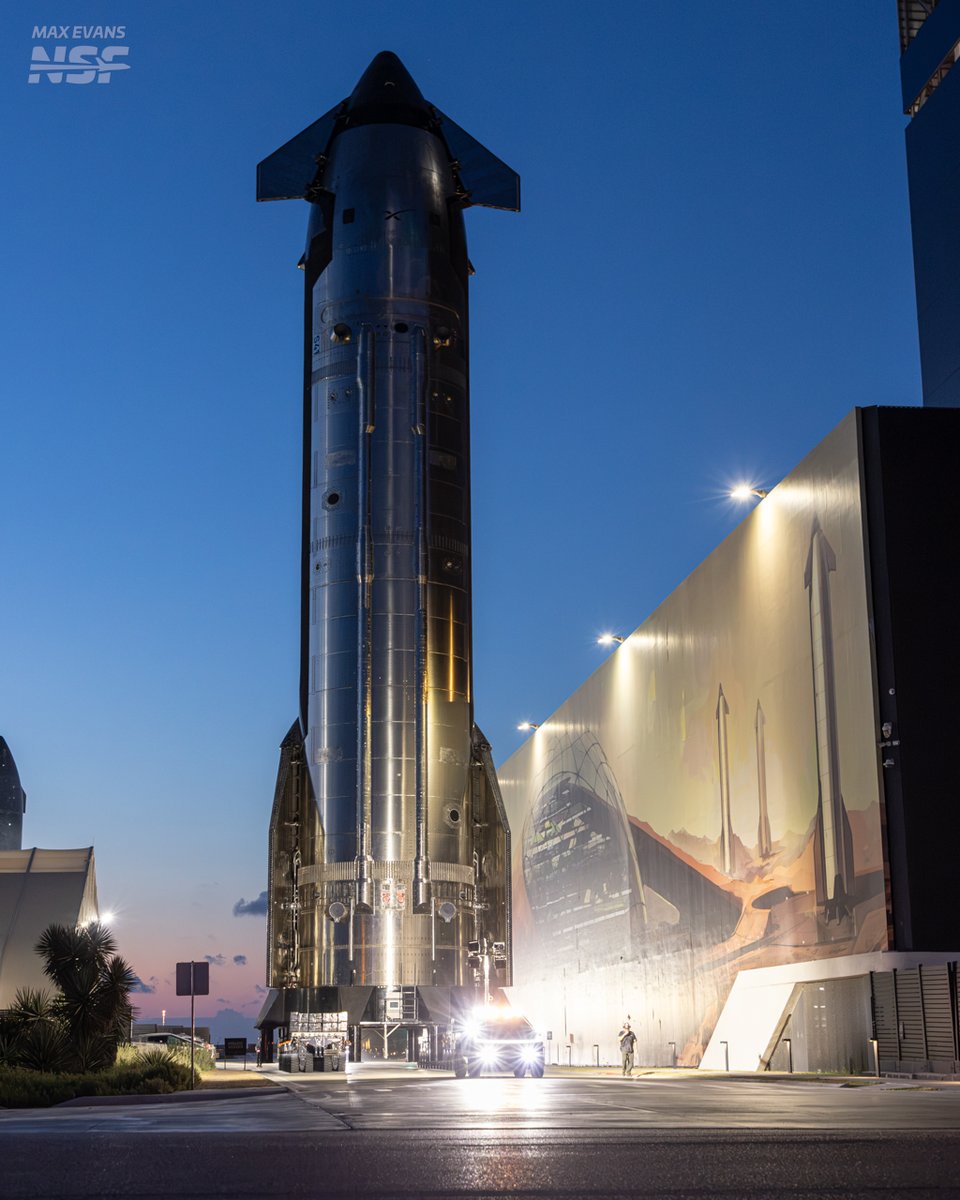
Ship 41 is on the move towards Pad 2 ahead of prelaunch testing in the coming days.
By this time next week, she will hopefully have been the first Starship vehicle to reach Earth orbit.
📸 - @NASASpaceflight
ROLL COVERAGE: https://t.co/MVqVVt78Rf
Michael Saylor is buying Bitcoin again.
And this time the price is already above $85,000.
Strategy just picked up 950 BTC for about $76 million.
First purchase in three weeks.
Total stash: 846,000 Bitcoin — around 4% of all BTC that will ever exist.
The market noticed.
Bitcoin ripped more than 6% in 24 hours toward $86,000.
Strategy stock jumped nearly 9%.
The twist:
Saylor’s “never sell” company sold BTC four times in the last four months when the bear market squeezed it.
Now the bid is back.
Context:
BTC dumped to $58,000 in June.
ATH last October was about $125,000.
September is usually weak.
This September isn’t.
Saylor doesn’t buy for the screenshot.
He buys when he thinks the recovery can last.
Is $85K the start of the next leg — or the trap before another fade?
#Bitcoin #Crypto #Saylor