For a few years now, a group of us have tried to explain that the biggest challenge in African democracies like Ghana, Nigeria, and Kenya is not really the POLITICS.
The real mess is in POLICY. We call this KATANOMICS.
But we have done most of our explaining using essays. Everyone tells us, however, that reading nowadays is hard! People are too swamped and busy.
So, we are trying our hands at using videos and photos. 😊
First video:
https://t.co/Sf5XeA8VwY
We are new to this so forgive the quality and focus on the message. But we are very welcome to all feedback. Keep them coming.
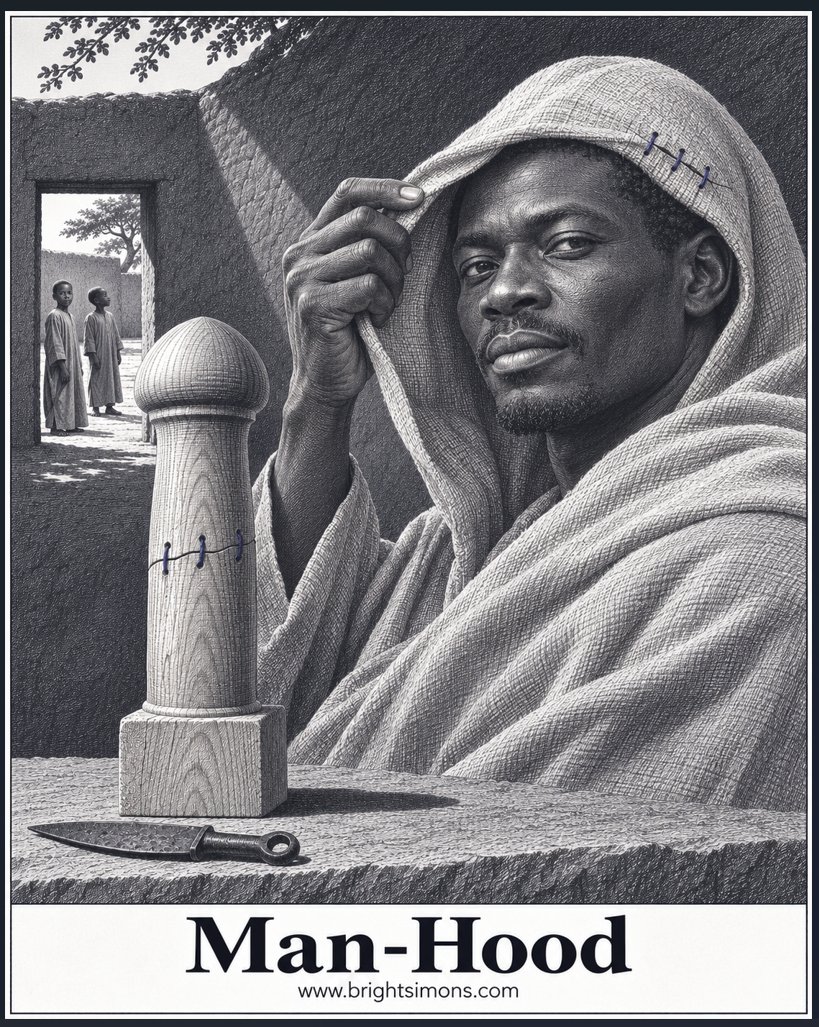
On Man-Hood
*********************
1. I was touched by news that surgeons at Korle Bu have reattached a man’s male member and that “he could now urinate on his own”. That even more than the titillating bit about “erections returning.” 🤦🏾
2. But the news also touched off some mournful accounts about mass castration I read long ago that continue to haunt me.
3. In 1861, a boy named Margal told a French doctor he’d been tending livestock when raiders seized him. They sold him to a castrator. Two months after the operation, a wealthy potentate bought him for his harem.
4. But Margal still couldn’t walk. When Ernest Godard examined him six months after the sale, he was wearing a metal device to keep his urinary passage open. Godard also noted, offhandedly, what the boy might fetch in Cairo then, where such trades were still brisk.
5. A few historians argue that the reason why the trans-Saharan slave trade doesn’t trigger the same political feelings today is because mass castration removed some of the demographic evidence down the line. Others say it lacked the compact horror of the Middle Passage and the plantation economies.
6. Whatever be the reason, I have long been more morbidly fascinated about what its dreaded episodes of mass emasculation say about “manhood” than anything else.
7. When it comes to castrated men and their eunuch roles, though, the trans-Saharan trade was hardly distinctive. Somehow, an idea developed over time that castration could in some way make courtiers more trustworthy and even better-focused.
8. That's to say, removing their "manhood" made them better men, for the purposes of others.
9. An idea that took root as much in the Roman and Ottoman Empires, as in Oyo, Hausaland, and Songhai.
10. Thus, a ruler could entrust his heirs to a man he believed incapable of founding a rival line. They could be relied upon to tend to harems and many of the other super-sensitive posts. Justinian sent Narses, a eunuch, to retake Italy, for instance.
11. Italian opera put the practice to another use. Castrated before puberty, Farinelli could produce a boy’s pitch with a grown man’s volume. The Spanish court recruited him in the hope that his singing would relieve Philip V’s melancholy.
12. "Manhood" has come to mean a part of the body and the whole condition of being a man. A great deal of cruelty has been embedded in that double meaning.
13. Emperor Justinian, for instance, recorded testimony that barely three out of ninety survive castration. One Explorer noted that it required 1000 boys to make 100 eunuchs fit for purpose. Purpose being: the perfect soldier, courtier, or harem-tender.
14. The man at Korle Bu said he’d been getting ready for lectures when the accident happened. I hope he’s back soon in class, so he can graduate into a dignified vocation.
15. Despite all the significance bestowed on that one organ in idiom, in practice, “being a man” is more often than not about throwing one's whole being into the relentless pursuit of society's stiff bar of socioeconomic purpose.
1. Unless you have been hiding under a rock, you probably know by now that the climate negotiations in Antalya, Turkey, failed over the weekend after oil producers like Russia and Saudi Arabia torpedoed plans to restore text about "transitioning" the world from fossil fuels (that plus a few other grievances.)
2. This is the first such failure since 2009.
3. A lot is being said about this failure that some say is actually a disguised victory. I only want to focus on something that struck me as odd in the positioning of some African countries.
4. I smell katanomics.
5. Kenya’s energy ministry signed minutes in Antalya on November 13th, setting out how it could work with the campaign for a global treaty to phase out fossil fuels.
6. Back home, one week later, Kenya's Energy and Petroleum Cabinet Secretary Opiyo Wandayi launched oil drilling in Turkana with mighty enthusiasm about Kenya becoming a serious oil player.
7. Vice President Tiémoko Meyliet Koné presented Côte d’Ivoire’s climate pledge in Antalya, and his country joined a group of countries insisting that COP31 must have explicit language calling for the phaseout of fossil fuels/oil/petroleum.
8. He shortly flew back home to open a fair in Abidjan six days later promoting fossil fuels. Alhaji Aliko Dangote, Africa's fossil fuel refining champion, was a principal honoree at the fair.
9. On the opening day of the Abidjan Summit, the Ivorian government presented a plan to raise crude production by 525% between now and 2040 and triple natural gas production.
10. There are a number of ways to reconcile these seemingly bizarre conflicts or tensions. But the most salient ones all point to katanomics.
11. Policy is rarely reconciled with political posturing in African countries so why should it surprise us when domestic policy doesn't align with international political posturing?
12. Furthermore, policy disaggregates, even more so in international policymaking. Geopolitics may aggregate different interests into a common position and deliver on the photo-ops for the world media.
13. Policymaking across international lines, however, must disaggregate any geopolitical position into choices and spill out all the glaring trade-offs about which investments go ahead, how to replace power and foreign exchange, and who bears the costs when and where.
14. That is why Ghana joined the treaty initiative in Antalya while seeking to revive a flagging oil industry with $3.5 billion in announced investment commitments. Also why in November, as Antalya got underway, its budget reported completed negotiations for new exploration rights in the inland Voltaian Basin.
15. Same reason why Nigeria would sign Africa’s continental free trade agreement in July 2019 and begin closing its land borders the next month. Or why Zimbabwe would go and join the WHO tobacco-control treaty in 2014, and still be pushing to increase tobacco production by nearly 50% at home by 2030 because it still hasn't quite worked out "alternative livelihoods".
THE BRIEF | African Newspage Newsletter
Africa’s pursuit of financial sovereignty and a greater voice in global financial markets takes centre stage in this special edition of THE BRIEF, following the launch of the Africa Credit Rating Agency (AfCRA) in Port Louis, Mauritius.
From concerns about international credit rating methodologies and the cost of borrowing to the need for credible African-led financial institutions, this edition explores AfCRA’s significance, the challenges of establishing market confidence and the broader implications for Africa’s access to capital and financial future.
Read More👇👇👇
https://t.co/yXgFMkLBlR
@DevReimagined@CSISAfrica@APRMorg@AU_ETTIM@_AfricanUnion@hmryder@LennonMonyae@tatchouopbelobe@BBSimons@HananMorsy14@APRM_MarieRose@ahunnaeziakonwa@Adam_Alqali
The symbolism of the Ghanaian state traces back to revolutionary ideas of national struggle that long predates the country's independence.
The country's flag draws on the same tricolour concept celebrated by many revolutionary movements.
In fact, the meaning of Ghana's flag colours are essentially the same as those in the 1851 flag of Bolivia, inspired by very similar Bolivarian ideas of independence.
Following Ethiopia (1897), ~18 African countries have since adopted the Tricolour red-gold-green symbolism.
I rather fear that you seem not to understand the serious issues at play,@innocent_dziafa
1. The fact that a massive cocaine bust happened in Beirut in late 2025 involving a shipment from Ghana but NACOC has to date failed to even acknowledge the incident, much less make arrests; and
2. And the fact that this Valencia bust involves the exact same pattern shows that NACOC has lost its grip on the situation.
Contrary to the impression it tried to create that it was working closely with foreign security agencies, it is beginning to look like it learns about some of these issues in the news like the rest of us.
Worse, it is unable to act on even post-arrest intelligence gathered overseas to tackle the cartels locally. And it can't seem to face up to the citizens and explain what their constraints are.
Are you aware that in September 2026, ecstasy was shipped from the same Valencia in Spain to persons in Ghana, an incident that triggered a manhunt across Europe? And was widely reported in several countries except Ghana?
None of this strike you as odd?
2.6 tons of cocaine!
Hidden amidst coconuts sent from Ghana to Spain!
Basically the same pattern as the November - December 2025 bust in Beirut (also involving container loads of coconut oil). The incident NACOC refuses to even discuss. Even though there are strong leads to an established network of freight forwarders.
It is clear from everything the Spanish have said that there was no intel collaboration with Ghana on the Valencia bust.
1. The container from Ghana was flagged because it fits a high-risk profile.
2. The discovery was made through enhanced inspections despite attempts to conceal.
Now that we have a very clear case of a massive security breach, NACOC must stop being defensive and open up for serious inquiries!
@BBSimons@patrickkwabena Thanks Bright for this education. My concern generally about these schemes is that we measure success in revenue. This is wrong. If the objective to get more discipline on the roads and therefore reduce accidents then we must additionally measure the level of safety on our roads.
IMANI VP, @BBSimons, says civil society activism in Ghana is not dying, but its impact is being reduced by growing fragmentation across the civic, media and political landscape.
https://t.co/shNahOHU1b
#IMANI#CivilSociety
I recently put on my *anti-fraud tech* hat (the vocation that pays my bills) to review Traffitech, the new automated traffic ticket/fine system in Ghana. Here is what I found.
1. You would notice that the base Traffitech fine of GHS 240 is more than 11x the minimum wage in Ghana.
2. So, minimum-wage earners must work for 11 days to pay each fine.
3. The median income in Ghana is ~GHS 2130 a month. Among informal workers, it is GHS 1200. And in Greater Accra, it is GHS 3000.
4. It is true that drivers who own their own cars tend to earn higher than the median wage. But a very large number of drivers on the road are commercial drivers who earn around the 3000 - 4000 a month mark.
5. One of the attached charts show you how the fines escalate against the disposable income of such drivers.
6. All of this to say that we should pay attention to COMPLIANCE as a function of AFFORDABILITY. If people simply can't pay, they will not pay. As the fines pile up, the ability to pay worsen.
7. It is not surprising that before the Kenyan scheme was suspended, compliance rate (people actually paying the fine) was a mere 16% and that in Cote D'Ivoire the authorities had to introduce an option to pay in installments.
8. Compare that with compliance rates of 75% in Berlin, 67% in Chicago, and 70% in New South Wales (Australia).
9. Apart from income, I would argue that a major factor for higher compliance rates in the above places compared to what we have seen in Africa is the SENSE OF FAIRNESS.
10. If drivers begin to feel that the whole scheme is arbitrary and it is hard to modify your behavior to avoid fines because the speed limits are hard to scope and determine, compliance will fall and arrears will pile up.
11. Something else will then happen: FRAUD.
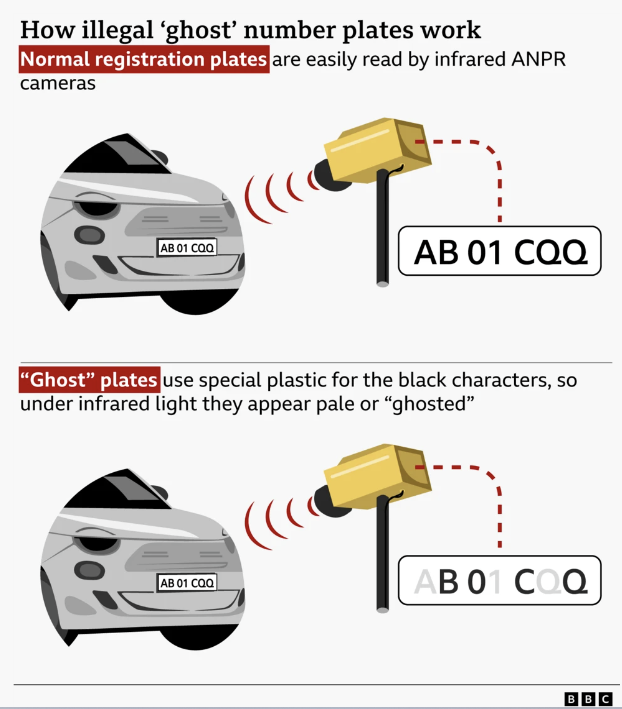
12. Last year, the UK authorities launched operation phantom, an exercise to detect car number plates deliberately tampered with to avoid automated tickets and fines.
13. Special cameras called "Sentio Ghost" were acquired from a company called Redspeed for the effort. Within 2 weeks, 4,335 ghost plates were recorded. Another provider, MAV, detected 1000 such plates at the Dartford Crossing. (Sensys Gatso, Ghana's provider, doesn't seem to have developed such tech.)
14. Researchers at UT Austin (Texas) recently showed how with $100 anyone can create a simple rim unobvious to the naked eye that reduces the performance of even the most advanced cameras by 60%. And now there are simple sprays that do similar things.
15. The situation is made worse by the poor street lighting in Ghana that makes using other spectra beside infra-red much harder.
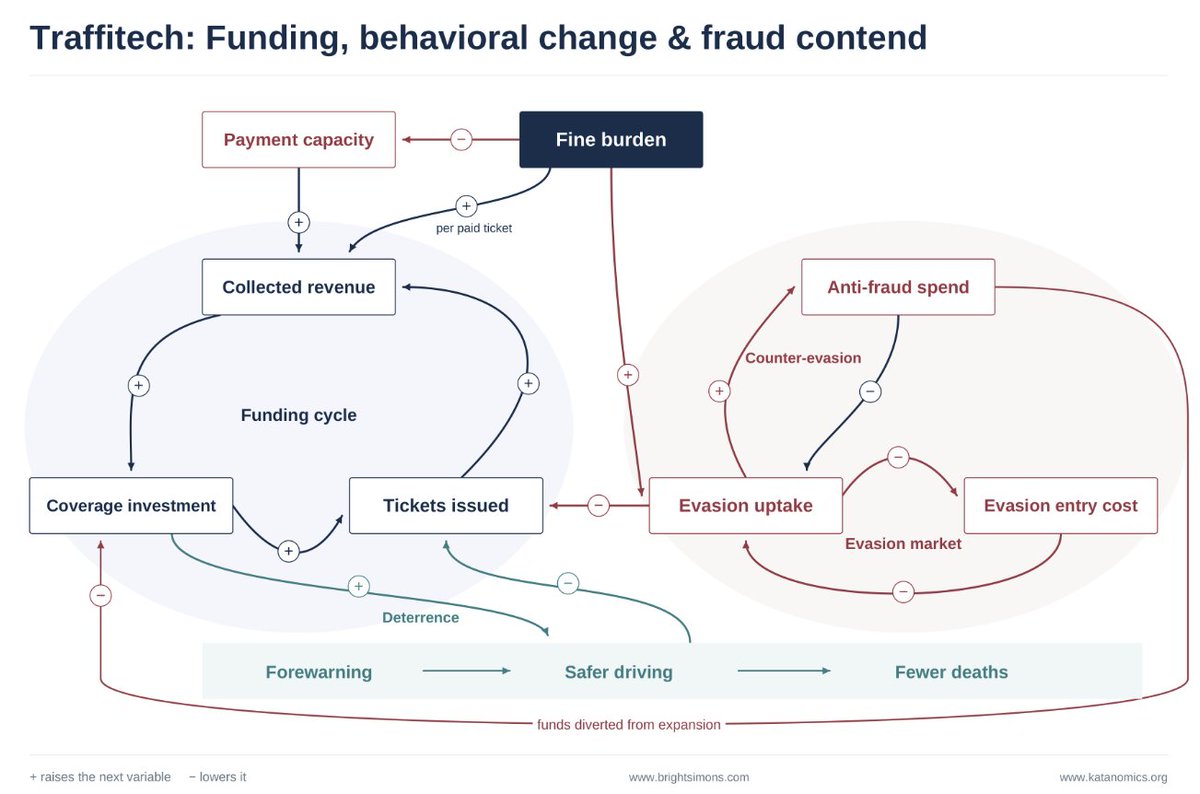
16. Capitalism means that if the number of evaders grow, the supply of "ghosting" tools will increase and costs will fall. Meanwhile, Mr. Frank Osei and Sensys Gatso will counter by pushing for more higher-tier cameras, which will drop revenue. But less revenue would also limit the ability to spread the system. See chart.
17. At any rate, research shows that in this fraud "arms race", the cost advantage is on the side of the criminals.
18. As the chart shows, there aren't easy answers about how to address these complex feedback loops. But, for sure, the idea that fines have to be kept high to serve as a deterrence is not all that smart.
Too many respected friends have asked me this question for me to continue to allow it to slide:
Is CSO activism dying in Ghana?
I don't believe it is. But I acknowledge that the impact is reducing a bit.
The reason, however, is not what the political partisans would have you believe.
It is not that all or the vast majority of CSO activists have suddenly been bought by the ruling party/government and are thus observing "table manners."
Let me share the explanation I gave to one of my friends.
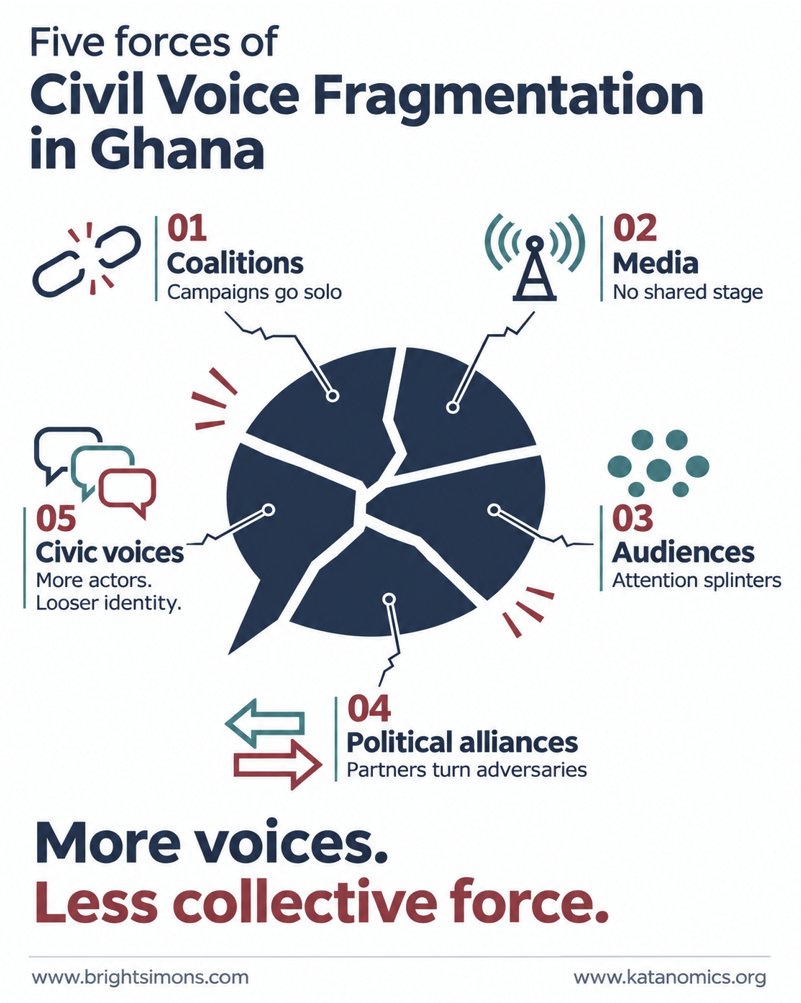
Five main developments are blunting the impact of CSO activism.
1.
A. Issue front fragmentation. In the past, CSO actors used to coalesce more formally around common campaigns. In the anti privatisation campaigns of the 1990s for instance, it wasn't just ISODEC. In the anti-Agyapa fight as well, it was more than just one or two CSOs. There were dozens.
B. These days, CSOs tend to go it alone most of the time.
C. This create the impression that the issue is "not a national issue."
2.
A. Media fragmentation. In the good old days, two or three media outlets, typically radio stations, were all you needed to capture national imagination and position an issue as a "national story." Today, there are dozens. Some are even reluctant to "jump on" an issue if they feel a particular media outlet has "branded" it too much.
B. Social media and a host of "bloggers" have also emerged.
C. Because of this, the workload of running a campaign has become almost unbearable, forcing many CSOs to just release statements and file petitions which do not have the same tempo and vibe.
3.
A. Audience fragmentation. In the past, there were fewer entertainment and information options, so politics served a high-octane excitement purpose. Today, audiences have a high threshold for stimulation.
B. Unless an issue is extremely sensationalised, it doesn't get traction.
C. People want stuff on their timeline or they don't bother. The same people then turn around to argue that CSOs are not commenting on national issues when they are doing so all the time. Somewhere else.
4.
A. Political fragmentation. There was a time when you could take it for granted that CSOs, the main opposition parties, and the main private media would align to balance the government's bigger information footprint. Not anymore.
B. It started a while ago and it has got worse.
C. Today, the main opposition party is not just estranged from most CSOs, it is actively doing everything to DISCREDIT them as paid lackeys of the government.
D. If you demonise and discredit CSOs, how do you expect the public to take what those same CSOs say seriously? Won't their effectiveness in holding the government to account be undermined?
5.
A. CSO fragmentation. There was a time when there were just two main types of CSOs: established NGOs and pressure movements.
B. There was a kind of established pattern as to who were the key voices and why that was so.
C. Today, a massively wide range of voices occupy that same space but do not necessarily regard themselves as "CSOs". Religious and traditional authority voices, for instance, are far more political now than in the past. CSOs' distinct contributions thus get drowned.
So, next time, you feel, sense, or hear that CSO activism is dying in Ghana, weigh your perceptions against the Five Forces of Civil Voice Fragmentation in Ghana.
.@BBSimons has raised concerns about the revenue structure under TraffiTech-GH automated traffic enforcement system, warning that linking a private operator’s earnings to traffic fines could create incentives that affect the fairness of enforcement.
https://t.co/odRpIl3RkV