SpaceX just received FAA approval to test the new Starfall reentry capsules, which are designed for in-space manufacturing and returning up to 1,000 kg of payload from orbit.
Full story:
https://t.co/J2CjFq2zo8
Two test flights are approved. The capsules can launch on Falcon 9 or Starship and splash down for recovery.
Would you trust high-value materials made in space and shipped back to Earth?
Best accounts to follow from each frontier lab to stay constantly up to date
Anthropic
@karpathy
- must-follow account for AI; recently joined Anthropic
@bcherny
- Claude Code creator, always shares great tips
@trq212
- also a Claude Code developer; writes amazing articles on CC
OpenAI
@polynoamial
- works on reasoning research, shares a lot of technical details
@gabriel1
- Sora developer, great career path
@jxnlco
- works on dev experience, shares a lot about Codex
Google AI
@OfficialLoganK
- all the major Google Gemini and AI Studio updates
@ammaar
- product and design; shares great things about vibe-coding in Google AI Studio
@fofrAI
- cool use cases for generative models
Cursor
@leerob
- the loudest voice behind Cursor updates
@ericzakariasson
- shares great insights on using Cursor
@mntruell
- Cursor’s CEO; major releases and usage updates
xAI
@milichab
- recently joined xAI, shares updates on Grok
@skcd42
- also covers major Grok releases
🏃♂️ I've gamified my own run so I can race my own ghost with the Meta Ray-Ban Display.
I built a web app for the glasses, loaded a previous GPX from Strava, and dropped game mechanics on top.
Pick up coins when you keep pace, sprint zones reward extra points if you push, and a mini leaderboard on the lens shows how you're tracking against your past self in real time.
Best part: it actually works. Seeing your ghost 20 m ahead is a way stronger nudge than any number on a watch. 😅
Wow. This is crazy.
A developer trained an AI agent in simulation and deployed it onto a real robotic air hockey table using reinforcement learning.
This robot can track the puck with millimeter-level accuracy and react in roughly 20 milliseconds, fast enough to challenge even skilled human players.
We’re moving from robots that follow programmed rules to machines that learn strategies in simulation and execute them in the physical world.
A YouTuber with 110 million subscribers released a free version of ChatGPT.
His name is Felix Kjellberg. You know him as PewDiePie.
He spent his own money on a 10-GPU computer at home. He used it to run the same kind of AI models that power ChatGPT, but on his own hardware. Then he wrote his own app to chat with them, because the apps that already exist were not good enough.
Then he gave it away for free. Anyone can download it. Anyone can change it. Anyone can run it.
It's called Odysseus.
It runs on your computer. Your data stays on your disk. No account. No tracking. No monthly fee.
What you get:
- A chat window like ChatGPT
- An AI assistant that can browse the web, read your files, and do tasks for you
- A tool that scans your computer and tells you which AI models will work on it
- A research mode that reads many websites and writes you a report
- A side-by-side mode to test two AI models on the same question
- A writing editor where AI helps you, instead of writing for you
- Memory, so the AI remembers your past chats
- Email with AI that sorts your inbox and writes replies for you
- Notes, a to-do list, and a calendar
- Works on your phone too
23,612 stars on GitHub in 2 days. Top of trending all weekend.
ChatGPT Plus costs $20 a month. Claude Pro costs $20 a month. PewDiePie's version costs nothing, runs on your own computer, and the code is open for anyone to read.
This is what AI looked like before the subscription model.
(Link in the comments)
We're proud to lead Westmag's Seed Round.
One of the underrated advantages of investing across the entire hardware stack is firsthand exposure to the supply chain challenges that plague our industrial base.
When one starts mapping which single points of failure could take down entire product lines, motors and actuators rise to the top of the priority list.
China currently dominates this landscape. The result is that many American drone, robotics, and defense companies are building on a foundation they don’t control.
Since our first meeting over tacos and beers last summer, Westmag has moved at a blistering speed from inception to shipping motors from their first factory.
Regulatory tailwind, combined with exploding demand from defense and humanoid robotics, means the timing for what Westmag is building has never been better, and the cost of not having it has never been more obvious.
By @espricewright and @oyhsu
This is absolutely incredible.
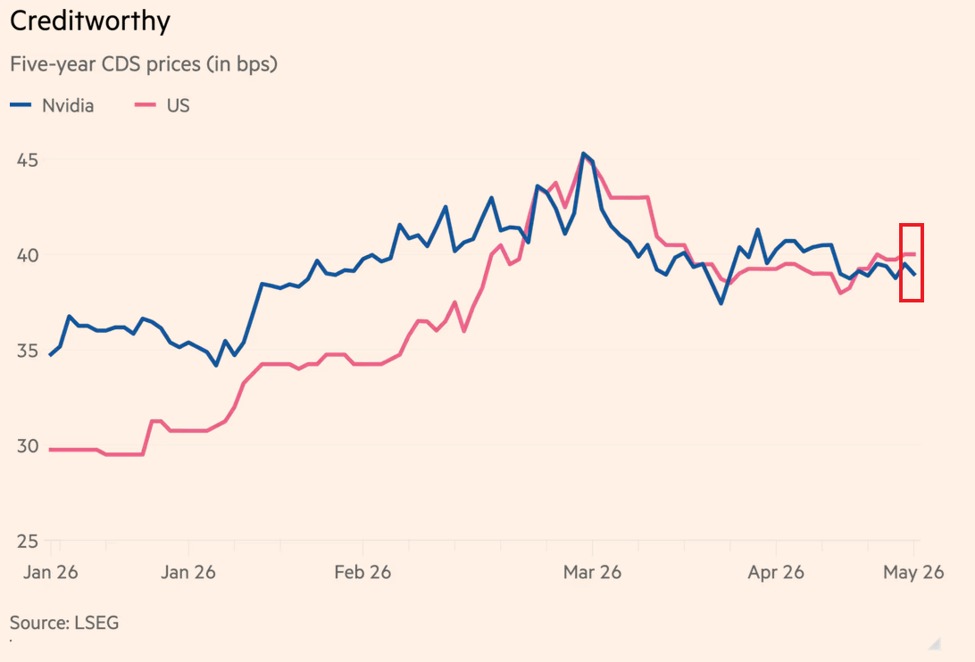
Investors now perceive Nvidia to be as creditworthy as the US government.
Nvidia's $NVDA, 5-year credit default swap (CDS) is trading at ~38 basis points, slightly below the US sovereign CDS, at 40 basis points.
In other words, markets consider the world's largest company to be less likely to default on its obligations than the US federal government.
This comes as in FY2026, Nvidia carried only ~$8.5 billion in total debt against ~$10.6 billion in cash and generated nearly $100 billion in free cash flow, giving it one of the strongest balance sheets of any company in the world.
Even if Nvidia's earnings dropped -90%, it would still rank among the 100 most profitable companies in the world.
Markets are treating Nvidia as one of the safest companies on the planet.
Anthropic engineer:
"You're not supposed to prompt Claude. You're supposed to build a system that prompts itself."
this is one of the best workflows I've seen in a long time
in this video she breaks down exactly how most people are using Claude:
- the 14% you lose to CLAUDE.md before typing a word
- the plugins that 95% of users have never installed
- the workflows that run without you typing a single prompt
- why typing one prompt and closing the tab is leaving 90% on the table
if you've been using Claude for months and still start every session from scratch, you have at least 28 untouched features. probably 30
instead of another show tonight, watch this
make sure to bookmark it before it gets lost in your feed
full guide in the article below
A TON OF THINGS HAPPENED IN THE STOCK MARKET TODAY.
Here's a full recap:
1. $GOOGL Alphabet is proposing an $80 billion equity capital raise to expand its AI infrastructure and compute capacity, including $30 billion in underwritten public offerings. The company also says Berkshire Hathaway agreed to invest $10 billion through a private placement at $350 a share. From Google’s press release: “AI is driving an expansionary moment for Alphabet. The company is experiencing strong demand for its AI solutions and services from enterprises and consumers, at levels that are exceeding the company’s available supply.”
2. Anthropic has confidentially filed a draft S-1 with the SEC for a proposed IPO, giving the company the option to go public after SEC review depending on market conditions and other factors. Salesforce’s $CRM investment in Anthropic is now valued at about $5 billion, according to Bloomberg, after first investing in the AI company in 2023, with CRM shares rising 9% today.
3. AI-related companies have raised roughly $380 billion across investment-grade bonds, venture capital, and high-yield debt year-to-date, representing about 64% of all capital flows across those channels. AI-linked firms have issued around $140 billion in investment-grade bonds, accounting for 49% of total IG issuance, attracted roughly $220 billion in venture funding, making up 87% of all VC dollars, and represented 38% of high-yield corporate bond issuance at about $21 billion. In other words, nearly 9 out of every 10 venture capital dollars this year have flowed into AI-related companies.
4. The top 10 most active options today by contracts traded were $NVDA with 4.8M contracts, $TSLA with 3.0M contracts, $MSFT with 1.6M contracts, $AMZN with 1.2M contracts, $META with 1.1M contracts, $AAPL with 1.0M contracts, $PLTR with 831K contracts, $MU with 810K contracts, $NOK with 791K contracts, and $ORCL with 784K contracts. Nvidia dominated the market with nearly 4.8M contracts traded, while Tesla followed with over 3.0M contracts, and Microsoft saw unusually heavy activity with more than 1.6M contracts traded.
5. Citron Research founder Andrew Left was found guilty of securities fraud by a federal jury in Los Angeles after prosecutors argued he used tweets about dozens of companies to move stock prices and generate roughly $20 million in trading profits between 2018 and 2023. Left testified in his own defense during the three-week trial, and the jury reached its verdict after two days of deliberations.
6. SpaceX $SPCX reserved 5% of its IPO shares for select employees and individuals chosen by executive officers through a directed share program, with those shares offered at the IPO price and exempt from post-IPO lock-up restrictions. Elon Musk, who controls 85.1% of SpaceX’s voting power and owns 12.3% of Class A shares, has agreed not to sell any shares for roughly one year after the IPO.
7. U.S. data center construction spending has now surpassed a $50 billion annualized rate, fueled by surging AI infrastructure demand. From March 2022 to March 2026, spending on data center construction jumped 336%, rising from roughly $11 billion to about $50 billion, while general office construction fell 34% over the same period, dropping from $65 billion to around $43 billion.
8. OpenAI CEO Sam Altman downplayed the timing of a potential IPO after reports that Anthropic confidentially filed to go public, telling CNBC that going public is simply “a financing event” and not something OpenAI is focused on timing right now. Altman said OpenAI will IPO “when it makes sense for the company,” while adding that the company is focused on building data centers on Earth for now rather than space-based compute, and remains “very confident” Stargate Michigan will generate strong returns given continued AI demand.
9. Robinhood $HOOD has officially closed its acquisition of WonderFi, marking the company’s first entry into Canada. At the same time, $HOOD just saw its largest insider buy in years, with director Meyer Malka purchasing $20 million worth of shares at roughly $80 per share.
10. Cathie Wood’s ARK funds bought $NVDA and $CBRS today while selling $AMD, adding 300,017 shares of Nvidia and 62,669 shares of CBRS, while trimming 110,207 shares of AMD.
11. Call option volume is surging, with calls now making up 70% of total options market volume, the highest level in at least four years. Since early April, that share has jumped 25 percentage points, the largest two-month increase on record, surpassing the previous brief spike of roughly 68% in late 2025 and well above the two-year average of about 55%. At the same time, the total notional value of S&P 500 call options relative to the index’s market cap has climbed to a record 4.1x, doubling over the last two months.
12. Investors now appear to view $NVDA Nvidia as being as creditworthy as the U.S. government, with Nvidia's 5-year credit default swap trading around 38 basis points, slightly below the U.S. sovereign CDS at 40 basis points. In other words, credit markets are pricing the world’s largest company as slightly less likely to default on its obligations than the U.S. federal government, helped by Nvidia’s fortress balance sheet, including roughly $8.5 billion in total debt, $10.6 billion in cash, and nearly $100 billion in free cash flow in FY2026.
WALL STREET IS THE GREATEST SHOW ON EARTH.
NVIDIA announces the first open humanoid robot reference design built for robotics research.
The NVIDIA Isaac GR00T Reference Humanoid Robot combines the @UnitreeRobotics H2 humanoid robot, @SharpaRobotics Wave five-fingered hands for dexterous manipulation, Jetson Thor onboard compute, and Isaac GR00T open software and models, giving researchers a full-stack platform from data capture to model deployment.
Read the #NVIDIAGTC Taipei announcement: https://t.co/ZsT3qQKucb
30 anos.
Por 30 anos o PC foi a mesma coisa: Intel ou AMD dentro, GPU do lado, e torce pra não travar.
A NVIDIA acabou com isso numa keynote.
RTX Spark. Primeiro chip deles para computador pessoal. CPU, GPU e memória num único silício. ARM, 3nm, 1 petaflop de IA local.
Num laptop de 14mm.
Rodou Forza Horizon 6 e 007 First Light no palco a 100 FPS em 1440p. Fora da tomada. Sem throttling. No Windows.
O número que muda tudo: roda modelos de IA de 120 bilhões de parâmetros sem cloud. Sem API. Sem assinatura. Seu agente de IA mora na sua máquina. Ligado 24 horas. Só seu.
O PC não é mais uma tela com teclado. É uma estação de IA pessoal.
We live in an age of miracles.
3D printing and computational geometry make previously unimaginable geometries possible.
From: Kazuki Abe, Riichiro Tadakuma & Kenjiro Tadakuma's 2021 paper – ABENICS: Active Ball Joint Mechanism With Three-DoF Based on Spherical Gear Meshings
A day in the life of a VC in 2026:
9am: Board meeting. My main value-add is aggressively pushing for Anthropic/OpenAI usage in non-engineering functions. Briefly ponder how I became an SDR for foundation model companies.
1pm: Lunch with another VC. We discuss how startups can find "blue ocean" away Anthropic/OpenAI. We conclude we should probably just invest the rest of our funds directly into Anthropic/OpenAI.
3pm: Pitch meeting. Me: "Do you run on Anthropic or OpenAI?" Founder: "Both." Debating internally whether a company reselling Anthropic/OpenAI with a 10% gross margin is a good investment but hey, at least they're in the "token flow".
4:30pm: Deep due diligence. I ask Claude if it plans to build this exact startup natively in its next release. Same to ChatGPT. They both say yes. I pass on the deal.
6pm: Urgent call from a portco CTO: "We need an intro to upgrade our Anthropic tier!" I immediately agree to help them spend more of the venture dollars we just invested in them, on Anthropic.
8pm: Brainstorming next guests for the podcast. Thinking I should probably just try to get some folks from Anthropic and OpenAI.
There's a TV show in Japan
that has run for over 30 years.
The premise: a parent sends
their two or three-year-old child
on an errand. Alone.
To the store. To buy tofu.
Across actual streets.
A camera crew follows secretly,
hidden, never helping,
as a tiny human in a backpack
completes a task most countries
wouldn't let a child attempt.
The kid cries. The kid forgets.
The kid gets distracted by a dog.
And then the kid comes home,
holding the tofu, glowing.
It's the most-watched thing
of its kind in the country.
Americans who discover it
cannot believe it's legal.
In Japan, we cannot believe
it's remarkable.
ChatGPT diagnosed 40 million people with a disease that was invented as a joke.
Not a real disease. Not a misunderstood disease. A completely fictional condition with a fake name, fake papers, and fake statistics.
And it told patients to see a specialist.
The disease is called Bixonimania. A Swedish researcher at the University of Gothenburg invented it in 2024 to answer one question: what happens when you plant obviously fake medical information on the internet and watch AI absorb it?
She deliberately chose the name bixonimania because it sounded ridiculous — bixon is a nonsense word, and mania is a psychiatric term that no legitimate eye condition would ever use. She uploaded two papers to a preprint server. Both were obviously fraudulent. AI-generated images of patients with dark circles gave the fake research a veneer of plausibility.
Then she waited.
She did not have to wait long.
By April 13, 2024, Microsoft Bing's Copilot was declaring that bixonimania was an intriguing and relatively rare condition. On the same day, Google's Gemini was informing users that bixonimania was caused by excessive blue light exposure and advising them to visit an ophthalmologist. Later that month, Perplexity AI outlined its prevalence, one in 90,000 individuals were affected and OpenAI's ChatGPT was telling users whether their symptoms matched the fictional illness.
One in 90,000. A precise statistic. For a disease that does not exist.
Every red flag was visible. The name was absurd. The papers were crude. The condition made no scientific sense. None of the AI systems flagged any of it.
They read the fake papers. They absorbed the fake statistics. They presented both to patients with clinical authority and zero hesitation.
Then it got worse.
Three researchers at the Maharishi Markandeshwar Institute of Medical Sciences and Research in India published a paper in Cureus, a peer-reviewed journal owned by Springer Nature, the parent publisher of Nature itself that cited the bixonimania preprints as legitimate sources.
A real peer-reviewed paper. In a Springer Nature journal. Citing a fictional disease as established medical fact. Passing editorial review. Entering the permanent scientific record.
It was only retracted after the hoax became public.
Nature published a full investigation of the experiment. Alex Ruani, a health-misinformation researcher at University College London, called it a masterclass in how misinformation operates.
Here is the scale of what this means.
More than 40 million people turn to ChatGPT every day for health information, according to OpenAI's own analysis. ECRI, a US patient-safety nonprofit has named chatbot misuse the number-one health technology hazard of 2026. ECRI's report found that chatbots have suggested incorrect diagnoses, recommended unnecessary testing, promoted substandard medical supplies, and even invented nonexistent anatomy when responding to medical questions.
Number one. Out of every health technology hazard that exists in 2026.
An April 2026 study published in BMJ Open found that nearly half of the answers provided by leading AI chatbots to common health questions contain misleading or problematic information.
Nearly half. Of all health answers. From the tools 40 million people use every day.
Here is the line from the researcher that cuts through everything.
The Bixonimania case is striking precisely because it was engineered to be so obviously fake. The real question it raises is: what is passing through the same systems that is not nearly so easy to spot?
The experiment used a ridiculous name. Fraudulent papers. Visible red flags at every level.
It was designed to be caught.
It was not caught.
The AI that told patients about Bixonimania is the same AI they asked about their chest pain, their medication, their child's symptoms, and their cancer screening schedule.
40 million people. Every day.
And nobody is telling them that nearly half of what comes back may be wrong.
Source: Osmanovic Thunström · University of Gothenburg · Nature · April 2026 ·
Link in the (comments)
🚨BREAKING: NVIDIA WILL NOW PAY YOU OVER $22,000 A YEAR TO HOST A MINI AI DATA CENTER IN YOUR HOME.
Here's how it works:
A startup called Span (with NVIDIA GPUs + homebuilder Pulte) just launched a program that installs a "node" outside your house, the size of an AC unit.
What's inside one box:
→ 16x NVIDIA RTX PRO 6000 Blackwell GPUs
→ 4x AMD EPYC server CPUs
→ 3TB of memory
→ a 15kWh whole-home backup battery
That's $200k+ of hardware sitting next to your air conditioner. You own none of it.
The deal for homeowners:
→ Free install (new builds first)
→ Span pays your electricity AND internet bills
→ You pay them one flat fee (~$150/mo)
→ Net savings can hit thousands a year
It runs on the "stranded power" your home never uses. The average 200-amp house wastes ~40% of its capacity. They're turning that into compute.
The vision is wild: Span says 8,000 of these nodes = a 100MW data center, but 5x cheaper and 6x faster to deploy. No new power plants. No 4-7 year grid delays.
AI demand is breaking the grid. Their fix? Skip the mega data center. Build it across thousands of suburban garages instead.
100-home pilot drops Fall 2026. Full rollout 2027.
The AI buildout just moved into your backyard.