Harmonix Profit Sharing Pool Apr Increase
We’ve just added more protocol revenue to the Profit Sharing Pool, bringing the APR from 23% to 35.31%, with rewards paid in USDC.
As more $HAR enters the pool, Harmonix will continue allocating protocol revenue to support competitive yields for our long term stakers.
Our goal is simple: as Harmonix grows, HAR holders should benefit directly from that growth.
Stake HAR and earn your share of protocol revenue.
the right way to use model capabilities is not to ship 10x more features to prod
it's to spend more time understanding your users, trying experiments, building prototypes, learning about things you don't understand so that you can ship things that actually work
Two Sigma manages over $60 billion. Their secret is in a 9 page PDF.
Their own quant researchers published the exact Machine Learning framework behind their time series regime detection & released it for free.
Bookmark & read the article below before someone takes it down.
Accidentally wrote a 5-chapter book on vulnerability research agents, felt wrong to build a research agent without first doing my research.
Written by GPT 5.5 xhigh with references to almost every major agent or cybersecurity paper in the past few years.
https://t.co/9DcYXZjfj2
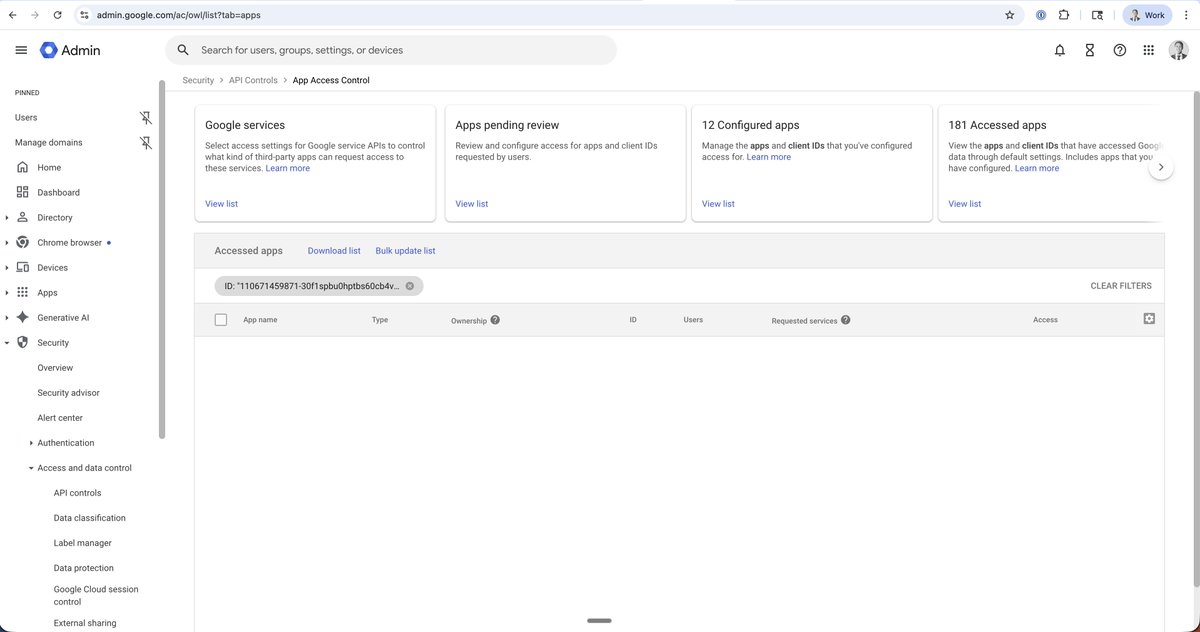
To check if your Google Workspace has been compromised by the same tool that compromised Vercel:
1. Go to https://t.co/TpuIOW5Fwg
- This is Google Admin Console > Security > Access and Data Control > API Controls > Manage app access > Accessed Apps
2. Filter by ID = https://t.co/uqJnCqp5Ah
- This is the ID of the compromised OAuth app
If you see an app after filtering, you have potentially been compromised
The interesting part is how the agent handled stopping. A human would keep trying — one more feature, one more idea — you're emotionally invested. The agent just looked at the IC slope across 11 trials and said: this is the floor. The discipline to stop is actually the hard part.
I took this idea and built an alphalab for microstructure alpha research on futures market. Instead of LLM training runs, each dot is a feature engineering trial scored by IC. Opus monitors the loop, decides when to stop, proposes next angles.
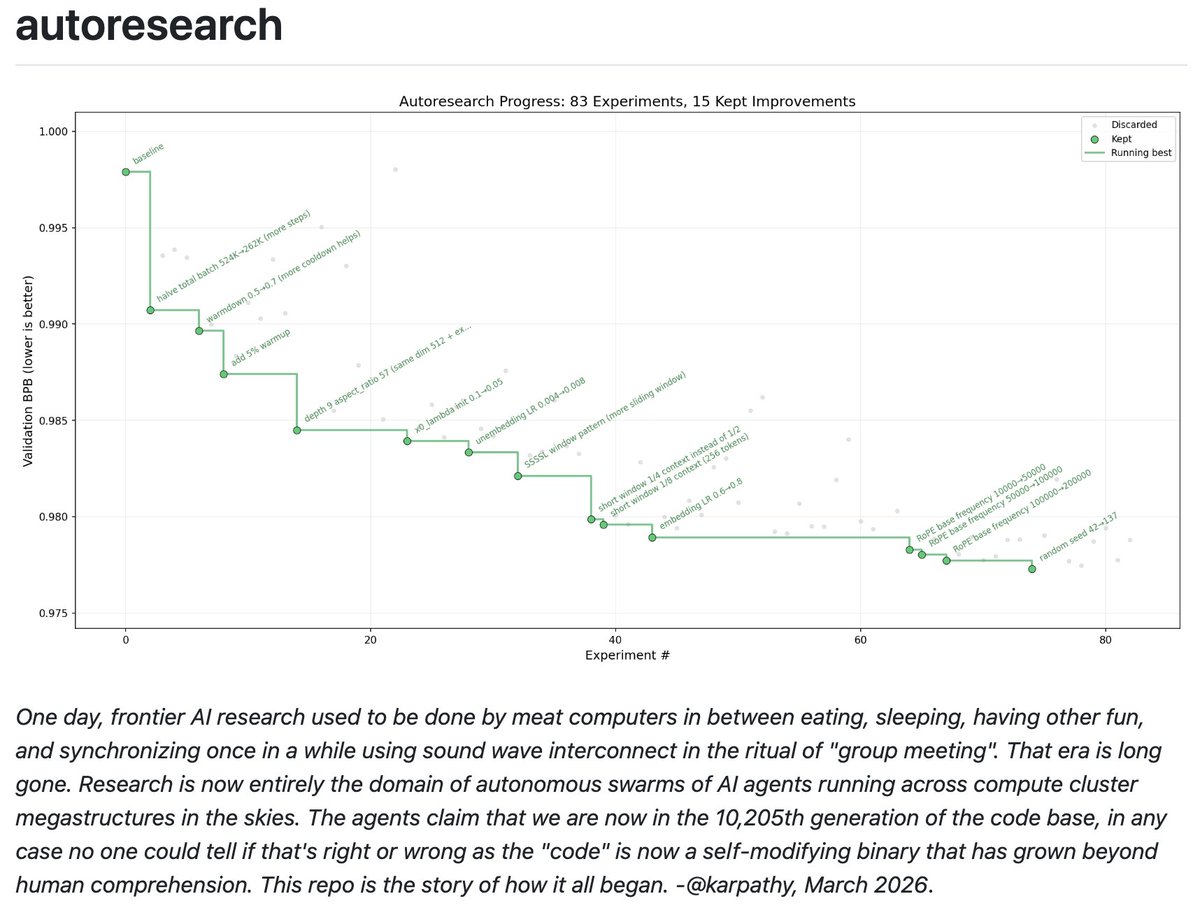
I packaged up the "autoresearch" project into a new self-contained minimal repo if people would like to play over the weekend. It's basically nanochat LLM training core stripped down to a single-GPU, one file version of ~630 lines of code, then:
- the human iterates on the prompt (.md)
- the AI agent iterates on the training code (.py)
The goal is to engineer your agents to make the fastest research progress indefinitely and without any of your own involvement. In the image, every dot is a complete LLM training run that lasts exactly 5 minutes. The agent works in an autonomous loop on a git feature branch and accumulates git commits to the training script as it finds better settings (of lower validation loss by the end) of the neural network architecture, the optimizer, all the hyperparameters, etc. You can imagine comparing the research progress of different prompts, different agents, etc.
https://t.co/YCvOwwjOzF
Part code, part sci-fi, and a pinch of psychosis :)
What killed it wasn't the model — the alpha is real. It's the fee structure. Gross edge is around 0.179 pts/trade. Minimum execution cost is 0.200 pts/trade. You can't solve that with better features. So I archived the direction.
Fixed TP/SL that doesn't adapt to volatility, a threshold that ignores signal quality, stop-losses triggering on temporary dips before price moves in the right direction. The model was predicting correctly. The trading logic was handing all the alpha back to the exchange.
Then I ran the full Rust sim with realistic fees. Gross PnL: +2,088 pts over 58 in-sample days. Fees: 2,187 pts. Net: -100 pts. Not bad luck — structurally wrong.
Software horror: litellm PyPI supply chain attack.
Simple `pip install litellm` was enough to exfiltrate SSH keys, AWS/GCP/Azure creds, Kubernetes configs, git credentials, env vars (all your API keys), shell history, crypto wallets, SSL private keys, CI/CD secrets, database passwords.
LiteLLM itself has 97 million downloads per month which is already terrible, but much worse, the contagion spreads to any project that depends on litellm. For example, if you did `pip install dspy` (which depended on litellm>=1.64.0), you'd also be pwnd. Same for any other large project that depended on litellm.
Afaict the poisoned version was up for only less than ~1 hour. The attack had a bug which led to its discovery - Callum McMahon was using an MCP plugin inside Cursor that pulled in litellm as a transitive dependency. When litellm 1.82.8 installed, their machine ran out of RAM and crashed. So if the attacker didn't vibe code this attack it could have been undetected for many days or weeks.
Supply chain attacks like this are basically the scariest thing imaginable in modern software. Every time you install any depedency you could be pulling in a poisoned package anywhere deep inside its entire depedency tree. This is especially risky with large projects that might have lots and lots of dependencies. The credentials that do get stolen in each attack can then be used to take over more accounts and compromise more packages.
Classical software engineering would have you believe that dependencies are good (we're building pyramids from bricks), but imo this has to be re-evaluated, and it's why I've been so growingly averse to them, preferring to use LLMs to "yoink" functionality when it's simple enough and possible.
There's a lot of cool stuff being built around openclaw. If the stock memory feature isn't great for you, check out the qmd memory plugin!
If you are annoyed that your crustacean is forgetful after compaction, give https://t.co/C5B7PJxorq a try!
@DenisVodchyts@SystematicPeter We can use agent team, one do the implementation and alway review by another one with our acceptance criterias for look ahead bias …