Die Schweiz steht am Scheideweg:
Behalten wir unsere Souveränität, oder lassen wir Brüssel bestimmen, was für uns gilt?
🔻Die Schweiz muss automatisch EU-Recht übernehmen und anwenden.
🔻Die Schweiz muss auch das künftige EU-Recht und die ganze EU-Bürokratie übernehmen.
🔻Bei Streitigkeiten hat der Europäische Gerichtshof das letzte Wort.
🔻Wenn die Schweiz EU-Recht ablehnt - auch demokratisch! - darf die EU uns abstrafen.
🔻Unsere direkte Demokratie wird schrittweise abgeschafft.
🔻Die Schweiz verpflichtet sich, Milliarden Franken an die EU zu bezahlen.
Helvetia ist unser Zeichen der Unabhängigkeit. Teile diesen Post, um sichtbar zu machen, was auf dem Spiel steht.
Most people still underestimate what $TAO | #Bittensor actually is.
Bittensor is a global, permissionless competition layer for every valuable digital service on earth. And it’s already producing outcomes that traditional companies simply can’t match.
Here’s the simple truth:
When you remove gatekeepers, remove hiring bottlenecks, remove geographic constraints,
and replace corporate hierarchy with open economic incentives — you get a system that outperforms centralized incumbents in both quality and cost.
That is exactly what Bittensor is proving.
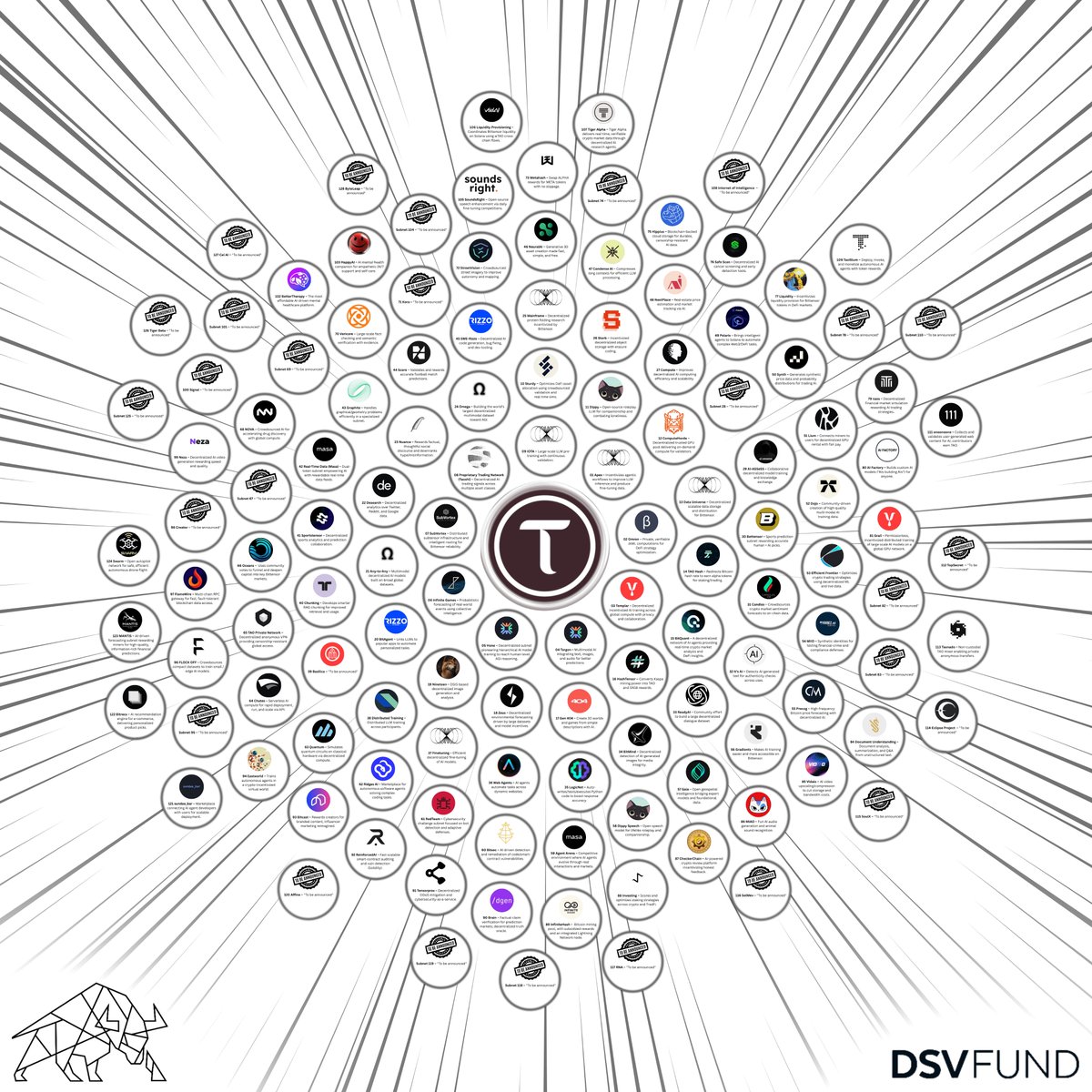
For example, look at @MaxScore & @webuildscore Subnet 44 (Score):
their vision-AI models are built by a global network of miners and now deployed in real-world production — from sports analysis to 3,000+ AVIA fuel stations across Europe.
No startup could spin up global compute, data pipelines, and model iteration this fast.
But a decentralized network can.
@zeussubnet Subnet 8 (Weather/Zeus) from @egillwx and @wouterhar is integrating with @WeatherXM, the world’s largest decentralized weather network, to build next-generation forecasting models.
Forecast accuracy isn’t improving because of bureaucratic R&D budgets — it’s improving because thousands of smart contributors worldwide are competing to produce the most accurate predictions.
Subnet 120 (Affine) from @const_reborn runs reinforcement-learning competitions where miners literally battle each other for optimization, producing compression benchmarks and agentic results you won’t see from traditional labs.
Again: competition > management.
This is the part everyone keeps missing:
Bittensor doesn’t reward pure compute.
Bittensor rewards intelligence — measurable performance that provides real value.
It’s a market — a global auction where the best outputs rise to the top, every block, every epoch, forever.
You couldn’t build a unified weather company, AI security company, sports-analysis company, and research lab simultaneously.
But Bittensor did — because it turns every domain into an open competition layer.
And this is why Bittensor is so disruptive:
It’s a worldwide arena where anyone can contribute model weights, data pipelines, training signals, reinforcement strategies, and domain expertise
and get rewarded strictly by real-world performance.
This is the future:
And we’re watching the first one being built right now.
And it’s winning
Image Source: @dsvfund
Dieser Mann erklärt, was passiert, wenn die EU wie geplant die 180 Milliarden russischer Vermögenswerte stiehlt. Wenn die EU das durchzieht, wird Europas Finanzsystem zusammenbrechen - das betrifft jeden EU-Bürger direkt.
Few realize this is one of the last moments we're seeing $LINK trading under $20
The 2025 adoption scale of @Chainlink went beyond expectations
700+ days in this monthly range
The day we leave it, you won't get this price ever again. I don't make the rules. Value capture does.
its so interesting that people can accept that $BTC could easily double from here. but $Link cant 100x. do people realize $Link would need less capital than BTC to make that move ?
going from 20B - 2T - $100-$200B in capitall
versus 2T to 4T - $500B
The names @chainlink listed collectively touch nearly the entire spectrum of global capital markets:
QUADRILLIONS per year in transaction volume (DTCC, SWIFT, Euroclear, SIX, TMX, BMV)
Tens of TRILLIONS in assets held or managed (UBS, BNP, Wellington, Schroders, etc.)
BILLIONS (soon trillions) in tokenized/digital assets (ADDX, Marketnode, Sygnum, AMINA, Wamid)
If even a SINGLE DIGIT PERCENTAGE of this migrates to tokenized rails and smart contracts, that’s trillions flowing through systems that need CCIP / oracles like Chainlink.
AND ALL OF THESE NEED $LINK TO FUNCTION.
We are excited to announce a major industry milestone in a global corporate actions initiative led by Chainlink in collaboration with 24 of the world’s largest financial organizations, including Swift (@swiftcommunity), DTCC (@The_DTCC), and Euroclear (@EuroclearGroup).
https://t.co/77PiHx6Eyl
Corporate actions are a critical building block for public equity to operate successfully onchain. Building on the foundation established in the first phase of our industry initiative, we now have successfully demonstrated how the Chainlink platform, blockchains, and AI help solve one of finance’s most complex data challenges in a production-grade solution with unparalleled data accuracy, ISO 20022 messaging functionality via Swift, connectivity across DTCC AppChain as well as additional public and private blockchains, and much more.
🧵⬇️
The market looks like short term plays into less promising assets before its all transitioned into the next generation of tech assets like ADA, LINK and others for the rest of the cycle, for as long as that lasts. Be it months or years.
Der Benner Zyklus!
Der Farmer Samuel Benner hat diesen Zyklen Chart 1875 entworfen und jede Boom und Krisenphase vorhergesagt.
Es zeigt nach beobachteten Mustern Booms und Krisen weit in die Zukunft voraus.
2026 wird demnach ein gutes Jahr für die Märkte.
Wird der 4 Jahres Bitcoin Zyklus verlängert auf 5?
2032 wird ein schlechtes Jahr und 2035 kommt der große Crash.
Solana tokens are coming to Base 🔵
The @base economy is expanding.
Users will soon be able to deploy, trade, and LP @solana assets on Aerodrome seamlessly in one simple, unified experience.
And we're here for it ✈️
It's a new day one.
We’re excited to announce a strategic partnership between Chainlink and SBI Group one of Japan’s largest financial conglomerates with the USD equivalent of over $200 billion in total assets.
https://t.co/eZFGt8ysDK
SBI Group and Chainlink will focus on powering several innovative use cases centered around tokenized funds, tokenized real-world assets such as real estate and bonds, regulated stablecoins, and more.
SBI Group and Japanese financial services companies will leverage Chainlink services, including the Cross-Chain Interoperability Protocol (CCIP), SmartData (NAV), and Proof of Reserve to unlock secondary market liquidity and enhance the operational efficiency of tokenized assets while seamlessly fulfilling compliance and privacy requirements.
Yoshitaka Kitao, Representative Director, Chairman, President & CEO of SBI Holdings, stated:
“Chainlink is a natural partner for SBI complementing our financial footprint with their market leading interoperability and reliability onchain. With our combined strengths, we are delighted to be working together on developing groundbreaking, secure, compliance-focused solutions, including powering compliant cross-border transactions using stablecoins, that accelerate the widespread adoption of digital assets in Japan and the region.”
Chainlink, UBS Asset Management, and SBI Digital Markets previously completed a solution for automated fund administration and transfer agency using smart contracts under the Monetary Authority of Singapore's (MAS) Project Guardian.
$Link Gpt breakdown👀
Chainlink didn’t just grab some corporate gold stars it just crossed a compliance moat that most crypto projects can’t even swim across.
ISO 27001 + SOC 2 aren’t buzzwords; they’re the benchmarks that Fortune 500s, banks, and governments look for before they plug critical systems into new tech. Translation: Chainlink just made itself legally and operationally palatable for the deepest pockets on Earth.
This isn’t just about “security best practices.” These stamps tell risk officers, regulators, and boardrooms: yes, you can use Chainlink without losing your job. That’s massive when you’re talking about integrating CCIP into settlement layers at Swift, DTCC, Euroclear, and beyond.
Competitors? Forget it. Most oracle or middleware projects are still playing “decentralized science fair.” Chainlink now has the same compliance posture as cloud giants and enterprise SaaS vendors. That means when RFPs hit the table, Chainlink is the only oracle that checks the mandatory compliance box.
And this is just Type 1. Once Chainlink moves to SOC 2 Type 2 (which proves controls are effective over time, not just at a point in time), it will look even more like a regulated-grade utility than a “crypto project.” At that stage, Chainlink stops being optional it becomes the default interoperability and data layer for finance.
---
🔑 The Bigger Picture
This is the institutional green light:
Enterprise adoption accelerates → faster volume on CCIP, Data Streams, Proof of Reserves.
Regulatory cover builds → policymakers will trust Chainlink’s rails.
Value capture skyrockets → more fees, more staking demand, deeper collateral requirements.
Chainlink isn’t just setting the bar it’s building the compliance moat that no other oracle or interoperability protocol has the resources or credibility to cross.
The implication? While others are still begging for attention, Chainlink just became audit-ready infrastructure for a tokenized financial system worth trillions.