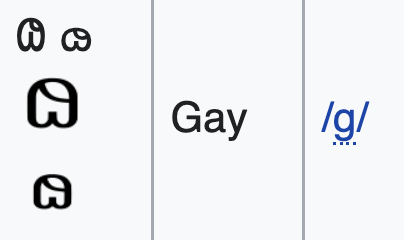
thinking about how Brigham Young invented an alphabet with a letter called "Gay" that looks like an amongus. truly a man ahead of his time. a prophet if you will.
Oh no voting in Spanish whatever next
Remember, this culture war stuff isn’t just a last resort from people with nothing else to go on. Excluding people based on language/skin colour/sexuality/gender is the point. Lack of representation is 100% what they care about.
This is South Carolina. We speak English here.
So why is our Republican supermajority legislature wasting taxpayer dollars printing and handing out the “I voted” election commission stickers in Spanish? Asking for a friend.
South Carolina FIRST.
Nigh is an archaic word by now, but we use its comparative and superlative forms all the time:
nigh
near (more nigh)
next (most nigh)
These words, especially near, got used as emphases so frequently that they rendered poor nigh obsolete, and now we can also say “nearer”!
Don’t miss your chance to read the new Cambridge element, Language, Water, Power, by Alastair Pennycook! Free access available until 4 June at
https://t.co/DpV7QBoyVH
#cambridgeelements#languageandlinguistics
@GaryHaubold@Aliteraryshadow Friendly linguist checking in!
The earliest use of "decimate" referred to a tithe. The killing definition came much later, and the practice wasn't common in Roman times.
And language changes, so if people mean something like "obliterating", that's fine.
https://t.co/eGMRJVJi9J
@ArthurCDent There are a lot of non-Chomskyan linguists (hate that that needs to be a category) who are learning from what LLMs can do. It’s cool tech, but it’s also informing linguistic theory.
Good news for #Gaeilge: people are using it for normal fun human stuff! It's not just a duty. Laura Pakenham breaks it down for us.
Laura is the author of "Irish: History and Culture Through Language", available from @simonschuster@adamsmedia
Full ep: https://t.co/DE5MxxIrmr
New ep: What's going on in our minds when we make sentences? Are we constructing trees? Or do we think of words sequentially?
We're climbing down from the trees with @MH_Christiansen and @YngwieNielsen.
Video (recommended): https://t.co/V7g7RjvVZM
Audio: https://t.co/r5YWm1xdZ8
Understanding Language through Humor by Stanley Dubinsky
Now in its second edition, this book is a thoroughly entertaining, but serious and comprehensive, introduction to linguistics.
📚 https://t.co/dzVrwDtzzk
How can climate refugees hold onto their language? Dr Mary Walworth of @CNRS explains that language is a cultural anchor.
She's on our latest episode.
https://t.co/oLGuE6CS6A
@NatGeo@NatGeoTV#PoleToPole
People on the island of Enusi weren't just glad to get a visit from Will Smith — they were also keen on meeting linguist Mary Walworth.
We're glad to see her too, as a guest on this episode.
https://t.co/oLGuE6CS6A
Find it on your pod listener.
@NatGeo@NatGeoTV#PoleToPole
Coming very soon — a live episode with television presenter @laurajpakenham about Irish.
All patrons free and paid are welcome. Details here, so click through and sign up!
@simonschuster
https://t.co/qhVS9wTYtK
@Stallinguist Great insight. I hadn't realised, but in the COCA corpus, SHERD is always in publications about archaeology; SHARD elsewhere.
Looks like they were both around in Old English, but they settled into different zones.
The AR/ER thing seems to be a bit later. But maybe same thing?
Yep, VARSITY is a short version of UNIVERSITY! And it’s a neat example of the ER/AR variation common at the time.
Even today, you can hear “derby” and “darby” in different places. Also “clerk” and “clark”.
Don’t forget SERGEANT, which sounds like “ar”.
Why does this ungrammatical sentence sound fine?
When your grammar says one thing, but your feels say another, you may have found a ✨linguistic illusion✨.
Dan Parker, author of "Agreement Attraction".
Available now from @CambridgeUP
Listen/watch: https://t.co/wNsmSAJRTJ
Linguists and language people!
Do a post about your latest research.
Then we can find it and maybe feature it on the show. We are looking for your work! ❤️