This #FullDiskFriday, @NOAA’s #GOESEast (#GOES19) 🛰️ captured cloud formations fitting into the western coastlines of the United States and South America like puzzle pieces! 🧩
Known as marine stratus layers, these form due to cold ocean surfaces interacting with relatively warmer air masses above them. Marine stratus layers cause foggy mornings in Southern California in the early summer months—a phenomenon that locals call “June Gloom”.
Happy #WorldPenguinDay! 🐧
These flightless birds are some of the most charismatic (and well-dressed) ocean animals, but some facts about them might surprise you.
Dive in today and find out how much you really know about these curious creatures!
🔗 https://t.co/EZxdm50XeP
There’s a reason Australia leads the world in rooftop solar installations per capita.
It’s not better panels.
It’s not more sun.
It’s not some secret tech advantage.
It’s cost. And the system built around it.
In Australia, a standard 6.6 kW rooftop system in 2026 typically lands around $3.6K–$5.7K USD installed.
Zero tariffs on Chinese panels, open imports, intense competition, streamlined installs. Quote → install → done.
The market is optimised for speed and scale.
Germany sits in a similar lane. Around $6.5K–$9.9K USD for a comparable system. Low friction, mature installers, and strong economics driven by high power prices. It works because the system supports it.
Then there’s the US.
The same system costs $16.5K–$22K USD. Same hardware. Same sun. But layered with tariffs on Chinese imports, permitting complexity, fragmented markets, and higher soft costs. Add protectionism and legacy utility structures, and the result is clear: higher prices, slower rollout.
This isn’t a technology story.
It’s system design.
Australia removed friction.
Germany streamlined it.
The US added layers.
And that shows up directly in adoption.
Fast, cheap systems scale.
Expensive, complex systems stall.
One is optimised for speed.
One is protecting the past.
That said, at ~3× the cost, it’s genuinely impressive to see US states still leading the solar charge. Texas, California, Arizona, Florida are pushing scale despite the friction.
Imagine what happens if the system gets out of its own way.
Cost always wins. ⚡
This is why you must plant more #trees and protect birds.
From an evolutionary standpoint, our brains are literally wired to find peace in birdsong. Birds sing in safe, stable environments — calm mornings and evenings with no predators around. So when we hear them, our brain reads it as: all clear.
A 2024 EEG study found that birdsong triggers the strongest alpha wave activity in the brain — linked to calm, peace, and mental stability. Birdsong activates the parasympathetic nervous system, signalling rest to the body, while dialling down the sympathetic system — the one responsible for fight-or-flight.
Studies show that nature sounds lower heart rate, blood pressure, and cortisol levels, and slow down breathing. Some research, using skin conductance monitoring, found that nature sounds relieve stress faster than many conventional therapies.
Urban noise is the opposite. Vehicle horns, industrial sounds — these are transient, non-rhythmic, and they directly activate the amygdala, spiking stress and anxiety.
Birds sing in the 2–8 kHz frequency range, and our ears are most sensitive to exactly that range. Research shows these sounds sharpen attention and boost mental productivity — a concept known as Attention Restoration Theory in cognitive psychology.
Plant trees. Protect birds. Your nervous system will thank you.
After 6 years, @mvankerkhove has quietly deleted her tweet stating #COVID19 was “NOT airborne” (22/3/2020).
No explanation. No rectification. No public erratum.
Transparency and accountability are essential for trust in public health. You don’t learn lessons by erasing them.
“He stood staring into the wood for a minute, then said: ‘What is it about the English countryside — why is the beauty so much more than visual? Why does it touch one so?’”
— from I Capture the Castle by Dodie Smith (born 3rd May 1896). #FolkloreSunday
The Amazon often gets the headlines. The Pacific Northwest stores more carbon per acre.
The old-growth Douglas fir and hemlock forests of Washington, Oregon, and British Columbia hold roughly twice as much carbon per acre as the Amazon rainforest — up to 1,300 metric tons per hectare in some stands. The biomass in a single ancient Douglas fir can exceed what an entire acre of tropical forest holds above ground.
Most of these forests were logged in the 20th century. The ones that remain are among the most carbon-dense ecosystems on Earth.
#forests #conservation #nature #climate
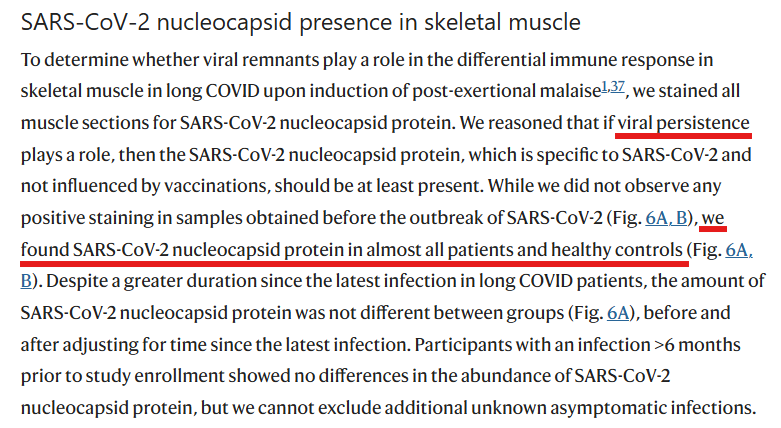
SARS-CoV-2 is persistent. Once the virus enters the body, it remains there. It's not naturally eliminated from the body.
It has been known for six years that we need antiviral drugs, but no serious attempts have been made to conduct research in this area.
https://t.co/NxdrQjFHPq
China currently has 339 gigawatts of wind and solar capacity under construction — roughly two-thirds of the world’s total.
By any serious measure, China is leading the clean energy revolution.
“With the rise of new tools in molecular biology, it’s becoming clear viruses & other pathogens can remain in the body or.. affect its workings for a.. long time.”
“we are beginning to realize that there is this whole world out there that we had absolutely no insight into.”