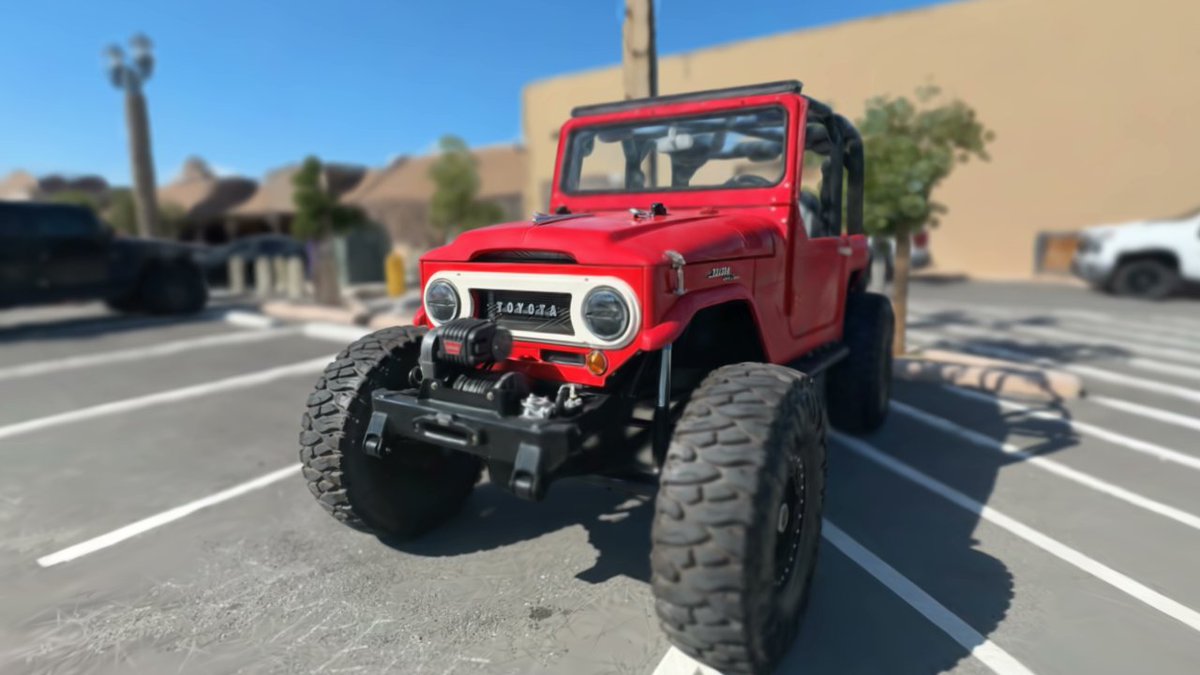
splat-transform's offline rasteriser now supports depth of field.
Each Gaussian dilates by its own circle of confusion in the projection pass.
New flags: --f-stop, --focus-distance, --sensor-size.
This test was rendered with a simulated f/0.8 aperture:
Massive VRAM improvements and 8K training are coming to LichtFeld Studio.
Since the last nightly build, you can already experience major VRAM improvements based on this wonderful paper:
"VkSplat: High-Performance 3DGS Training in Vulkan Compute"
This enables uncapped training, which will be merged today and made available in the next nightly builds to all current supporters.
If you haven’t already, please consider supporting the project.
Bronze sponsoring, for instance, costs much less than a yearly paid subscription to closed-source competitors, offers better quality and many more features, brings your brand onto the homepage, and lets you use LichtFeld Studio forever.
Support the project here:
https://t.co/mdGITFOGVQ
Image: Training on office2 8k images from the eyefull tower dataset
Published a collection of artworks on @playcanvas!
Gaussian splatting for artistic preservation and visualization, could this become a new standard for digital archives?
Explore the collection: https://t.co/8zDsPTfgZM
@BecetDidier@willeastcott@webgl_webgpu@RadianceFields
Introducing 3D Gaussian Splatting to Mesh 3.0 by KIRI Engine! I'd like to say it gives the best mesh quality from 3DGS by far in the market! Showcases: https://t.co/H7PCeyAz5p If you are getting trouble with bad results in phone scanning, try this out. Special thanks to paper GGGS (https://t.co/lgW94U8iu6), which inspired us a lot! #GaussianSplatting #3DScan #CVPR2026
Spark 2.0 is here! 🚀
We’re redefining what’s possible on the web with a streamable LoD system for 3D Gaussian Splatting.
Built on Three.js, you can now stream massive 100M+ splat worlds to any device from mobile to VR using WebGL2. All open-source.
Dive into the tech 👇
It only took 4 years to get this out, but its here. A video on how to design, build and use Scale bars in your photogrammetry!
Please share it around!
https://t.co/qCBs1PZelj
From Blobs to Spokes: High-Fidelity Surface Reconstruction via Oriented Gaussians
TL;DR: Gaussian Wrapping interprets 3D Gaussians as stochastic, oriented surface elements and derives closed-form vacancy and normal fields, enabling fast, watertight, and compact mesh extraction of full 3D scenes.
Contributions:
– We introduce Oriented-Gaussians and their associated training strategy in the multi-view setting.
– We derive a theoretical connection between 3DGS and implicit surface reconstruction by formulating Gaussians as oriented surface elements, inspired by Objects as Volumes [39]. Importantly, this leads to closed-form expressions for both normal and occupancy fields at arbitrary locations without any additional learnable parameters.
– We propose Primal Adaptive Meshing, a mesh extraction procedure that leverages the derived Gaussian fields to produce high-quality, water-tight meshes at controllable resolution, enabling recovery of extremely thin structures such as bicycle spokes (Fig. 1).
Experiment: using Gaussian Splatting (Apple “Sharp”) as an alternative to UNESCO’s generative AI approach for reconstructing stolen cultural artifacts.
Original : https://t.co/uIS53BQIKm
Test : https://t.co/dXkU4T55HQ
@UNESCO@playcanvas@willeastcott#GaussianSplatting#3DGS
Building a feature to visually indicate which cams perform worst during training.
Btw, if some cams are misaligned, you can simply select them and disable for training!
For an upcoming project at @active_theory I've been experimenting with a file format i'm calling ActiveFrame.
Like a video format, leveraging H.264 compression, allows random-access to any frame and it's fully hardware accelerated. No runtime depedencies, works eveywhere.
Here is a high resolution Macroscan of a Honeybee - I managed to get sub-pixel registration accuracy with this one so you can easily discern the feather-like structure of the individual hairs.
View on SuperSPlat:
8 million splat version - https://t.co/3qlgSNi320
I've completely rewritten the script for extracting sharp frames from videos using Python, and I've also implemented a GUI. I'm releasing the code.
https://t.co/QgYOsPjkvh
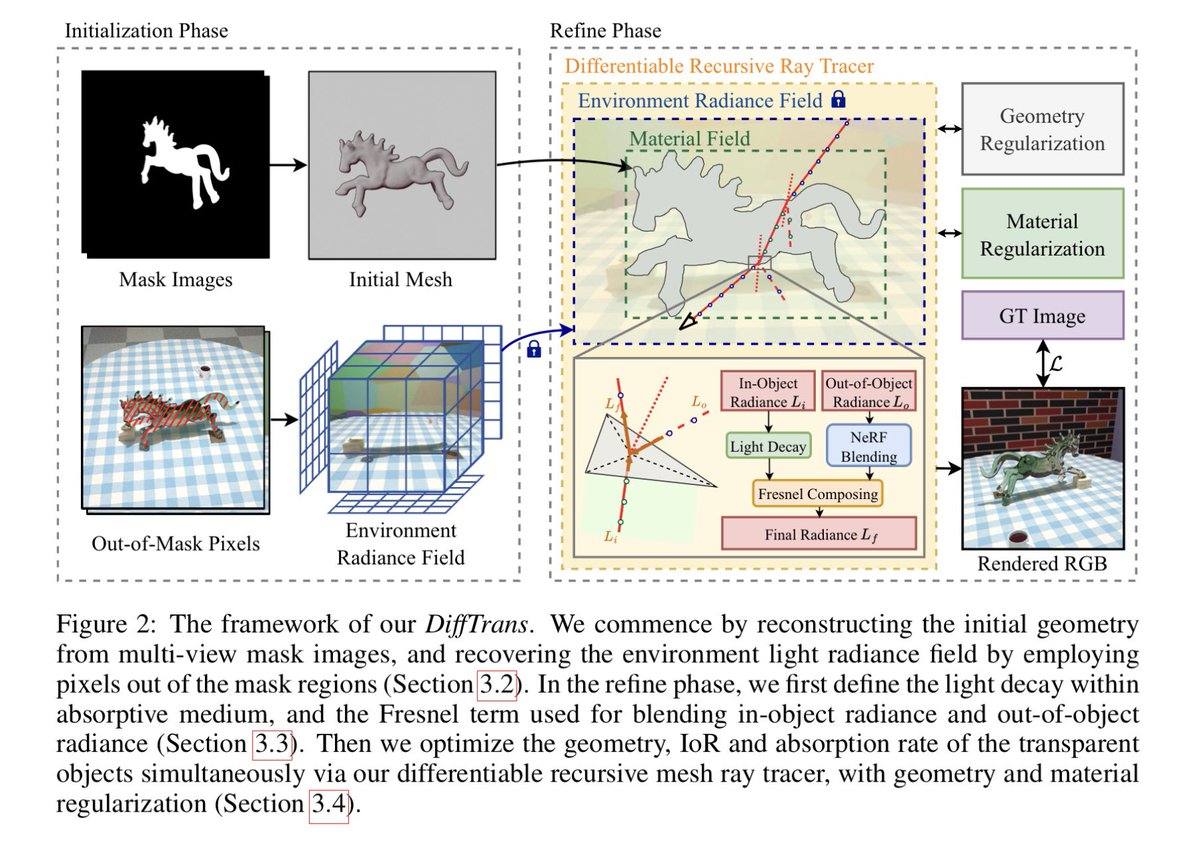
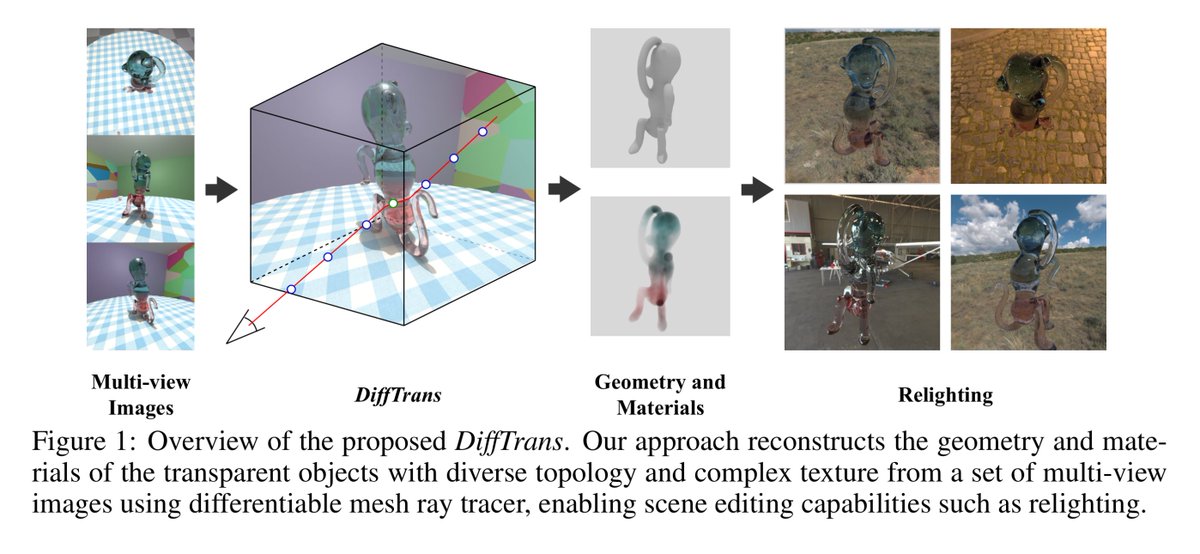
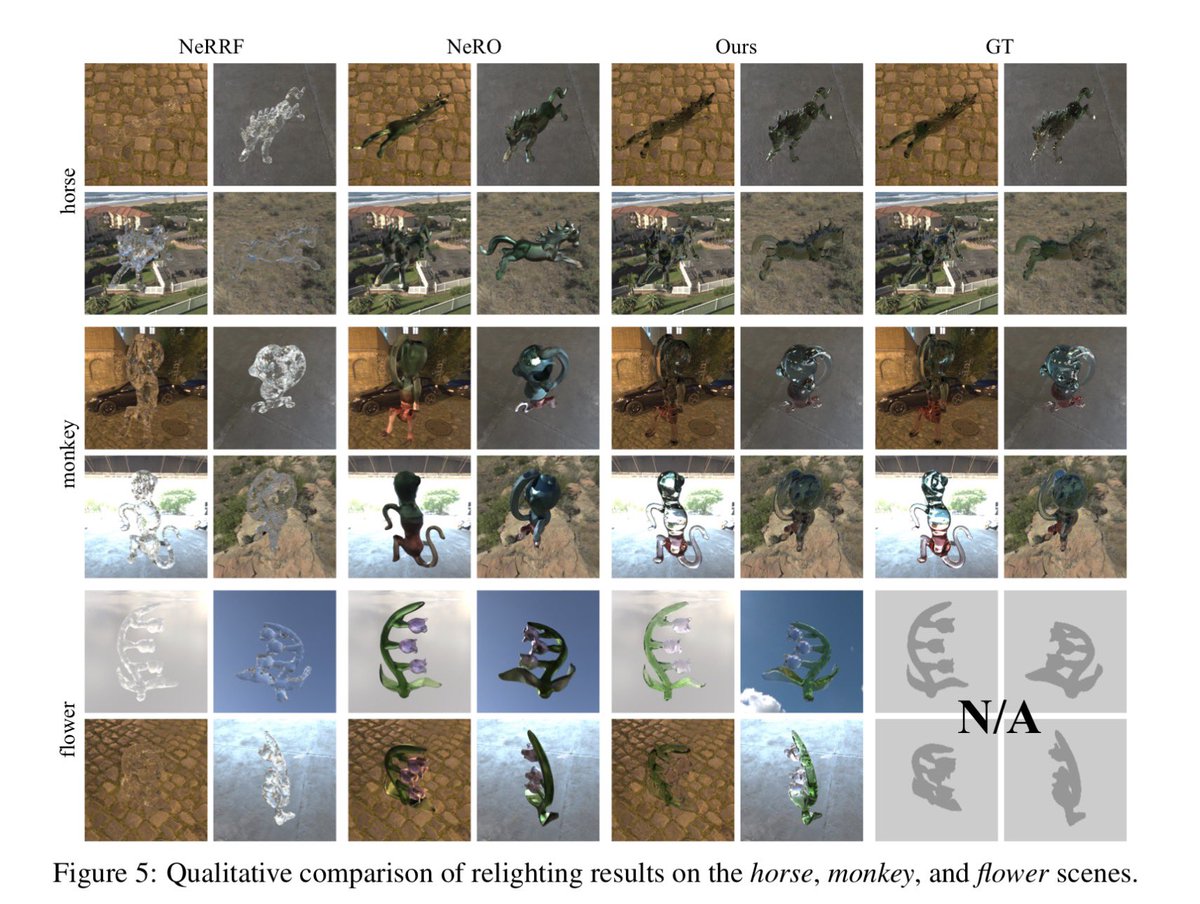
DiffTrans: Differentiable Geometry-Materials Decomposition for Reconstructing Transparent Objects
Changpu Li, Shuang Wu, Songlin Tang, Guangming Lu, Jun Yu, Wenjie Pei
Paper: https://t.co/Gc4PZV4eIW
Code (soon?): https://t.co/RL31GaKm2j
Abstract:
Reconstructing transparent objects from a set of multi-view images is a challenging task due to the complicated nature and indeterminate behavior of light propagation. Typical methods are primarily tailored to specific scenarios, such as objects following a uniform topology, exhibiting ideal transparency and surface specular reflections, or with only surface materials, which substantially constrains their practical applicability in real-world settings. In this work, we propose a differentiable rendering framework for transparent objects, dubbed DiffTrans, which allows for efficient decomposition and reconstruction of the geometry and materials of transparent objects, thereby reconstructing transparent objects accurately in intricate scenes with diverse topology and complex texture. Specifically, we first utilize FlexiCubes with dilation and smoothness regularization as the iso-surface representation to reconstruct an initial geometry efficiently from the multi-view object silhouette. Meanwhile, we employ the environment light radiance field to recover the environment of the scene. Then we devise a recursive differentiable ray tracer to further optimize the geometry, index of refraction and absorption rate simultaneously in a unified and end-to-end manner, leading to high-quality reconstruction of transparent objects in intricate scenes. A prominent advantage of the designed ray tracer is that it can be implemented in CUDA, enabling a significantly reduced computational cost. Extensive experiments on multiple benchmarks demonstrate the superior reconstruction performance of our DiffTrans compared with other methods, especially in intricate scenes involving transparent objects with diverse topology and complex texture.
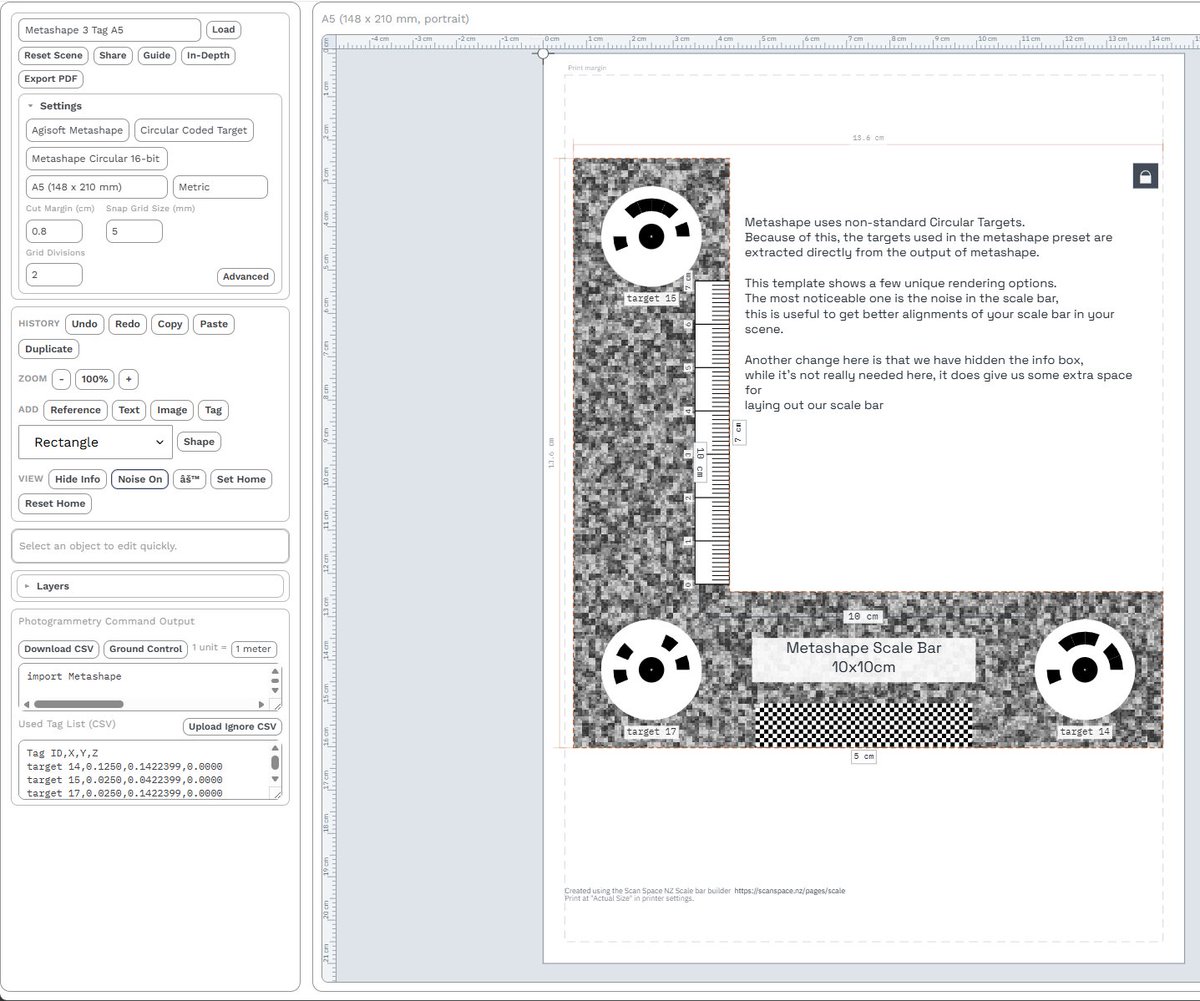
I've just released a Free #Photogrammetry Scale bar design tool!
https://t.co/DTzWMy0vM7
This tool is designed to make the creation of scale bars at home really easy, and accurate enough for most tasks (as long as you print at 100% scale!)
Let me know what you think!
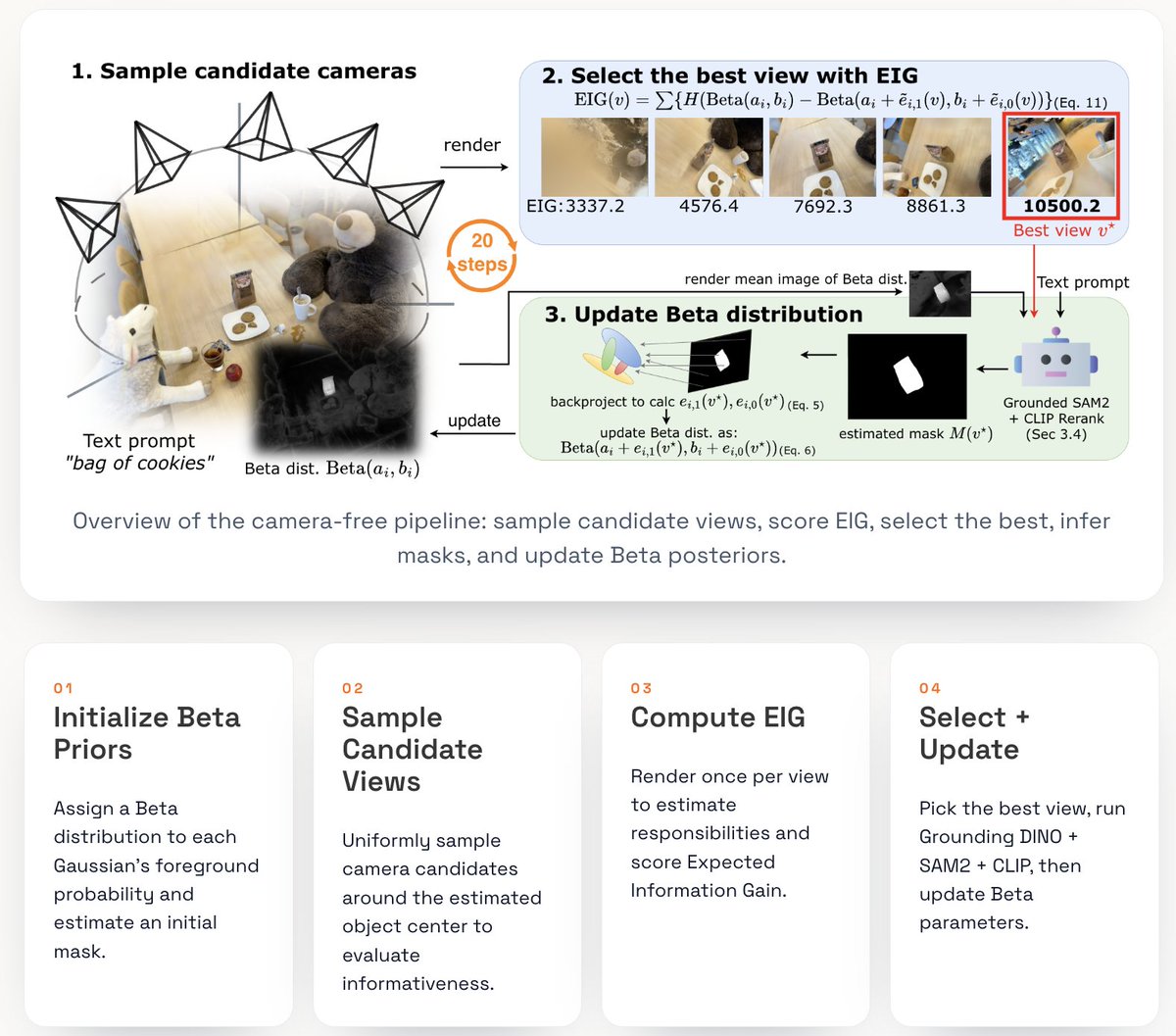
🎉 Our paper is accepted to #CVPR2026!
We present a training-free, camera-free method for 3DGS segmentation that runs in seconds, with a Bayesian reformulation for deeper theoretical insight.
Check it out:
https://t.co/3PPuT7mLiF
https://t.co/yhBJP4IYzv
See you in Denver!
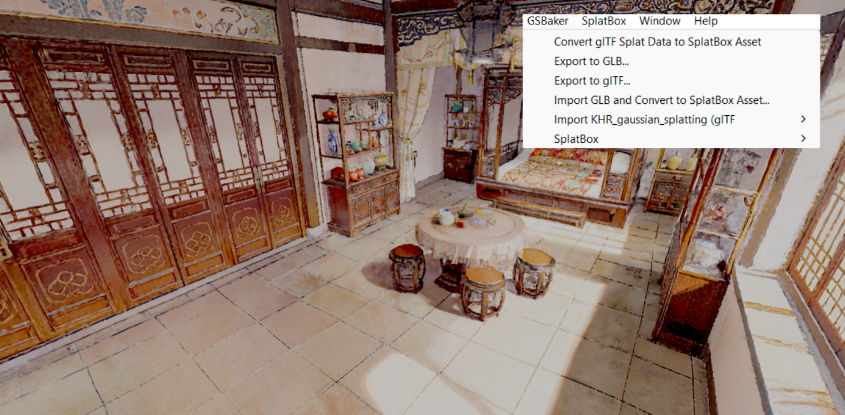
🎉 Built a glTF-GLB importer for Gaussian Splatting in Unity using the new KHR_gaussian_splatting extension from Khronos!
PLY was never the right universal format for 3DGS - it's a point cloud format retrofitted for splats.
glTF -GLB brings:
Standardized attributes
(position, rotation, scale, SH coefficients)
Seamless coexistence with meshes & terrain
Cross-platform interoperability
Extensible compression support
The future of 3D Gaussian Splat delivery is here.
Note : glTF can wrap SPZ as an extension - giving you both interoperability AND compression.
https://t.co/u7S5dtNmVU
#GaussianSplatting #3DGS #glTF #Unity3D #Khronos #gamedev @theworldlabs
Most 3DGS segmentation tools either pre‑train per scene or lock errors into a feature field you can’t undo.
ArtisanGS instead turns a few 2D masks into editable 3D object selections via Cutie tracking + black‑box splat aggregation, then lets you iteratively correct mistakes with consistent 2D/3D selection modes.
���� #NVIDIAResearch paper: https://t.co/blLWdpN9QC