How was the Swedish news agency TT affected by a coordinated information campaign from Azerbaijan?
I have, together with @Bedig_A, investigated how the regime uses a digital army to push their narratives in Western media.
https://t.co/UFlN8DhoEe
My latest for the @Caucasus_Watch
No matter how much the opposing sides and political forces accuse each other of corruption, wars, and bad governance, in the end, the discourse often boils down to the binary concepts of “pro-Russian” and “pro-Western.” However, while they compete and wait for the election results, it is crucial to understand how significant the role and involvement of Karabakh Armenians are in this electoral process.
https://t.co/MLGtMpirk9
Azerbaijan has now confirmed it destroyed the Stepanakert Cathedral in Artsakh.
By labeling Armenian Christians—who have lived there for generations—as “occupiers,” it claims the demolition “cannot be distorted in any way as the destruction of religious or cultural heritage.”
Cultural genocide after the ethnic cleansing of 120,000.
https://t.co/f5NvLAJ4Uz
A classic example of a state-defensive Turkish narrative about the #ArmenianGenocide of 1915. Even Ottoman records and later demographic studies indicate mass death on a far larger scale.
https://t.co/zwx9zVWocO
New York Mayor Mamdani published the text given to him by the Armenian lobby without examining it. No Armenians were killed on April 24.
Until World War I, Armenians rebelled approximately forty times. During World War I, taking advantage of the Ottoman Empire’s engagements with the Russian army in the East, they took the final step toward independence. They significantly impaired Ottoman supply and provisioning lines. In addition, by forming armed bands, they started to massacre civilian Turks, Kurds, Circassians, and Arabs living in Eastern Anatolia.
When the Ottoman government, despite all its efforts, was unable to prevent the onslaughts of Armenian terrorists, it published the Circular of April 24, which closed Armenian committees such as Dashnaksutyun and Hunchak, and led to the arrest of individuals confirmed to be associated with these organizations.
No conflicts occurred during the arrests of April 24, and no prominent Armenian was killed. However, the arrest of the leadership cadre of the committees rendered the potential rebellion leaderless and ineffective.
Prominent Armenians did not heed the warnings of Talat Pasha and other statesmen to give up their dream of independence. Armed bands continued their massacres. They killed thousands of Muslims by supporting the Russian army during the siege of Van, which ended with its invasion on May 15. In response to this situation, the Ottoman government was forced to enact deportation measures on 27 May. As the late historian İlber Ortaylı stated, the Armenian deportation of 1915 was not a precaution against a possible rebellion. Rather, the Act of Deportation in 1915 was a response to an actual rebellion and collaboration with the enemy army, and it was inevitable under the circumstances of the time.
It was planned that 924,158 people would be deported. However, not all of them were deported. Approximately 650,000 Armenians were deported and transported. Six months later, the deportations were halted. Therefore, the number of deported Armenians was lower. Also, after the Armistice of Mudros in 1918, a significant portion of the deported Armenians had returned to Anatolia.
When deportation became inevitable, security measures were taken for the lives and property of the deported Armenians. However, due to either the persecutions of Armenians against the Muslim populace in the hinterland or the personal inadequacies of some individuals, some unwanted events occurred. The Ottoman government investigated the crimes committed during the deportation and punished those responsible.
Oh come on, Spain! Azerbaijan basically reenacted Guernica in Nagorno-Karabakh, using killer drones and it’s destroying all traces of Armenian culture and life.
Joseph J. Bezjian (1916–1986) - his family fled #ArmenianGenocide - was a U.S. counter-surveillance expert whose most notable contribution was uncovering one of the most ingenious spying devices of the Cold War.
https://t.co/SBbBKRGdO0
@HellenicEchoes The Nazis also showed their admiration for Atatürk and the New Turkey through various means, one such being the construction of certain sculptures.
https://t.co/JCDWItPYWr
@AlexColeFCDO The UK’s archives contain numerous documents that provide evidence of the Armenian Genocide, including diplomatic cables, reports from British officials, and other correspondences.
https://t.co/2A5hUL9q0i
In 1919, Britain accused the Ottoman Empire of committing a “crime against humanity,” a label that was adopted by the international community.
https://t.co/hU4kdqKRTe
In 1919, Britain accused the Ottoman Empire of committing a “crime against humanity,” a label that was adopted by the international community.
https://t.co/hU4kdqKRTe
https://t.co/2A5hUL9q0i
In December 1895, Queen Victoria expressed her distress about the “shameful, savage massacres” of Armenians, including men, women, and children, as well as the misrule in Constantinople, in her diary
111 years ago, 1.5 million Armenians were killed - starved, tortured, and murdered.
37 countries recognise this as genocide. The UK still does not. It’s time we did.
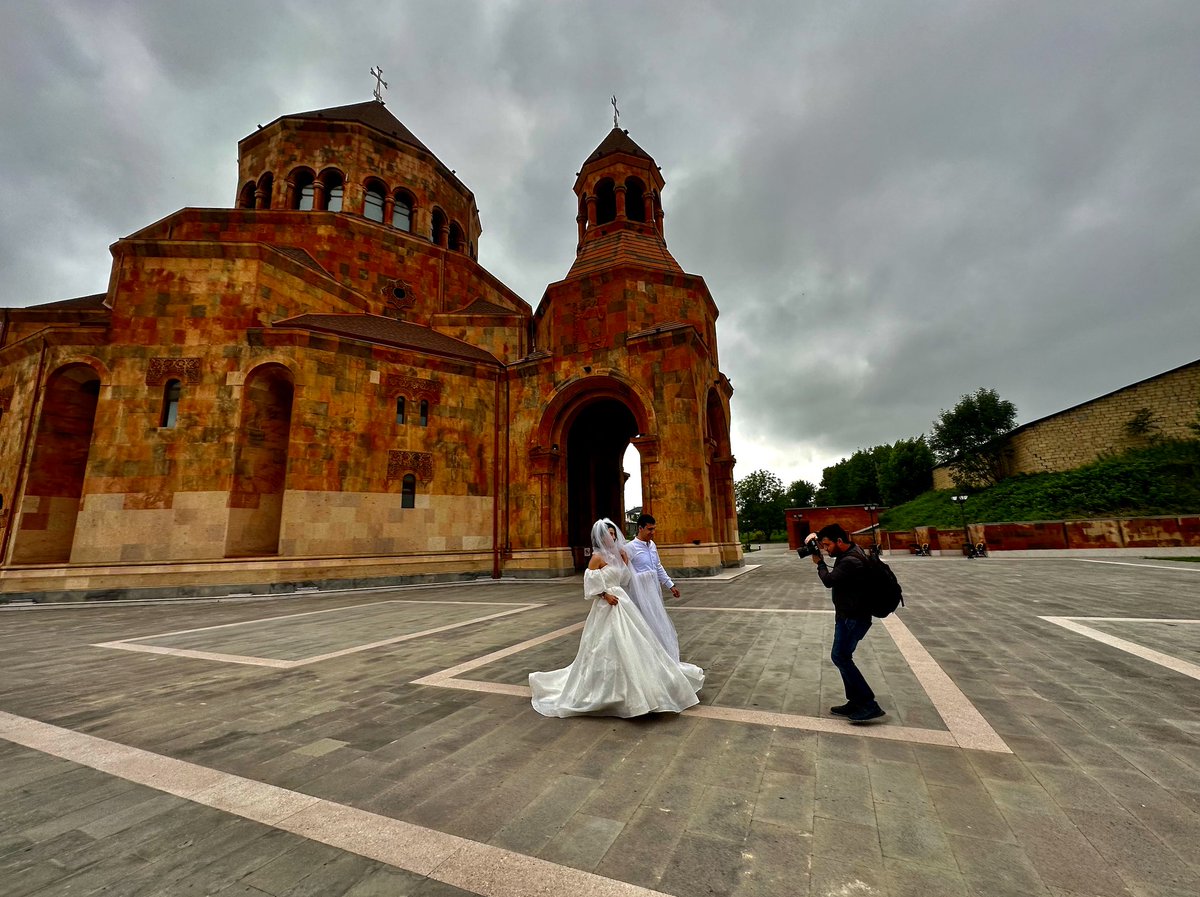
BREAKING: The Holy Mother of God Cathedral in occupied Stepanakert has been destroyed by the Azerbaijani regime, according to the Artsakh Culture and Tourism Development Agency, on the eve of the 111th anniversary of the Armenian Genocide.
Constructed between 2000 and 2019, the cathedral was the city’s central church of the Armenian Apostolic tradition and a symbol of revived religious life after decades of Soviet suppression.
It followed an earlier church dating back to the late 19th century that was shut down during the Soviet period, restoring a presence that had been deliberately erased.
More than a place of worship, the cathedral stood as a visible expression of Armenian historical and cultural continuity in Artsakh. During the blockade, it also became a key gathering point, one of the few remaining spaces for communal and spiritual life under siege.
Artsakh’s cultural authority said the destruction is part of a broader, systematic effort to eliminate Armenian cultural presence, describing it as a deliberate act of erasure targeting identity, heritage, and continuity.
It also condemned the lack of response from Armenia’s authorities and the absence of meaningful international reaction, warning that silence only deepens a sense of impunity and further undermines the prospects for the return of displaced Armenians by severing their ties to their homeland.
This is not simply a barbaric and, unfortunately, well-known policy of demolishing Armenian traces from Artsakh; it is a step aimed at humiliating the Christian world and the Christian faith. This reflects Aliyev’s true approach toward the Christian religion.
When Azerbaijan demolished the Nagorno-Karabakh parliament building, it did so in a very ostentatious manner, but what will people say when they see bulldozers demolishing a giant Christian church?
The videos that have been circulated show that the church is no longer there.
Turkey/Armenia: Here is rare footage of Armenian Christian children during the Armenian Genocide.
These kids endured unthinkable suffering.
Sadly, similar evil still happens today.
Let us not grow tired helping and praying over persecuted Christians in our time.