@FelRegard@hot_rails@AnthropicAI You'll wish you had a book if the lights go out and everything digital is gone, gone, gone. There's a reason the ancients kept data in stone. It's still available to read thousands of years later.
@FelRegard@hot_rails@AnthropicAI You'll wish you had a book if the lights go out and everything digital is gone, gone, gone. There's a reason the ancients kept data in stone. It's still available to read thousands of years later.
The mystery of Gobekli Tepe continues…
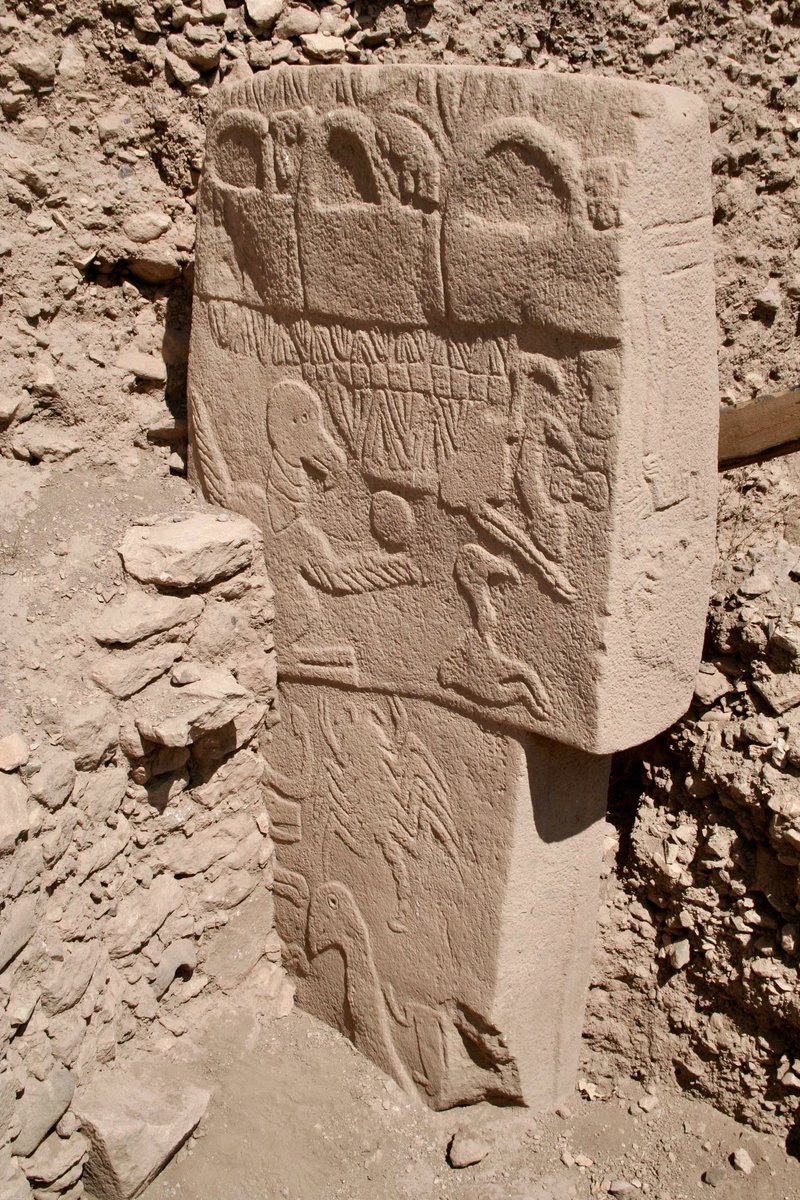
Archaeologists need to *fully excavate* Pillar 43
**It’s a bizarre fact that what is the most discussed/debated relic of this entire mysterious site has never been *fully* unearthed and documented! 🤯
We don’t have the full story. What other carved depictions are waiting to be discovered on this pillar?
@ShadowofEzra Well, to be Biblically honest, that whole journey to the 'Holy Land,' a couple times where they were told to take off their sandals because the ground they were standing on was holy... not saying the land is evil but weirdly dismissive of the physical property
A 5,000-year-old object in Egypt's Cairo Museum has pitted traditional archaeologists against modern engineers: The Sabu Disk! 🏛️💥 Archaeologists call it a mere vase. But when a 3D-printed replica was tested in water, the result was truly mind-blowing... 👇
Discovered during excavations in Saqqara by British researcher Walter Bryan Emery in 1936, this disk was unearthed from the tomb of Prince Sabu, who lived around 3000 BC. Measuring 61 cm in diameter and 10 cm in height, this object was dismissed for years by mainstream scientists as a "candle holder" or a "decorative item."
However, the disk's design and material are far too complex for it to be an ordinary ornament! 🧐
The disk is carved from schist, a highly brittle and flaky stone. With its 3 curved lobes bent inward at 120-degree angles and a cylindrical tube right in the center, carving it so flawlessly without shattering it using the primitive copper and stone tools of the era is practically impossible from an engineering standpoint.
The real big surprise came during the water test. When researchers spun an exact replica of the disk at high speeds in water, they witnessed the creation of an unexpectedly powerful vortex. In other words, this mysterious object operates on the exact same hydraulic principles as modern-day "centrifugal water pump impellers"! 🌊⚙️
This situation brings the following incredible possibilities to mind:
🔹 Was a hydraulic prototype developed 5,000 years ago to facilitate irrigation in Egyptian agriculture?
🔹 Or were ancient artisans actually trying to replicate a much older, advanced technological device originally made of metal, using the stone-working means they had?
Although mainstream archaeology insists on calling this object a "candle holder," the Sabu Disk continues to make us question everything we know about the technological limits of the ancient world.
Do you think this flawless design is just a regular decorative item, or a lost marvel of ancient engineering? 🏺✨👽
They’re putting vaccines into U.S. food now.
Rep. Scott Cepicky..."One head of lettuce might be normal and the lettuce next to it could contain a vaccine." Foods need to be labeled as vaccine-laced. You shouldn’t buy tomatoes and unknowingly get a polio vaccine.
Petrie measured a granite box in an Egyptian pyramid in thousandths of an inch.
Along 106 inches of granite the top edge wanders from a straight line by an average of just 7 thousandths of an inch.
The box lies in a granite chamber under the pyramid at Lahun in Egypt's Faiyum, and Flinders Petrie, the British archaeologist who excavated the site, published these numbers in 1891.
🔹The surface is ground
🔹No lid has ever been found
🔹The base slopes nearly 4 inches
🔹The 50-inch ends err by only 4 thousandths
🔹Its bevelled edges meet true in 3-sided pyramids
The 2 long sides come out at 106.100 and 106.116 inches, a difference of about 4 sheets of printer paper held across nearly 9 feet of red granite.
Petrie rated proportion the hardest test of all, because it demands every other accuracy at once and leaves no way back, since nothing can be corrected by removing more material.
Petrie called it the finest piece of mechanical work, and he had the numbers to say so.
What toolkit would you need to grind 9 feet of granite that straight and that parallel?
NASA has released one of the most detailed visualizations ever created of Earth’s ocean currents.
Using data from satellites and advanced ocean models, the map reveals massive rivers of moving water, swirling eddies hundreds of miles wide, and the powerful Gulf Stream carrying warm water from the Gulf of Mexico across the Atlantic.
Some folks don’t believe that a “principled AI company” would destroy books after they suck out all the information for their models, even one-of-a-kind books and manuscripts.
Here it is admitted in open court.
Pillar 43 at Gobekli Tepe dates to 14,800 BCE.
Until we grasp this, we will not be able to comprehend the history of mankind and its relationship with the Holocene.