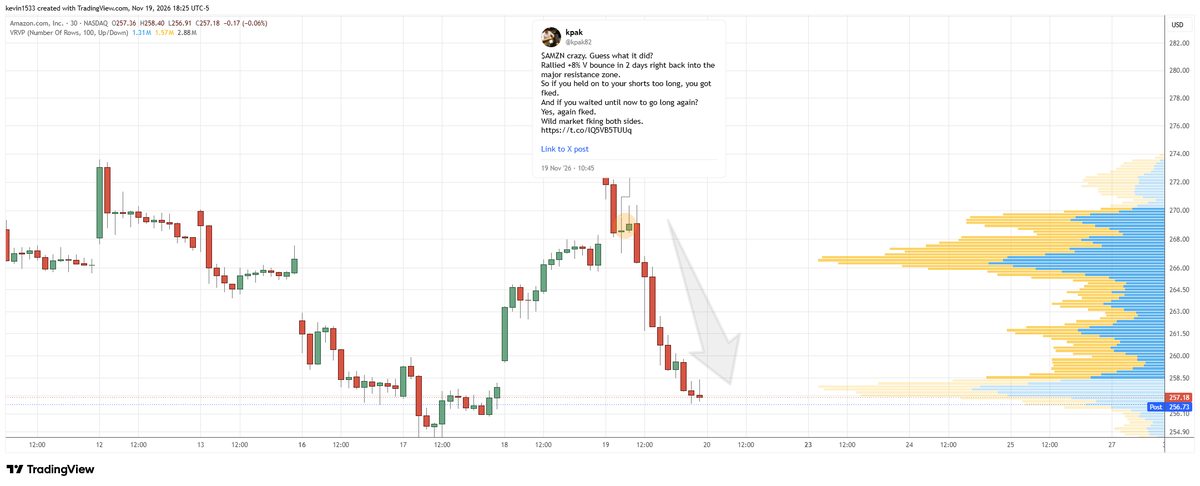
Be careful with subs that average down 2-4 times after entry.
Day 1: "entering long here"
Next day dip: "add more here"
Even bigger dip: "ok bring it lower baby.. right into the bear trap.. mother of all supports. adding big time position here."
$AMZN One benefit of following me. I remind people not to take suicidal trades.
Dont go long at major resistance folks.
Dont chase the top of extreme short term moves.
If I told you there’s a special course guaranteed to make you a better trader, and it won’t cost you anything, would you do it?
There’s one catch: you’d have to focus for one week and not be able to trade. Would you do it?
If you answered yes, then you can get a guaranteed upgrade in discipline and a stronger sense of control over the market by simply by not trading for one week.
One day without trading is difficult for most people. One full week of abstinence puts you in the top 10–15% of traders worldwide.
The hard part of quantum computing isn't building one good qubit.
It's building the ten-thousandth one exactly like the first.
Most quantum machines are hand-built, one lab system at a time. Beautiful science. Terrible factory.
IonQ's subsidiary Oxford Ionics does it differently. It prints the qubit controls onto standard silicon chips — the same wafers the electronics industry already mass-produces.
No exotic new factory. No handmade, one-off devices. You scale the way the chip industry already knows how to scale.
Why it matters for $IONQ: the roadmap needs 10,000 qubits in 2027 and millions by 2030. Those numbers only happen if qubits are manufactured, not hand-built.
Qubit count wins press releases. Manufacturing wins the market.
#quantumcomputing
$IonQ Here is the thing almost every quantum analyst gets wrong about IonQ: they analyze the company as if it were a set of assets. It is not. It is the product of a leadership decision. Strip out @NiccoloDeMasi and IonQ is not the company it is today — and the entire four-part Quantum Technology Integration Series, read together, is ultimately the story of one transformation. Call it the de Masi Impact Formula.
The formula is simple to state and hard to replicate: take a strong but single-pillar trapped-ion hardware company, install a leader who understands that the fault-tolerant era will be won at the intersection of capability AND platform, and then execute a vertical-integration strategy fast enough that by the time competitors recognize the playbook, the moat is already built. That is what has happened at IonQ over roughly fifteen months. It is not an accident of physics. It is a deliberate, sequenced, leadership-driven build — and it is why IonQ leads the commercial Tier 1 cohort at 9.2 near-term and 9.3 blended, ahead of IBM by 1.2 points, Google by 2.1, and Quantinuum by 2.3, under every sensitivity profile the framework tests.
Look at what the formula actually produced. A foundry path no other commercial quantum company has — SkyWater, now stockholder-approved, chip samples already in hand. Live quantum networking on three continents while rivals have none deployed. A security business (ID Quantique, ~300 patents) and a sensing business (Vector Atomic) that generate revenue today — funding the wait that pure-play competitors must finance externally through dilution. A space and defense position — SDA HALO, MDA SHIELD, DARPA HARQ — that anchors a sovereign role capital alone cannot buy. And underneath all of it, the hardware to justify the platform: the highest demonstrated two-qubit gate fidelity in the field at 99.99%, peer-reviewed, achieved without ground-state cooling; the first trapped-ion qLDPC breakeven, peer-reviewed June 4, 2026, running nine error-correcting codes on one device with zero hardware reconfiguration; and the only commercial revenue above $100M GAAP in the entire sector.
None of those pillars is a coincidence sitting next to another coincidence. They were acquired, integrated, and sequenced under one strategic vision. That is the difference between a CEO and a custodian. Niccolo did not inherit this platform — he assembled and nurtured it, and he integrated it fast enough that the federal government is now spending billions trying to incentivize the rest of the industry to replicate the vertical-integration position IonQ reached first and on its own balance sheet.
Here is the mechanism that makes the formula compound rather than merely add — the flywheel at the center of the capstone synthesis. The foundry is the root node: it accelerates iteration across every hardware pillar at once. Compute and networking become a single system at fault-tolerant scale, because the 2028 path to AQ1,000 is a networked multi-chip architecture, not a single bigger chip. Security and sensing revenue fund the build. Space and defense extend the network globally and deepen the sovereign moat. And code efficiency multiplies the manufacturing edge: IonQ’s BB5 code encodes four logical qubits in eighteen physical against Quantinuum’s seven-to-one, which means fewer physical qubits per logical qubit, which means more capability per wafer — on a wafer cycle a foundry makes faster. Two advantages that compound instead of stacking. A research lab can match a single IonQ result. It cannot match the flywheel, because the flywheel is a leadership architecture, not a lab outcome.
The full four-part case “The Quantum Tech Integration Series”— built to be tested, with the conditions that would change the verdict named explicitly demonstrates Niccolo’s leadership- not just within @IonQ_Inc but his overarching impact on the quantum industry.
Part I — Quantum Technology Adoption: Enterprise Decision Framework
https://t.co/BQYPUPsMrh
Part II — Quantum Software Adoption: Decision Framework for the Programmable Quantum Era
https://t.co/REvecZhuNK
Part III — The Quantum Full Stack: Defining the Quantum Tech Era
https://t.co/Vbuk5SGIkL
Part IV — The Quantum Frontier Report: The Race to Lead, the Compounding Advantage, and the Investor Imperative
https://t.co/8CxHCie4Pf
Bonus — Analytical Review: IonQ vs. Quantinuum (synthesis of Parts I–III)
https://t.co/yunhiRvdPz
IonQ is unquestionably the overall leader in quantum tech because of its leadership - and that leadership created a flywheel that will take competitors years to replicate, if ever.
I want to tell you why I believe $IONQ just delivered the most significant commercial quarter the quantum industry has ever seen.
Last night’s report landed after the Nasdaq plunged 5.5%, its worst day in 18 months. Reporting on a day like this is like playing a video game on "legendary" difficulty.
Fear dominated the market. IonQ brought the numbers:
• $173.8M quarterly revenue, up 336% YoY
• $1.2B backlog
• Full-year revenue guidance raised to $505–515M
• Expected 110% growth in quantum computing revenue this year
Yes, the headline revenue includes SkyWater. It isn’t all quantum computing. The SkyWater acquisition is already bearing fruit in faster iteration cycles for their new chips. Further, IONQ Is positioning itself as a key piece of the quantum supply chain.
Quantum computing accounted for approximately TWO-THIRDS of new contract dollars signed by IonQ’s Platform segment. Further, Superion is sold out through 2027.
And the implications for the quantum industry extend beyond $IONQ: SkyWater is manufacturing for D-Wave and Qolab, while NVIDIA plans to deploy IonQ’s Superion 256 at its research center.
We’re seeing the foundations of an industry take shape. System sales, manufacturing demand, and integration with AI infrastructure.
Congrats to the $IONQ team for leading the way in the commercialization of the quantum technology!
When was the last time I took an unplanned/random trade?
I cant remember. It's been a couple of years.
It's by design since I write a newsletter and run a sub, everything I do has to be presented to my members/clients with evidence to back up my actions.
Otherwise, it would be disrespectful.
If we all treat trading like an actual job with competition, you would not come to work unprepared or do anything careless/lazy that could get you fired or replaced.
Being disciplined means following basic rules (all the time, no exceptions) to tame the monster inside of you.
You know the crazy degen that’s inside all of us telling us to “yolo, fuck it. I’m not waiting. This is good enough.”
Wanting a dopamine hit. Wanting to feed and get instant gratification.
One cheat day, one small “harmless” entry could (and likely will) ruin everything you’ve worked hard to build.
One of the hardest things for most people to do (including myself in my first few years) is to do nothing for just ONE day.
Once you detox from overtrading, you start enjoying sitting on your hands and planning rather than jumping in and hoping for one lucky break that could dig you out of the hole.
“Quantum technologies are job creators. We’re not job disruptors.”
That was one of the messages our CEO, @NiccoloDeMasi, shared with Andrew Marr on LBC as they discussed what the next era of computing could mean for economies and societies around the world.
Quantum is moving beyond the laboratory. From computing and cybersecurity to sensing and navigation, governments and businesses are starting to consider how these technologies could reshape critical industries and infrastructure, and unlock new opportunities across healthcare, materials science, engineering, logistics and financial services.
For IonQ, the opportunity is about more than building powerful quantum systems. It is about helping build the skills, infrastructure, manufacturing capacity and workforce needed to put quantum technology to work.
Watch the interview below.
#QuantumTechnology #QuantumComputing #Innovation
$IONQ IonQ awarded $7.5M follow-on funding from AFRL to advance full-stack quantum networking.
This expands Phase 2 of the $21.1M collaboration first announced in January 2025. It builds on the Phase 1 physical network foundation in Rome, NY by adding the optical, hardware and software layers needed for real-world, interoperable deployment outside the lab.
What Phase 2 adds:
→ Free-space optical links (C-band) with automatic pointing, acquisition and tracking for open-air entanglement distribution
→ Quantum frequency converters to connect heterogeneous quantum hardware over standard telecom infrastructure
→ Automated control software for self-tests, monitoring, failure handling and results export
→ Upgraded hardware including O-band modules, enhanced polarization control and quantum network interface cards
Jordan Shapiro, President of IonQ’s Quantum Platform: “This follow-on funding underscores the strength of our long-term partnership and validates IonQ’s full-stack approach. We are unlocking new domains for quantum networking by going to free space optics.”
The goal is a deployable model for defense communications, metropolitan networks and multi-node quantum systems.
🔗 https://t.co/Jvv1jDfx2o
#IonQ #Quantum #AFRL
$IONQ Earlier I showed the price. Here is why the software layer is worth it, and who is building it.
Genki Okano, Senior Quantum Application Engineer at Classiq, explains why he joined.
His image: imagine having to understand how an Android phone works inside just to use it, then learning an Apple phone from scratch to switch. That is what quantum computing used to be like.
Classiq's platform takes care of the layers in between and solves "the biggest challenge so far, bridging the gap between the user and the hardware."
That layer takes rare skills. IonQ has its own teams on it, and works with the whole ecosystem to move it forward and prove real use cases.
Classiq: IonQ invested in November 2025, and the use cases keep coming. Israel's gas grid operator INGL ran a pipeline problem on IonQ Forte-1.
Horizon Quantum: IonQ holds 13.3% and Horizon is buying an IonQ 256-qubit system.
Kipu Quantum: strategic partnership since February 2026. Their protein folding on a 64-qubit IonQ system took a Best Paper medal at IEEE Quantum Week in September, and IonQ's Chad Sakac presented the work to customers at Investor Day.
Software makes the hardware usable. IonQ builds it in-house, and with the teams that matter.
#IonQ #Quantum #Classiq
$IONQ Intel is buying Classiq for a reported $2.3B. IonQ invested in it six months ago.
Classiq is the quantum software layer: you describe the algorithm, it builds the circuit for the machine you target. Its co-founder and CEO Nir Minerbi announced the deal today: "we aim to bring quantum computing to developers and organizations worldwide."
IonQ joined Classiq's strategic round in November 2025, and Classiq's SDK already runs circuits on IonQ's cloud, Forte included.
The biggest quantum acquisition to date is a bet on software. IonQ is already connected to it.
🔗 https://t.co/4PcP9DmflU
#IonQ #Quantum #Classiq #Intel
Quantum computing sounds abstract — until a drugmaker hands it a real problem.
IonQ, with AstraZeneca, AWS and NVIDIA, ran a key step of a drug-making reaction on a hybrid quantum-classical system. The reported result: the end-to-end run went from months to days — more than 20x faster.
That's a June 2025 company-reported figure, not an independent audit. But it comes from a named pharma giant, not a staged demo.
Why it matters for $IONQ: a Big Pharma partner isn't a logo. It's a customer with a molecule problem and a budget.
Quantum isn't a lab toy. It's being handed the hard problems.
$IONQ
You think you own a quantum computer stock.
You also own a quantum networking company.
Through a string of quiet acquisitions, IonQ now owns an entire quantum-networking stack:
• ID Quantique — the commercial leader in quantum-safe security. Its QKD hardware makes the near-unbreakable encryption keys banks and governments buy today.
• Lightsynq — the photonic wiring that links separate quantum chips into one bigger machine.
• Qubitekk — builds and runs real entangled-photon quantum networks in the field right now.
Why it matters for $IONQ: quantum networking is a second multi-billion-dollar market — secure communications, the quantum internet, and the interconnect that lets qubit counts scale. IonQ owns these pieces. It doesn't rent them.
$IONQ isn't just a quantum computer. It's the whole stack: computing, networking, security.
#quantumcomputing