Most founders do not need more investor names.
They need a better capital route.
ScaleSignals helps founders understand which funders fit, what evidence they need, and how to approach them without wasting months.
Start here: https://t.co/K7qEgOlq19
A founder told me last week he wished he had spent the first month of his last raise on capital route selection instead of outreach.
He raised £3M in eight months.
The right route work upfront would have cut it to four.
Capital route is the strategic decision. The deck is the execution.
More investor conversations often create more narrative drift.
Each meeting introduces feedback the founder absorbs into the next pitch.
By meeting fifteen they are pitching a hybrid built from objections of investors who never wrote the cheque.
If your deck has changed materially across the last ten meetings, the drift has already happened.
Here is the full ScaleSignals piece:
How SpaceX Built the Cadence No Rival Could Buy
https://t.co/FGs5ADwTb4
It is the first article in the new How They Built It series, where I break down how exceptional companies turn capital, timing, infrastructure, trust and operating discipline into hard-to-copy advantage.
#SpaceX is not just a rocket story.
It's a cadence story.
Every launch created data, trust, learning, cost insight and capital confidence.
That is the real lesson for founders.
Build the proof loop competitors can see but cannot easily copy.
New ScaleSignals piece:
How SpaceX Built the Cadence No Rival Could Buy
@elonmusk
Most founders are optimising for meetings instead of alignment.
Twenty meetings is not a raise. Three aligned conversations are.
The shape of the calendar predicts the shape of the raise more reliably than the deck does.
The sharpest GPs pass faster than the rest of the market.
Fast passes come from funds where the decision is clear — fits cleanly or does not fit at all.
Slow passes come from genuinely difficult decisions — companies sitting on the edge of the mandate.
A slow maybe usually means a deal that should not have been in the room.
Revenue quality is replacing TAM as the first filter in many investor conversations.
TAM mattered when the constraint was finding large enough markets.
The current constraint is finding revenue defensible enough to support the next round.
The filter has moved.
Capital is spreading geographically.
More funds active outside Silicon Valley than at any point in the last decade.
But fit is getting harder, not easier — because route logic now matters more than list length.
Full analysis today.
Slow growth with strong evidence reads better in 2026 than fast growth with weak evidence.
Not what most founders are being told.
Startup media rewards velocity. Investors are rewarding defensibility.
The disconnect costs founders months.
Six recent rejections from a GP I work with.
None said no because the company was wrong.
All said no because they could see the fundraising timeline collapsing inside the founder's pipeline.
The signal that broke the deal was visible weeks earlier.
Six months ago, the only question a founder asked me was how much equity
to sell. Now the question is which capital to use at all.
I didn't just feel that shift. The market called it in real time.
THE BEFORE (late 2025):
@PeterJ_Walker (Carta) laid out the dilution ladder — seed founders selling ~19.5% a round. The whole game was how much equity to give.
@deedydas (Menlo) flagged the crack underneath: VC fundraising down ~75% from the 2022 peak. The equity tap was already tightening.
THE AFTER (now):
@andrewziperski said, "finance is now a first-class citizen in Silicon Valley."
Shaun (@shaunabe): borrowing against revenue, assets, offtakes — private
credit thriving where equity used to be the default.
WHAT I SEE FROM THE SEAT (the part the headlines miss):
The clean priced round didn't get more competitive. It concentrated — AI
took the lion's share of equity dollars, and everyone else quietly rebuilt
the stack around debt, revenue-based and blended structures.
And the part almost no one's saying: venture debt itself is now rotating
away from software toward hardware and physical, because lenders fear AI
eating the recurring revenue they underwrite against.
So I mapped it. December vs June, side by side — what rose, what fell, and
what it means for how you structure your next raise.
https://t.co/PFf97vfTVE
Strong evidence changes the conversation before the founder enters the room.
A partner who read your one-page thesis before the meeting walks in partly convinced.
A partner reading the deck for the first time during the meeting starts from zero.
Evidence sent in advance is not extra work.
Fifty capital providers currently writing cheques outside Silicon Valley.
Verified deployment in the last six months. Capital type. Stage. Region. Ticket. Best route in.
Provider intelligence for Vantage members today.
Investor fit is not only about names. Names are the surface.
Underneath sit five layers.
Route. Timing. Mandate. Proof. Trust.
All five have to align or the meeting becomes the wrong meeting regardless of who attends it.
Investor fit is not only about names. Names are the surface.
Underneath sit five layers.
Route. Timing. Mandate. Proof. Trust.
All five have to align or the meeting becomes the wrong meeting regardless of who attends it.
I've started noticing something from the GP seat.
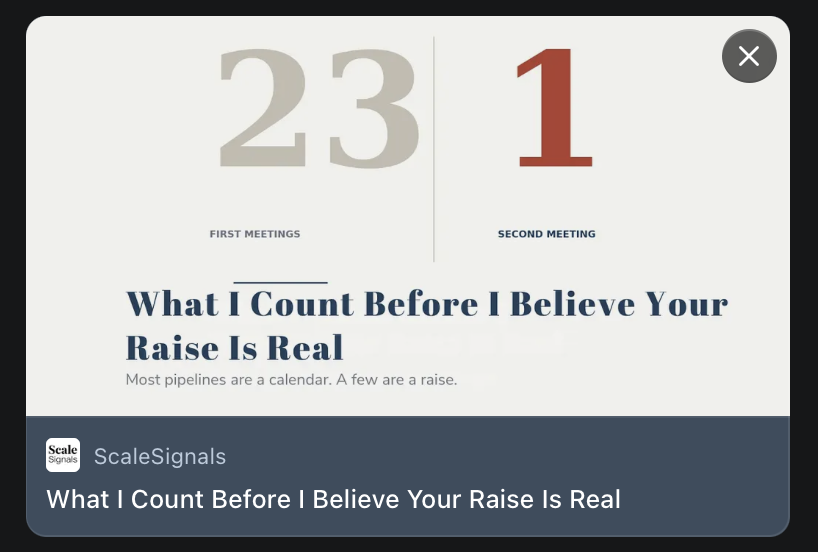
The number that tells me a raise is real isn't first meetings. It's how many investors asked for a second one.
A first meeting costs an investor nothing. A second one costs internal capital.
Curiosity is questions. Conviction is movement.
https://t.co/vN4rqemrMZ
Keep us updated' is not a process.
It is the polite version of we have not decided to do this with you.
Founders who treat it as engagement waste four months.
Founders who treat it as a soft no redirect to investors actually moving.
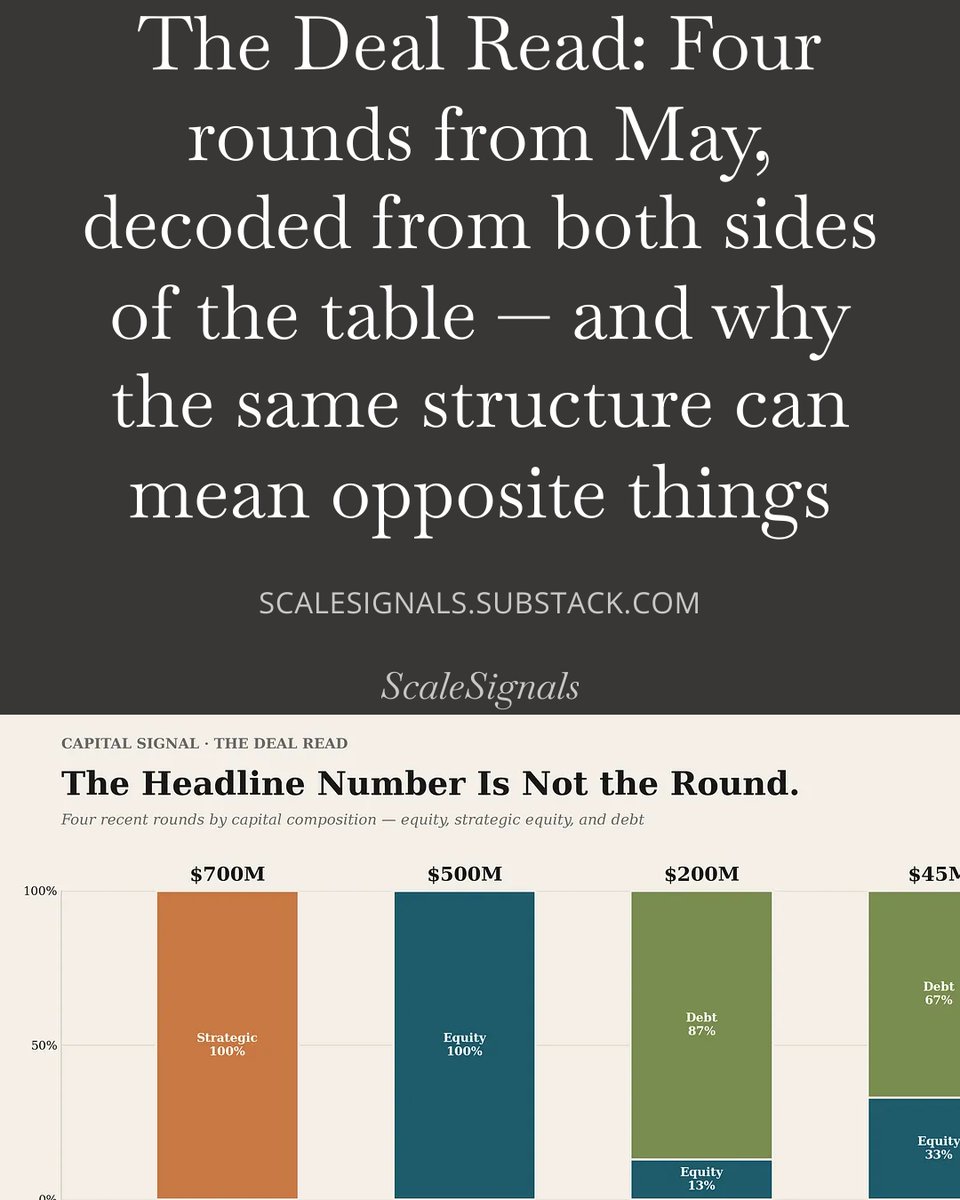
Capchase "raised $200M" last month.
$26M was equity. The other $174M was a credit facility.
87% of the headline number was debt — and most people read it as a startup mega-round.
The number is never the round. The structure is.
New Deal Read decodes four of May's biggest raises:
https://t.co/Ka4jTjaIRD
One of the most shared threads this week wasn’t about a funding round — it was a simple observation: while some founders optimize their persona for foreign VCs, others are quietly building distribution, users, and revenue.
The gap that eventually appears in the market can be brutal.
It’s an evergreen truth dressed up in 2026 clothing. Sales and marketing still make up the vast majority of early startup life, no matter how elegant your product or how sharp your AI wrapper. The founders who treat those functions as core (not afterthoughts) are pulling ahead.
Sunday evenings are good for this kind of honest reflection. Are you spending your energy on what actually moves the business forward, or on the version of the story that looks best on a pitch deck?
The wrong investor conversation is not neutral.
It consumes time. Exposes positioning to the wrong audience. Distorts the narrative.
And leaves a paper trail the right investor will see during references.
Founders treat bad meetings as practice.
Investors treat them as data.