He’s running loads from land to land. No matter the state. He can always slide right through the hand. He’s smuggling from land to land. - @MtGrassUnit
I have no market outlook.
Most traders think that's a weakness. It's the only honest position.
I don't know if crude goes up or down next month. I don't know which currency breaks. I don't know which equity moonshots.
My system doesn't need to know. It needs to be present when it happens.
100+ markets means I'm already there.
Buy and hold relies on outliers. It just doesn't admit it.
Studies show 4% of stocks generate all long-run market gains. The other 96% are noise.
So buy and hold is an outlier strategy. A passive one that endures 50-80% drawdowns to capture those outliers.
Trend following hunts the same 4%. It just doesn't sit through the 80% drawdown to get there.
Same upside. Severed downside. That's the only structural difference.
Small losses aren't a sign the system is broken.
They're proof it's working.
Every stop I take is a risk release valve. I accepted a small, linear loss to avoid the non-linear one that doesn't come back from.
The traders who won't take small losses are the ones who eventually take the big ones.
They wait. They average down. They tell themselves it'll recover.
The stop isn't a failure. It's the cost of staying solvent.
Here's the most brutal part of the paper: they took this simple trend following rule and compared it against the biggest and most successful CTAs.
When you subtract out what the trend contributes, the famous alpha of most of those managers goes to zero or turns negative.
Most trend followers want consistency. I want outliers.
Consistency is a property of the edge. Outliers are where the money actually is. I design my approach to stay in the game long enough to catch a tail event when it arrives.
I can't plan for the outlier. I can only stay positioned for it.
THE LONE RIDER
He rode into town with no name on the ledger, no apology in his saddlebag, and a CAGR that made grown men weep into their lukewarm beer.
The wind came down off the ridge that morning, dry and full of warning. Down in the valley, the herd of managers stood quiet, heads low, chewing on their benchmarks. Safe. Smooth. Saddled to the index. One of them was explaining his risk-adjusted returns to a fence post. The fence post looked bored. Another was rebalancing into bonds. A tumbleweed rolled past and shook its head.
Then somebody pointed north.
A lone rider on the horizon. Poncho. Squint. A cheroot clenched between his teeth like a man who has personally seen what mean reversion does to a portfolio and lived to tell the tale. Dust on his coat, sun at his back, reins loose in a steady hand. His horse was also long crude.
They call him Mulvaney.
YTD north of a hundred. Triple digits carved into the canyon wall like a name on a grave marker. The kind of number that makes the saloon go quiet when you say it out loud. The piano player stops mid-song. Somebody's drink hits the floor. A consultant faints. A 60/40 portfolio quietly excuses itself and walks out the back door.
The townsfolk will tell you it cannot be done. They will speak of drawdowns the way old men speak of wolves, in hushed tones around the fire, certain the beast is waiting just past the treeline. They will polish their Sharpe ratios by lamplight and call it courage. They will form committees. They will hire a man with a clipboard. They will write a memo about the memo. The Lone Rider does not own a clipboard. The Lone Rider owns a position. The position owns cocoa.
He walked into the saloon once. Ordered a whisky. The bartender asked how he liked it. He said, "Trending." The bartender poured it anyway and never spoke of it again.
Out past the last fence post, where the trend runs wild and the outliers roam, he keeps his own counsel. He does not flinch when the thunder rolls. He does not cut his winners to please the crowd at the bar. He does not blink. The man has not blinked since 2008. Some say he cannot. Some say he simply will not give the market the satisfaction. A risk manager once asked him about his vol target. He stared at the man until the man remembered a previous engagement in another county.
A junior analyst asked him about his stop loss. He just looked at him. The analyst is now a rancher in Wyoming. Happier, by all accounts. Sends a Christmas card every year. Signs it "Thank you."
He sizes up. He sits tight. He rides the whole damn distribution to the end of the line. When the move ends, he tips his hat. When the next one starts, he is already there. Nobody is sure how. There is a theory..... Nobody asks.
Catch the move. Honour the trend. Let the country do its work.
Tip of the hat to Paul Mulvaney and his outfit. The faithful keep the faith. The Lone Rider keeps riding.
Somewhere out there, the next outlier is already kicking up dust.
Saddle up.
#TrendFollowing #OutlierHunter #SystematicTrading #MulvaneyCapital
Mulvaney Capital Management
The Mulvaney Global Markets Fund
YTD 105.52%, April 24.40%
Trend Following is non-random rebalancing.
Most portfolio rebalancing is mechanical and time-based—monthly, quarterly, or triggered by fixed percentage deviations. It treats markets as largely efficient and assumes that deviations from target weights are temporary “noise” to be corrected. In that sense, traditional rebalancing is close to random with respect to price direction. It systematically sells what has gone up and buys what has gone down, regardless of whether those moves are the early stages of meaningful trends or just short-term fluctuations.
Trend Following, by contrast, is non-random rebalancing. It does not rebalance on a clock or toward a static allocation. Instead, it continuously reallocates capital based on observed price behavior. Positions are increased, maintained, reduced, or exited according to predefined rules that respond to persistent directional movement. When a market trends upward, exposure grows or is maintained; when it trends downward, exposure is reduced or reversed. This is not arbitrary—it is a rules-based process that systematically shifts capital toward strength and away from weakness.
In this framework, every trade and position adjustment is a form of rebalancing—but one that is conditional, directional, and information-driven. The “information” is not fundamental forecasts or discretionary views, but the empirical evidence embedded in price trends. Over time, this creates a portfolio that is constantly adapting, concentrating risk in markets exhibiting sustained movement and withdrawing from those that are stagnant or reversing. The result is a dynamic allocation process that is far from random—it is explicitly designed to capture the asymmetric payoff profile of trends.
This is why Trend Following often appears to do the opposite of traditional rebalancing. It buys higher and sells lower, not out of indiscipline, but because it is reallocating toward markets where the expected payoff of staying with the position is favorable—driven not by a higher probability of success, but by the potential for large, asymmetric outlier moves. In this sense, Trend Following is best understood not just as a trading strategy, but as a systematic, non-random rebalancing mechanism—one that replaces arbitrary timing with a consistent response to price behavior across a wide range of markets.
And just like that we are back where we started.
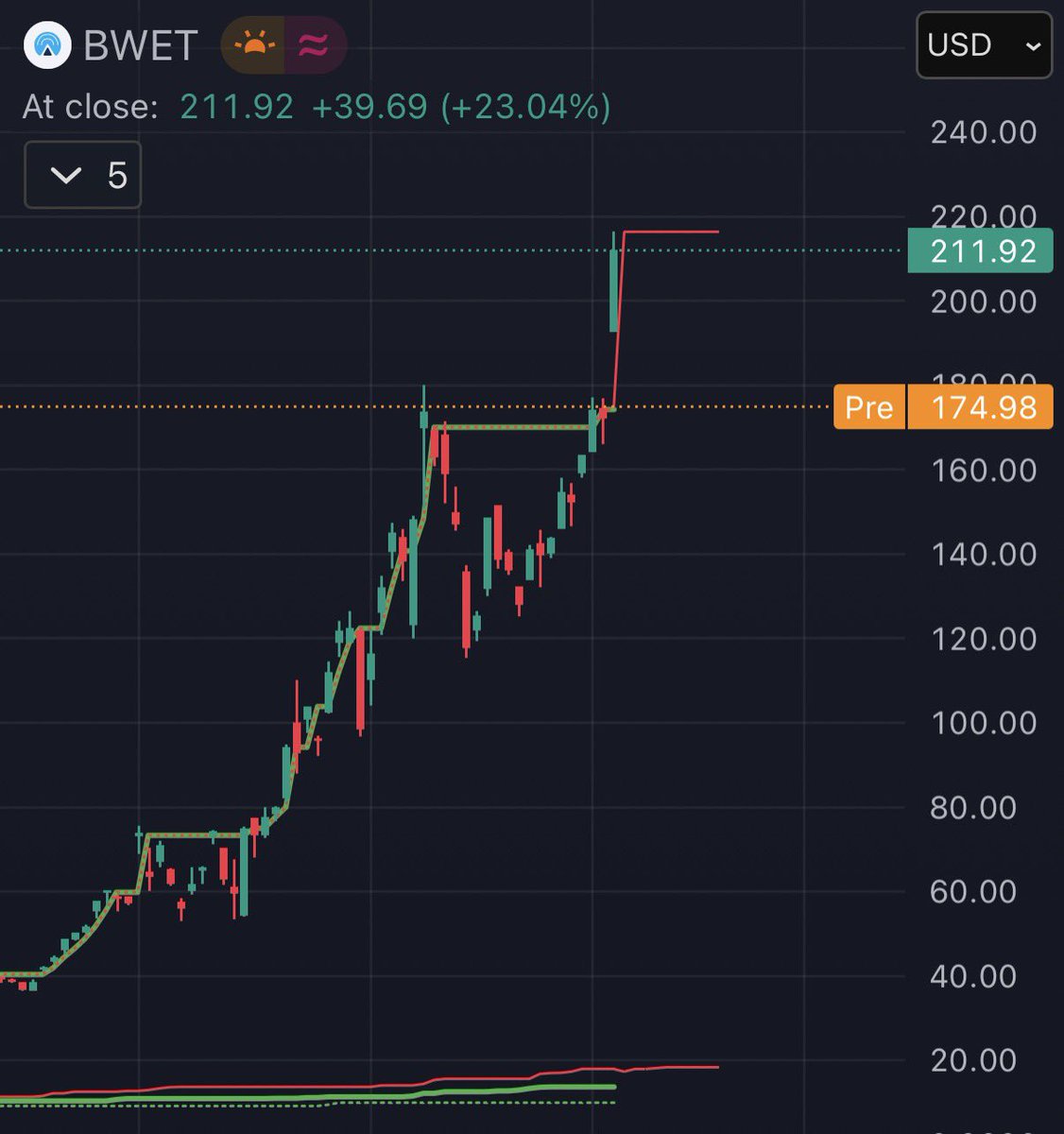
Excellent case for diversity. While this is currently my largest winner and can swing my portfolio on a daily basis, it’s just one of 100+ possible positions and one of 70+ open positions.
#trendfollowing#diversity