Educator and finance enthusiast with a passion for science and a love for learning. Sharing insights on education, finance, politics and general knowledge.
We are all aware of a meeting the Oromo activists who are now camping in moyale held yesterday to create a narrative that this war is "Garre-Borana War".
You hypocrite what are you telling us?!
Dear Honorable @FarahMaalimM
I have been concerned by some of your recent media remarks regarding the Gari-Borana conflict in Moyale. I worry that the framing, however well-intentioned, could inadvertently heighten tensions rather than contribute to resolving them.
This is not an ethnic-level Oromo-Somali conflict, but rather a recurring dispute between two clans with close kinship ties, a shared language, and a common territory. Such disputes have persisted intermittently for decades and are sometimes exacerbated by cross-border contraband traders and unscrupulous security operatives. I therefore believe it is important to approach the situation with caution and avoid framing a localized conflict in ways that could turn it into a broader ethnic or national confrontation.
Sadly, this is not the first time you have made inflammatory remarks of this nature. A few years ago, when tensions arose between Somalia and Ethiopia, you delivered an incendiary speech directed at the Oromo, which was followed by reports of harassment and assaults against Oromo refugees in towns across Somalia. Such incidents underscore the potential consequences of rhetoric that risks inflaming ethnic tensions.
Brother Farah, I know you personally, and our relationship goes beyond politics. We have shared both good and difficult times. I have had the pleasure of hosting you in my home in Addis Ababa, and you have graciously welcomed me into yours, where I enjoyed a wonderful meal with your family. You were also among the first people to reach out and offer help when I recently faced a dangerous situation. I recall these moments because I know you as a fundamentally good-hearted and caring person, and I write to you in that same spirit of friendship and mutual respect.
As an elder statesman, you are someone whom I and many other younger politicians have looked to for advice, wisdom, and guidance on important national and regional issues. Precisely because I hold you in such high regard, I hope you will understand my concern. Your words carry weight, and with that comes a responsibility to promote restraint, understanding, and peaceful coexistence, especially when tensions are high.
Brother, I say this with genuine respect and affection. Please continue to be the voice of wisdom and guidance that we have come to expect from you.
Best regards,
Your younger brother,
Jawar Mohammed
Last elections, you supported and still support the worst governor ever seen in the history of kenya Mohamed Adan Khalif.
Isn't this hypocrisy?! @AbdikadirMohami@ahmednasirlaw
CS @kipmurkomen, I've heard @rigathi refer to you as the most childish person to ever hold a cabinet position in this country. After hearing your response on the Homa Bay violence, I totally agree with Gachagua. In fact, I now think that reference is unfair to genuinely childish people, because you are worse.
"Once you have been told there are goons waiting for you, why do you still go there?" is the response from the Cabinet Secretary for Interior and the country's security tsar?? I froze when I heard you saying that, and played the clip over and over again to be sure.
You are incompetent, foolish, childish, naive and clearly unstable, all at the same time.
Do you know why? Because opposition politicians will soon prepare goons to warn your beloved pro-government rallies of dire consequences if they visit certain areas, and we will all expect you to say "once you have been told there are goons there, why do you still go?"
You assume goons can only be the government types.
You do not know that Haiti started with goons.
You haven't internalised the fact that the Rwanda genocide was conducted by Interahamwe goons who slaughtered nearly a million souls in just three months.
And to be honest, Kenyans deserve better, if the man in charge of their security can say something as crazy as you have.
Do you remember Rachel Wandeto? Well, when you still foolishly thought hers was an attack by DCP guys on your UDA, you and your UDA clowns at Interior were quick to breathe fire on the steps of Harambee House about upcoming action on Gachagua. What's the update on that, by the way?
With your statement, you have basically told Kenyans planning rallies across the country that they are on their own as long as those who want to attack them are pro-government. This means that the opposition will make its own security plans and you will return to the steps of Harambee House only when your people are on the losing end.
If you are the one we are looking up to ahead of the elections, I am afraid the country is staring at really bad times ahead. No wonder Western powers want you gone from that socket. And by the way, on average, there are usually more opposition goons in the country than pro-government ones at any time in the country's history.
You can test this hypothesis by leaving all of us to our own devices. Ruto should urgently rid himself of you!
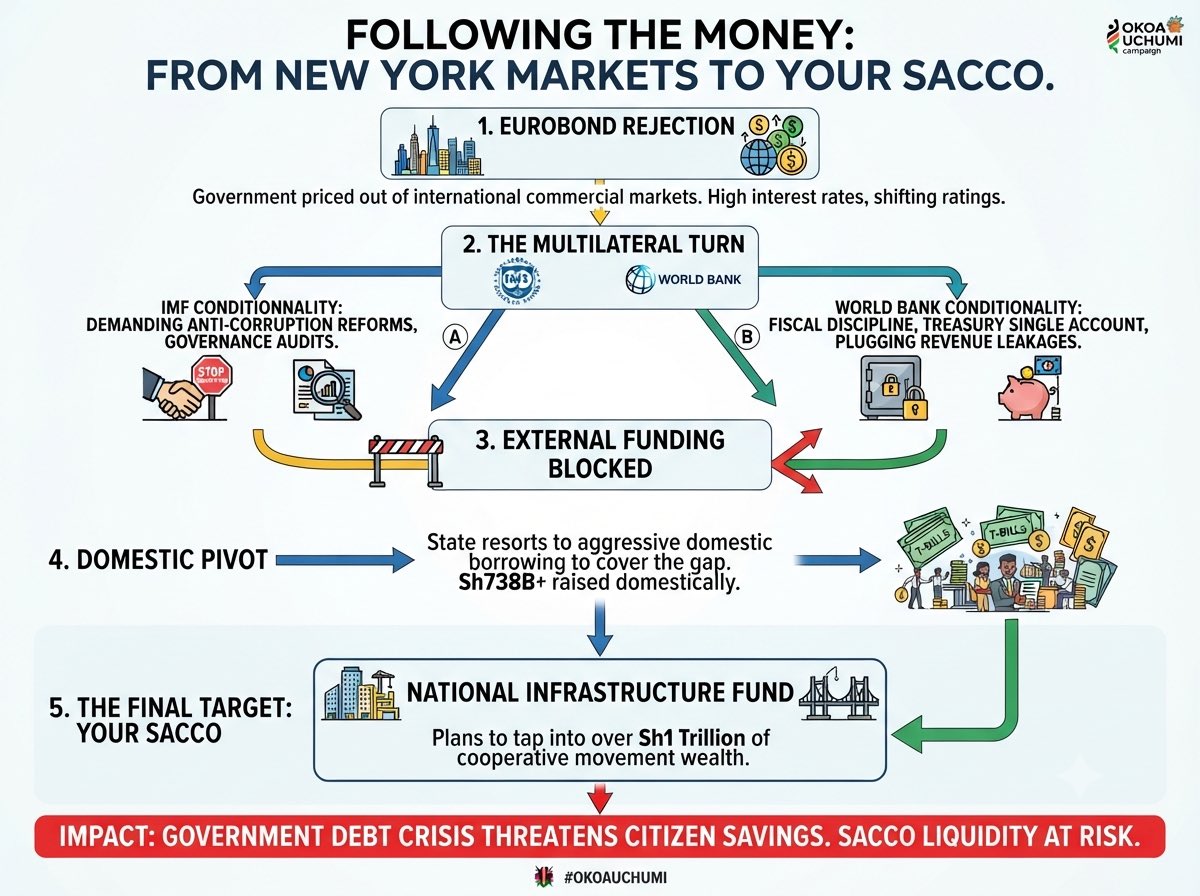
When the government gets locked out of international commercial markets, who pays the price? You do. Here is how the debt crisis is moving from global boardrooms straight to your SACCO savings.
1. The Eurobond Rejection:
The government avoided high-interest commercial debt markets like New York due to prohibitive costs and shifting credit ratings. Instead, they turned heavily to multilateral lenders: the IMF and the World Bank.
2. The Catch-22 of Conditionality:
But IMF and World Bank money is never free; it comes with structural adjustments. Recently, the pressure intensified. The IMF demanded aggressive anti-corruption frameworks and a major governance diagnostic audit. Simultaneously, the World Bank tied its $750 million support to strict fiscal discipline, pushing for the implementation of the Treasury Single Account and closing loopholes on public cash leakages.
3. The Domestic Shift:
Faced with strict external anti-corruption strings and a desperate need for cash, the state pivoted internally. They aggressively ramped up domestic borrowing, driving net domestic financing past approximately Sh 700billion this fiscal cycle alone.
4. Coming for the SACCOs:
But domestic banks and Treasury bills aren't enough to fill the gap. Now, the state is eyeing the massive, resilient pool of citizen wealth: the over Sh1 trillion held in Kenya’s cooperative movements. Under the guise of financing the new National Infrastructure Fund, the architecture is being laid to tap into SACCO liquidity.
Austerity measures failed to plug the gap because corruption wasn't dealt with. Now that international lenders are holding the mirror up to state governance, the government is looking inward and your hard-earned savings are the next target.
Ama turudi Mattress banking ?
The Dual-Track Mediation and Somalia’s Protracted Constitutional Crisis
The two-day, dual-track talks taking place today and tomorrow between the Federal Government—whose original parliamentary and presidential mandates expired months ago—and separate opposition factions, namely the Somali Future Council and representatives of former President Mohamed Abdullahi Farmaajo’s Nabad iyo Nolol movement, send alarming signals about the future of the nation.
The talks are being mediated today, Day 1, by the Turkish government and tomorrow, Day 2, by the influential international quartet—the United States, United Kingdom, European Union, and United Nations. This highly fragmented diplomatic approach underscores five core realities:
1. Hassan Sheikh Mohamud’s Intransigence and Capture of Power
Hassan Sheikh Mohamud has twice been honored by the Somali people with the highest office in the land: the presidency. Despite this, he has failed to demonstrate the democratic grace required either to earn a third mandate legitimately or to leave behind a unified and harmonious Federal Republic of Somalia at the conclusion of his second term.
Rather than handing power to a legitimately elected successor government operating under a consensus-based constitution, his aggressive push to extend federal mandates unilaterally through disputed constitutional amendments has made one reality unambiguously and abundantly clear: a destructive fixation on retaining and consolidating power.
2. The Geopolitical Disunity of Somalia’s International Partners
Somalia’s international partners—particularly the Turkish government and the influential Western quartet—have failed to present a unified political mediation strategy.
Instead of coordinating their leverage to address Somalia’s explosive and deteriorating political, security, and economic situation, their separate and disconnected interventions risk creating diplomatic friction. This lack of alignment encourages further political squabbling, delays a peaceful resolution, and threatens a tragic and destabilizing end to decades of international stabilization efforts.
3. Strategic Missteps and Growing Suspicion Surrounding Turkey’s Role
As a vital partner and “brother country,” Turkey’s failure to intervene constructively before the federal mandates expired has severely damaged its standing among many Somalis.
By operating on a diplomatic track separate from the international quartet and by conducting talks with the Federal Government and the opposition through separate channels, Ankara has created the impression that it may be siding with specific individuals rather than protecting the collective interests of the Somali state.
The decision to engage the Somali Future Council and Farmaajo’s faction on separate sub-tracks also risks fragmenting the opposition and weakening its collective bargaining power.
This approach has generated deep suspicion and carries serious strategic risks for all parties involved. Turkey has already suffered a significant loss of trust among many Somalis, who now openly question whether Ankara can still function as an impartial neutral broker.
4. The Opposition’s Red Line: Defending the Constitutional Order
The opposition’s willingness to participate in these multi-track talks stems from a desire to avert violent escalation, prevent a definitive descent into usurper rule, and protect national unity.
However, the window of opportunity to rescue Somalia from further institutional collapse is closing rapidly. For any mediation to succeed, international actors must take a firm position in defense of democratic constitutionalism.
This requires:
* the immediate suspension of all unlawful legislative and executive actions by the expired federal authorities; and
* a binding and non-negotiable commitment to hold indirect parliamentary and presidential elections within a strict 60-day period.
While many African states are engaging China through debt restructuring regimes. Somalia enters with a clean sovereign balance sheet after debt relief as Beijing pivots toward trade, zero tariffs and investment over lending. https://t.co/RHEc8DeBiS https://t.co/SpFgjOZZza