The man who won the Nobel Prize just told the world that AI is not the energy crisis, it is the cure for it.
Everyone has been screaming about how much electricity AI consumes, the data centers, the training runs, the billions of queries every single day.
Hassabis just said AI will extract 30 to 40 percent more efficiency out of national power grids, grids that, right now, operate at only 30 percent of their total capacity according to Stanford researchers.
That means the grids we already built are massively underused, and AI is the key to unlocking what is already there.
But that is the smallest part of what he is saying.
He is saying AI will crack nuclear fusion, the energy source that has been 30 years away for the last 60 years and DeepMind is already working with Commonwealth Fusion in the US to help AI contain plasma inside fusion reactors.
His personal mission is to use AI to discover a room-temperature superconductor, a material that would allow electricity to travel with zero loss, something physics has never been able to deliver.
The implications of that alone would reshape the entire global economy overnight.
He is also saying AI will design next-generation batteries and build the best climate modeling systems humanity has ever had, using them to figure out exactly where the planet is breaking down.
Think about what this means, the thing everyone is blaming for the energy crisis is the same thing being bet on to end it forever.
Today, we are emerging from stealth and launching PrismML, an AI lab with Caltech origins that is centered on building the most concentrated form of intelligence.
At PrismML, we believe that the next major leaps in AI will be driven by order-of-magnitude improvements in intelligence density, not just sheer parameter count.
Our first proof point is the 1-bit Bonsai 8B, a 1-bit weight model that fits into 1.15 GBs of memory and delivers over 10x the intelligence density of its full-precision counterparts. It is 14x smaller, 8x faster, and 5x more energy efficient on edge hardware while remaining competitive with other models in its parameter-class.
We are open-sourcing the model under Apache 2.0 license, along with Bonsai 4B and 1.7B models.
When advanced models become small, fast, and efficient enough to run locally, the design space for AI changes immediately. We believe in a future of on-device agents, real-time robotics, offline intelligence and entirely new products that were previously impossible.
We are excited to share our vision with you and keep working in the future to push the frontier of intelligence to the edge.
@aminkarbasi@GoogleResearch Congrats. It’s very interesting. Do you think this could enable current SOTAs to run on current Macbooks , even iPhones? Like opening the gate to on-device AI with great models..
Very interesting research by @GoogleResearch
Could be quite a breakthough to enable on-device high performing AI and getting in a few weeks or months Today’s SOTA on current Macbook Pros, even iPhones etc
https://t.co/Jpmk6lIrNr
These are all fantastic ideas. In general, there is no EU Inc. without accountability on performance.
There should be an embedded methodology for tracking multiple performance factors…KPIs and, in case of failure, the possibility for remedies to kick in immediately.
Without this approach, the EU Inc. will be a “nice to have” piece of theoretical harmonization that unfortunately won’t succeed in practice
Re: EU Inc — the role of courts
There are two issues Europe needs to address, for EU Inc and beyond:
🇪🇺 National courts are extremely slow (hundreds of days, often years).
There is no real or rapid consistency in how EU law is applied across the 27 national court systems. 1/4
We want to congratulate the @EU_Commission , @EUCssrMcGrath , @EZaharievaEU@vonderleyen - and the Europeans who spoke up - for this draft EU inc proposal, as it's a good starting point. Pending further review, we'll highlight now some of the interesting items 1/7
We did. And we did say it’s important to set KPIs on speed and cost: caps.
Regulation or directive, in any case we need a results-oriented company law where registry fees are not 10x or 100x the fees of other successful countries
Not 10x slower.
We need speed and efficiency
What we said to the EU Commission when building EU Inc is simple.
Look at the World’s best : fastest, most affordable, most digital company law.
Make it as fast or faster. Same price.
Make Europe number one.
In 2 days we’ll find out how ambitious is the @EU_Commission
March 18th. 🗓️
That is the date the EU Commission is scheduled to unveil the "EU Inc" (28th regime) draft law. 🇪🇺
After contributing so much effort to shaping this, I’m excited for the ecosystem to finally see the text coming out soon.
Stay tuned.
Very insightful, Shane Legg reminding us that human brains are on a mobile device -humans- limiting the energy, weight etc that a brain can have.. a limit we don’t have with data centers, opening the way to super intelligence
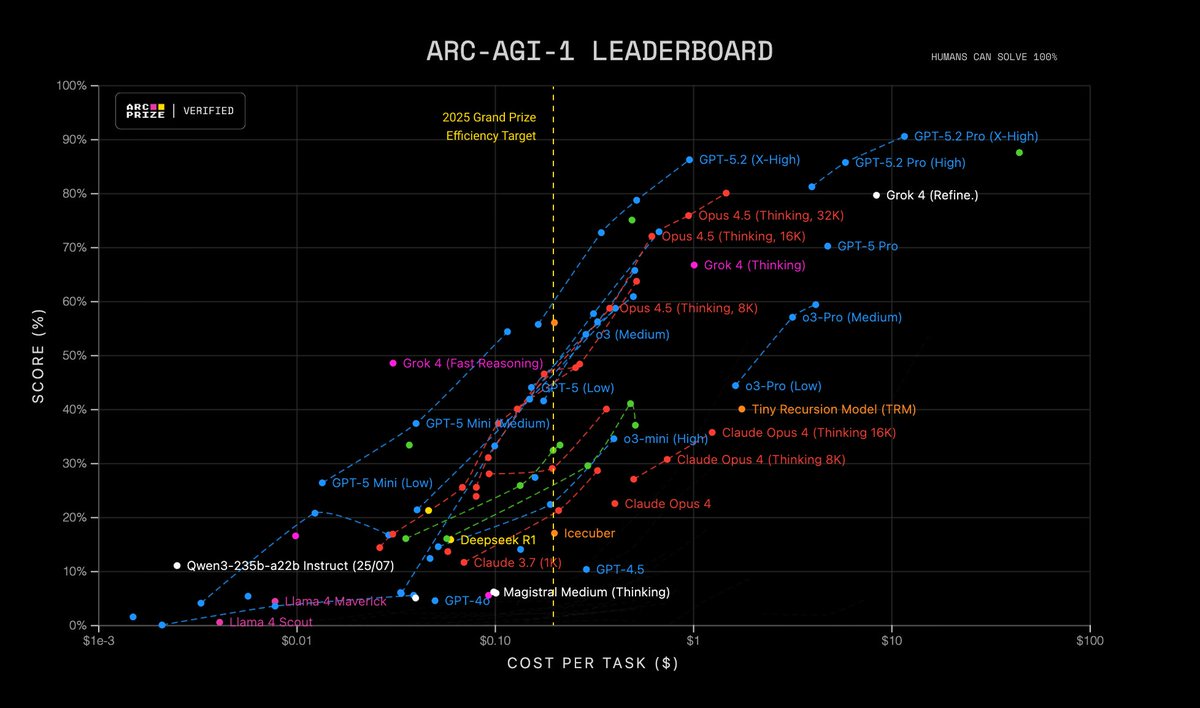
A year ago, we verified a preview of an unreleased version of @OpenAI o3 (High) that scored 88% on ARC-AGI-1 at est. $4.5k/task
Today, we’ve verified a new GPT-5.2 Pro (X-High) SOTA score of 90.5% at $11.64/task
This represents a ~390X efficiency improvement in one year
@mikeknoop Interesting.
Somehow reasoning capabilities could be said to develop overfitting on the fly on the new data they are tested on..
Given their no prior training, they’re good at (over) fitting a new set of data..
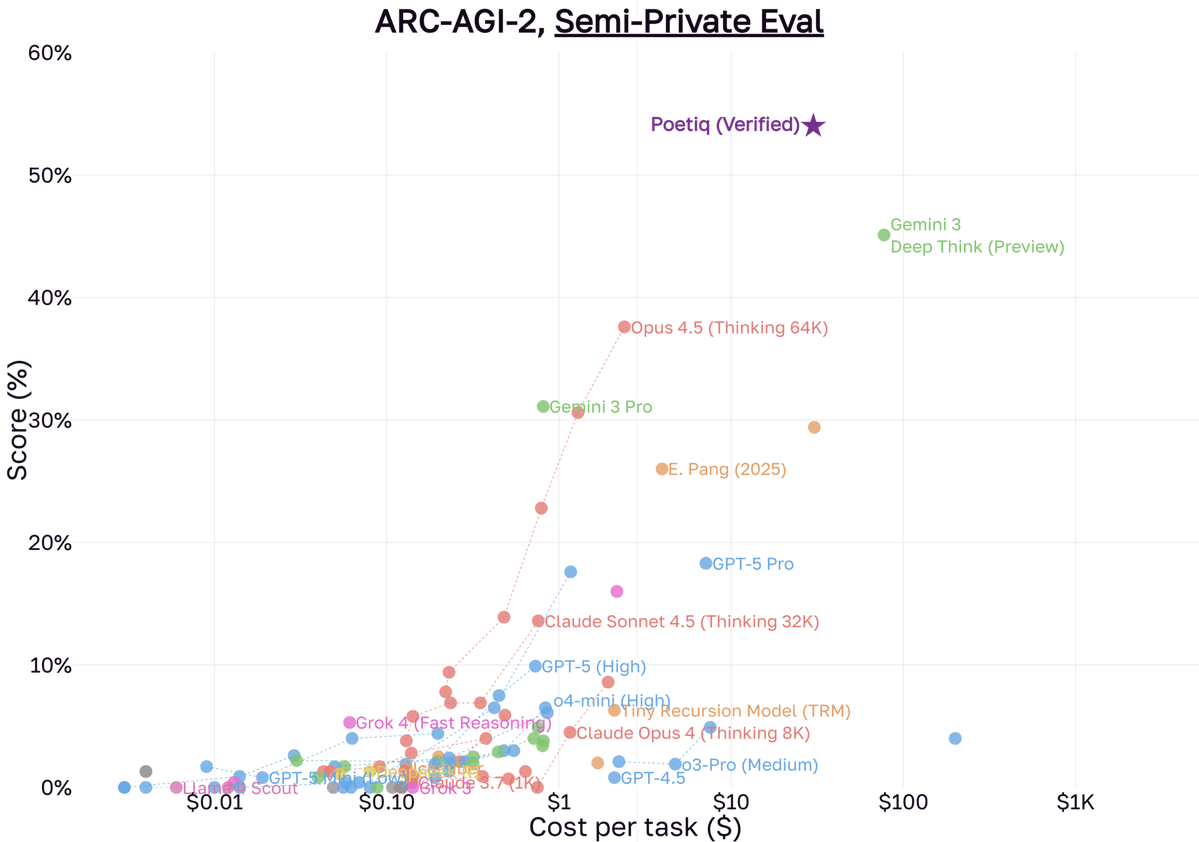
Poetiq has officially shattered the ARC-AGI-2 SOTA 🚀
@arcprize has officially verified our results:
- 54% Accuracy – first to break the 50% barrier!
- $30.57 / problem – less than half the cost of the previous best!
We are now #1 on the leaderboard for ARC-AGI-2!