O GPS fez a gente terceirizar o caminho.
AI está começando a fazer a mesma coisa com o pensamento.
Durante boa parte da história, o trabalho também exercitava o corpo. Quando o trabalho ficou menos físico e mais intelectual, exercício virou uma atividade separada.
A academia é, de certa forma, um ambiente que devolve ao corpo a fricção que a rotina tirou.
Eu acho que estamos entrando num movimento parecido com o cérebro.
Hoje qualquer pequena fricção cognitiva já pode ser passada para uma AI. Uma dúvida, um documento para revisar, uma decisão para organizar.
Isso aumenta muito nossa produtividade. Eu uso todos os dias.
Mas tem um efeito colateral difícil de medir: a gente pratica menos o caminho entre não saber e formar uma opinião.
O GPS leva você ao destino. Mas, depois de um tempo, você já não sabe explicar como chegou.
AI pode fazer o mesmo com julgamento.
Aprender a usar AI vai virar básico. Preservar pensamento crítico suficiente para perceber quando ela está errada talvez seja bem mais difícil.
Se o trabalho do futuro exigir menos esforço mental, em algum momento vamos precisar criar esse esforço de propósito.
What will be the gym for thinking?activity.
The gym is, in a way, an environment that gives the body back the friction that daily life took away.
I think we're entering a similar movement with the brain.
Today, any small cognitive friction can already be handed off to AI. A question, a document to review, a decision to organize.
This greatly increases our productivity. I use it every day.
But there's a side effect that's hard to measure: we practice less the path between not knowing and forming an opinion.
GPS gets you to the destination. But after a while, you can no longer explain how you got there.
AI can do the same with judgment.
Learning how to use AI will become basic. Preserving enough critical thinking to notice when it's wrong may be much harder.
If the work of the future requires less mental effort, at some point we'll need to create that effort on purpose.
What will be the gym for thinking?
Let me guess...
You’re trying to balance the size of your ambition with what your family actually needs from you.
You have good taste, but you never want to become the guy who forgot where he came from.
Competitive. Scrappy. But still willing to shut up and learn when you don’t know something.
Your wife is the boss at home. And you know you need that.
Chronically anxious. The only thing that seems to quiet your anxiety is doing more.
You want freedom, but keep taking on so many responsibilities that freedom never actually arrives.
Confident enough to bet big. Insecure enough to never believe you’ve made it.
You need recognition. You just hate admitting how much.
You notice your parents getting older exactly when your career starts demanding more from you (This one hurts...)
You walk into any business and immediately start calculating how much revenue it probably makes per day and what should be the bottom line.
Yeah.
You’re in the right place.
The most sophisticated way to procrastinate today is to upload a document to AI and call it progress.
If you ask AI to review something before you have an opinion about it, you probably did not save yourself a review.
You created two. https://t.co/Zn01BiR9DF
I canceled my Anthropic 20x plan and moved that spend to OpenAI.
Three months ago, Claude Code was clearly ahead in my workflow. This decision would have sounded ridiculous.
The gap shrank much faster than I expected.
Voice mode changed how I delegate work. The harness became more reliable. The app UX fits how I actually work. And the token economics give me much more useful work for the money.
At some point, this stopped feeling like a model comparison. It became a non-brainer.
I still use Claude Code for some jobs. But Codex is now my default, and I canceled the 20x plan.
I don't think it's a coincidence that OpenAI killed Sora, started winding down Atlas and improved Codex this fast.
One day this will be a Stanford business case: how a company this large killed side quests, focused on a market it was losing and changed where I spend my money in three months.
I started this company while finishing my urology residency in Brazil.
We started with a service. Software came later.
I wrote down the main decisions I would carry into my next company: https://t.co/Xapoervb9P
You should try computer use again.
There is now an entire market selling frontier labs data from real workflows: how people use software, move through interfaces and recover when something breaks.
That investment is starting to show up in the products.
I used to spend at least two hours a week formatting articles for X and Substack. Copying text, fixing headings, placing images and checking the preview. Nothing hard. Just annoying enough that I kept doing it manually.
Now I have a Codex skill that runs the browser workflow and formats the article exactly the way I want it. I still review before publishing, but those two hours are basically gone.
If you tried computer use a few months ago and gave up, try again.
It got really good at the boring stuff.
Naomi Bashkansky left OpenAI to build “telepathy”: a non-invasive headband that turns thoughts into prompts for AI.
The interesting bet isn't the BCI itself. It's that once agents get fast enough, typing becomes the bottleneck.
Sounds absurd. They're already building it.
Probably an unpopular opinion: the best people I know are walking contradictions.
The investment banker who plays piano. The religious AI researcher. The introvert who became an actor.
They refused to let one label kill their curiosity.
Those are the people I want around me.
He is selling the product, but turning adoption into a service.
Tobi Lütke’s argument with River at Shopify is that agents should work in public group chats. People increase their AI fluency by watching how others prompt, correct, and redirect them.
The problem is that most organizations are nowhere near Shopify’s level of AI maturity. They still don’t know what to delegate, what to trust, or how to consistently extract value from an agent.
This business model closes that gap. You install the agent, stay in the group chat, fix what breaks, and teach the customer how to use it in real work.
At this stage, the operator is part of the product.
Is the harness the new moat?
Chamath says this is where the action is. YC is already proving the point.
They are using the same multi-agent harness across accounting, legal, events and engineering.
Models change. The company’s context, workflows and business rules don’t.
I think this layer is way more important than it looks.
Here is my AI investing guide.
Sitting here August 2026, my current best thoughts are as follows:
1. LPS (Land Power Shell) is still the most obvious and fastest path to cash on cash returns. Lots of value can be assembled and traded quickly at this layer. And as data centers get more pushback, energized land can explode in value. Very bullish here.
I’ve stepped into this layer very aggressively. My partner @anitavlallian and I have acquired almost 6GW coming online in a ramp from today thru 2029 of grid power and behind the meter.
2. Silicon - I helped get @GroqInc off the ground in 2015 and we licensed it to @nvidia for $20B Dec2025. I won’t invest or incubate anything in this layer now. The perf demands of the chips are too high, manufacturing precision is too complex and supply chain influence to get adjacent components like memory isn’t possible for a startup anymore. Lots of capital will be wasted here chasing Groq and Cerebras’ success. Note that both startups made sense a decade ago when these constraints were much more modest.
3. Clouds - Clouds are very very lucrative but very hard to build and very expensive and technically complicated to maintain. And as alignment becomes a more important issue, I expect the clouds will be asked to build robust KYC and attest to it. This makes the risk:reward ratio skewed. I don’t want to be responsible when the USG says a cloud allowed a bad actor to do something bad because of poor KYC.
4. Models are complicated. The big open question is how much of the revenue being generated by them today is because of tokenmaxxing and poor model behavior. If it’s a lot, then the annualized revenues will diminish meaningfully even as token consumption inflects upwards. This is the big economic question at this layer.
5. Harnesses are where the action is and why I started @8090solutions two years ago. In a nutshell, the harness helps enterprises owns their proprietary context (what Alex Karp calls their ‘alpha’). This is an enterprise’s data, workflows, evals, and business rules. A harness that gives this to an enterprise is what creates very low model-agnostic switching costs, which further reinforces my views of #4 above.
6. Applications will be another long term winner along with harnesses. This is where the differentiation between “off the shelf” and “custom time and materials” melts away. Every company, with the right harness, can now imbue their alpha into the software that runs their company. I expect this to mean that “off the shelf” is largely replaced with custom software creating a huge opportunity to write these solutions for companies. Build once and sell repeatedly is a laggard GTM motion for a SaaS world that isn’t needed here. Think custom by design, alpha embedded, proprietary by nature.
Fin.
Good luck to all the players!
The best thing I read at Stanford this year had nothing to do with management or AI.
It was Arthur Brooks basically telling ambitious people that we are doing satisfaction backwards.
His formula is brutally simple:
Satisfaction = what you have / what you want
We spend our entire lives increasing the numerator. Better job. More money. More status.
The f*cking denominator grows with it.
So the math never closes.
This year I watched some of the unhappiest people I know fly private and play golf on a Tuesday. I also know extremely productive people whose productivity is, honestly, an anxiety disorder that only calms down when they make progress.
We call that drive btw.
Brooks asks people to build an anti-bucket list. Look at your goals and remove the wants that are mostly about status, validation and being seen.
I don't know if I can do that. But the gap between what I say I value and what I actually chase is uncomfortable.
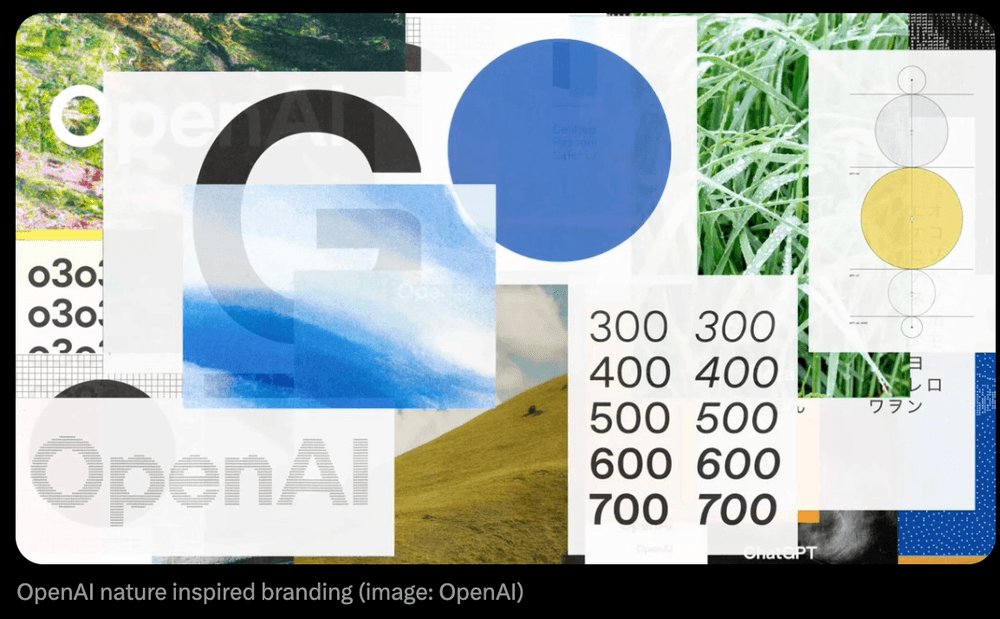
Soft colors. A bit of moss. Every AI company suddenly looks like a wellness retreat.
We’ve now gone through three phases of AI slop.
Phase 1 was purple gradients.
Phase 2 was serif fonts.
Phase 3 is nature photography.
There’s nothing wrong with any of these choices.
But when good taste becomes a template, it becomes slop too.