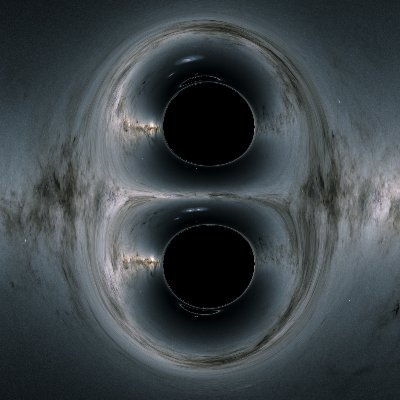
v0.3.5 is out! https://t.co/MIn40h7LYC This release brings up to 2x performance improvements, improves automatic detection of spherically symmetric metrics, and fixes the binary black hole metrics. Many of even the most complex metrics now run at around 30fps
@touzlamalice It looks awesome though, sorry not trying to downplay the work here because I know the suffering of building this from scratch, there's vanishingly little information on how to create these sims
@touzlamalice tend to eat more memory bandwidth, vs just modifying the bssn equations themselves to have constraint damping built-in. Because then you don't have 4 extra fields to load/write (which is also more important in GPU-land because of VGPR usage)
@getjonwithit + hydro schemes are traditionally order 2-3ish which seems on the low end. Allegedly you can build pretty high order weno schemes, but might have undesirable properties. Be super interesting to see
@getjonwithit Is there a link to equations anywhere? Would be interested to test this. Mixed thoughts on hydro-spacetime-techniques, drop in order is a tad unappealing vs kreiss-oliger, + flux limiting seems like it might have problems with constraints as well
@getjonwithit Formal constraint error proof seems to be v complicated here so I've only ever really seen people do it analytically on flat backgrounds or specific cases, formal theory provers might be able to give it a crack but BBH collisions are a tricky class of pdes
@getjonwithit Useful formally provable Qs are: How many grid cells needed to represent horizon such that constraints are unable to leak across it due to discretisation errors. Related: Does integrator/modifications preserve causality of constraint errors + what is constraint error prop speed
The slight sketchiness is that the black holes should be inspiralling a little earlier than they are, and have one orbit of nearly constant radius, possibly my initial conditions. Its a huge step up though, especially for how low res this is (213^3)
Huh well! Ignoring the giant explosion at the end, this inspiral is only slightly sketchy which is a big improvement. This https://t.co/niSdHkyhok paper is pretty wizard
There are two very cool things going on here:
1. The damping is proportional to one of the fields, instead of constant. There's less damping near the black holes
2. These kinds of black holes are famously unstable at the beginning of the sim, and that paper improves that a lot
@__int32 The nan's are as a result of the singularity escaping from the event horizon of the black hole after, which is a slight problem. There's sadly no point trying to directly fix that, you have to cure the initial field failure
@__int32 Interestingly the sim actually breaks at the 8 second mark, the video quality isn't amazing but you can see the appearance of two extra blobs which merge with the black holes. It seems to be some kind of shock in the field due to a spurious oscillation
Technically a working binary black hole collision, for the next article. I forgot just how impossible it was to debug anything just by staring at the underlying fields, when reimplementing this from scratch
@physbuzz2 Thank you so much, this is extremely kind! Its not actually *that* complicated to implement, but the information that exists on how to do it is sort of scattered to the winds a bit