I have PSSD from Zoloft. I am a student from Czechia. I feel emotionally lobotomized, and chemically castrated. My cognitive symptoms have been improving.
The point that people were locked into the asylums and not in the Workhouse is important. The asylum was nicer, but you were essentially a prisoner. I expect you have seen this https://t.co/SXvMmvfAtg
It's literal hell. Flames would be more merciful.
At least people have the same circumstances and conditions in hell.
Like this, I could earn one million, go to fancy restaurants, live in a hotel, be in a close relationship with someone amazing... It would all be completely meaningless.
I feel like an empty eggshell.
Petition:We want the Government to hold a public inquiry into whether the current balance of risks and benefits of SSRI and SNRI antidepressants is acceptable, particularly in relation to long term use and under recognised side effects.
https://t.co/juOYORrNCG
@newstart_2024 Some of us have been suffering from PSSD for several months, but there are lots of people who have been suffering for years or even decades. We should have come up with a cure by now, but there is still no help.
"For decades, people have been told that depression is a biological disorder and that antidepressants 'work”' and 'save lives', as if these are indisputable facts. They are not. They are part of a myth – one that conveniently supports the interests of the multibillion-dollar pharmaceutical industry.
Since I first became a psychiatrist in the early 1990s, there has been a more than fourfold increase in antidepressant use. Currently, 96 million prescriptions are issued each year. In July, new figures showed the number of people taking antidepressants has risen from 8.9 million last year to 9.1 million users. That’s about 19 per cent of the adult population.
I don’t just think antidepressants are overprescribed, I’m not convinced they’re useful at all. Antidepressants don’t rectify a chemical imbalance or any other biological process, as people were led to believe; they numb emotions. The question is, is this useful, and how harmful are they?
When I was working as a junior doctor, seeing people with depression, I didn’t understand why people thought antidepressants were effective. Sometimes people got better when they started antidepressants, of course, but usually, other things in their lives had changed – they got a new job or patched up a broken relationship – which explained their improvement just as convincingly. I remember mentioning this to my senior registrar. His reply came as a shock. 'Yes, of course,' he said. 'Antidepressants are just active placebos.' It was a light bulb moment for me."
#MentalHealth #antidepressants
https://t.co/QQAXqa5mvj
It's literal hell. Flames would be more merciful.
At least people have the same circumstances and conditions in hell.
Like this, I could earn one million, go to fancy restaurants, live in a hotel, be in a close relationship with someone amazing... It would all be completely meaningless.
I feel like an empty eggshell.
PSSD is a neurological condition caused by SSRIs. It can leave people with permanently numb genitals, chemical asexuality, the inability to feel love, connection, or pleasure, and severe cognitive impairment. Lives are permanently upended. Why are people still not being warned?
#pssd @Realalexclark
ANTIDEPRESSANT WITHDRAWAL INJURY is a serious neurological brain injury that happens even when you stop an SSRI following “standard” doctor tapering advice.
After long-term use, the brain & nervous system adapt and change but the rushed 2-4 week one-size-fits-all tapers doctors still use are dangerously fast and actively causing brain injuries on a massive scale.
Right now, thousands of people are being harmed simply by doing exactly what their doctors tell them and end up with long-term neurological damage and years of disability.
The system gaslights victims, denies the harm, and hides the truth.
This rivals the opioid crisis.
If you've been affected, you're not alone. Share your story. #antidepressantwithdrawal #pssd
"Is it fair and honest to describe PSSD as permanent?"
Persistent harm must be understood in practical, patient-centered terms
Objection: "There is no proof that PSSD is biologically irreversible. Isn't describing it as permanent scientifically inaccurate?"
My response:
I am using permanent in a practical, patient-centered sense. There are currently no established treatments. We do not know how long it might take for treatments to start to emerge.
I am not claiming that researchers have established that every underlying biological abnormality is impossible to reverse.
But a condition that oftentimes naturally persists indefinitely, doesn't have clear biomarkers, and for which there are no treatments deserves to be taken seriously.
To put it concisely:
-A condition that persists for decades may be functionally permanent.
There is currently no established intervention that reliably reverses PSSD.
Reliable long-term recovery rates remain unknown.
Some people may live with the condition for the remainder of their lives.-
If someone develops PSSD at 40 and experiences it until death, the condition was permanent in their lived experience.
The theoretical possibility that scientists might eventually discover a treatment does not restore the years they have already lost.
Patients should not have to demonstrate molecular irreversibility before decades of treatment-associated disability are recognized as potentially lifelong harm.
The Chemical Imbalance theory and why it still a matters
I’m seeing a lot of posts on here claiming that it doesn’t matter that the low serotonin/chemical imbalance theory turned out not to be true so long as the drugs work.
Here’s my take on why it does matter:
1. Most people still think it's true
IMO the theory still matters because most of the public still believe it. It is still the dominant model for understanding the causes of mental illness for most people. With all the talk of medical misinformation why has no one attempted to correct public misperceptions?
2. Erosion of Trust
By promoting a false narrative and then failing to correct it, psychiatry and pharmaceutical companies have undermined public trust in mental health care. People might quite reasonably question what other psychiatric claims are similarly exaggerated or unsubstantiated.
3. Medicalization
Millions of people were told (falsely) that they had a chronic condition which needed correcting through pharmacological intervention. This convinced people to prioritise drugs over other interventions (how can therapy resolve a chemical imbalance in my brain?) and to use them long term possibly even for life (like 'insulin for diabetes').
3. Pathologizing the individual
By blaming a person’s ‘broken brain’ the theory blinded people to the situational and environmental causes of their struggles undermining their personal agency.
4. Violation of Informed Consent
Patients agreeing to take SSRIs under the false impression they were correcting a chemical imbalance is a violation of informed consent.
5. Financial incentives
Why was the 'low serotonin' theory of depression widely promoted to the public right at the same time that a lucrative new generation of drugs were being launched?
Surely we can see that to so casually brush all of this under the carpet as ‘no big deal’ without any attempt to correct the public’s perceptions is problematic to say the least.
One tragic pattern I see repeated in prescribed harm cases is this:
A child grows up in a neglectful or dysfunctional family. They develop depression or anxiety and are put on medication. The medication causes harm rather than relief.
Now more vulnerable than before, the child becomes increasingly dependent. The family responds by doubling down on neglect and invalidation, framing them as the problem. The clinician, rather than questioning this dynamic, often reinforces it.
The result is a second abandonment, the child is left harmed by treatment, trapped in the same environment that contributed to their distress, and with even fewer means of escape.
Robert F Kennedy Jr on the dangers of SSRIs:
"I’ve watched people come off SSRIs....I watched a family member get off them after a couple of years, and she was suicidal literally every day. She woke up every morning and said, ��I don’t want to live.’ She said, ‘The only reason I’m staying alive is for you guys, for the family.’
That’s heartbreaking to hear from a family member. And I’ve heard that from hundreds and hundreds of people, the same story again and again. It can be prolonged, and for many patients it’s completely unexpected.
Physicians often handle this by saying, ‘This is your original symptoms reasserting themselves, get back on the SSRIs,’ and they get locked into a lifetime cycle that, for many patients, is cataclysmic. It’s a system failure."
RFJ Jr at the MAHA Institute at the Mental Health & Overmedicalization Summit May 4, 2026
@MikhailaFuller @_innercompass @MAHA_Institute
Antidepressant withdrawal and online support
We keep getting told that psychiatrists have never seen antidepressant withdrawal or that it is at best minimal.
Online tells a different story. There are currently over 100,000 people in Facebook support groups desperately trying to help one another get off these drugs. Similarly, the peer support site Surviving Antidepressants has over 200,000 visits per month.
Why are so many people turning to online support?
It's because the practitioners they trusted with their health aren't up to the task.
Yet we are supposed to believe that AD withdrawal is not a problem?
The denials just aren't credible. When is the profession going to take responsibility for the crisis it has created?
#SSRIs #morethan2weeks #prescribedharm
Interesting article in the New York Times today:
"The more fixated we are on mental health, the more sensitive we become to anything that might qualify as a symptom and the more we use clinical language to describe normal emotional experiences like grief, burnout and loneliness. This broadening of what we think counts as a disorder — known as concept creep — encourages us to pathologize ordinary life and see ourselves as mentally unhealthy."
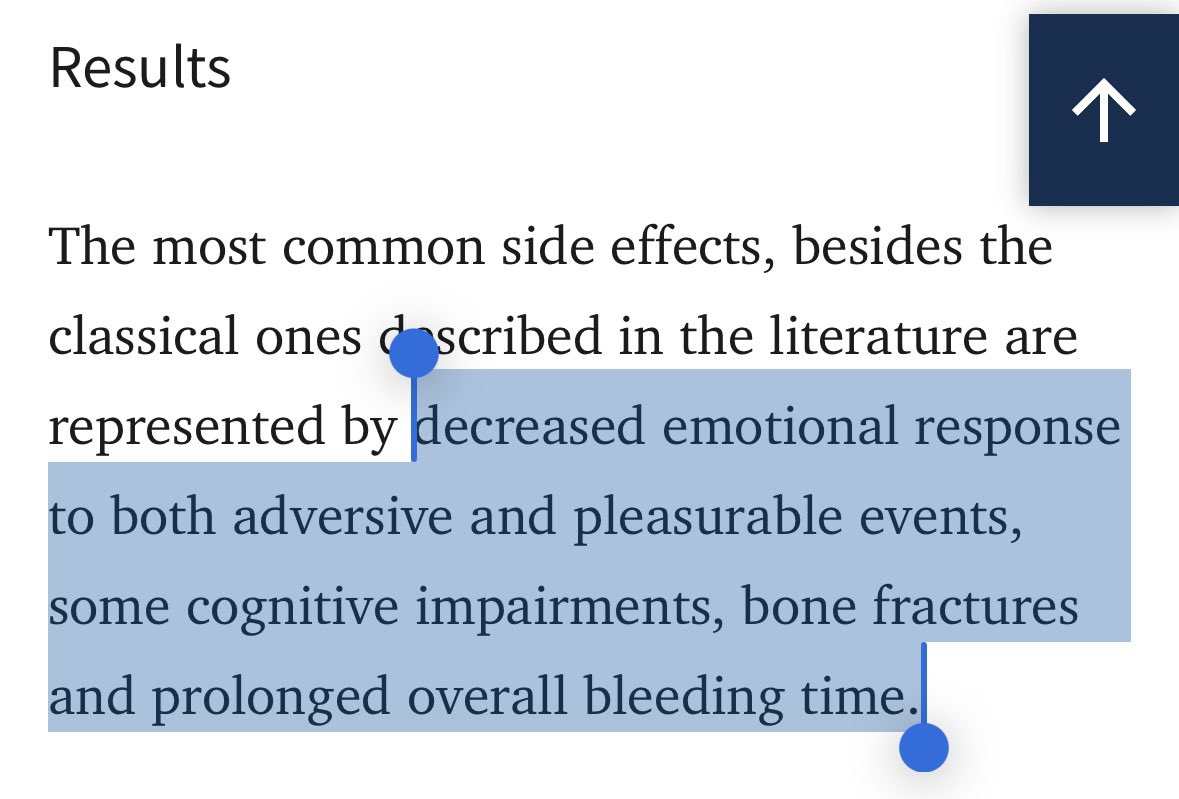
long term ssri therapy(3+ years) is linked to emotional blunting, and theres evidence for it having cognitive impairments, bone density issues, and apparently bleeding?
if these meds help you, take them, but please do not think that theyre a cure.
you dont use a crutch forever