Elon Musk is a big believer in Inversion Thinking.
Not just Musk — Albert Einstein, Charlie Munger, and Marcus Aurelius too.
Here's what it is, how to use it, and become better at it:
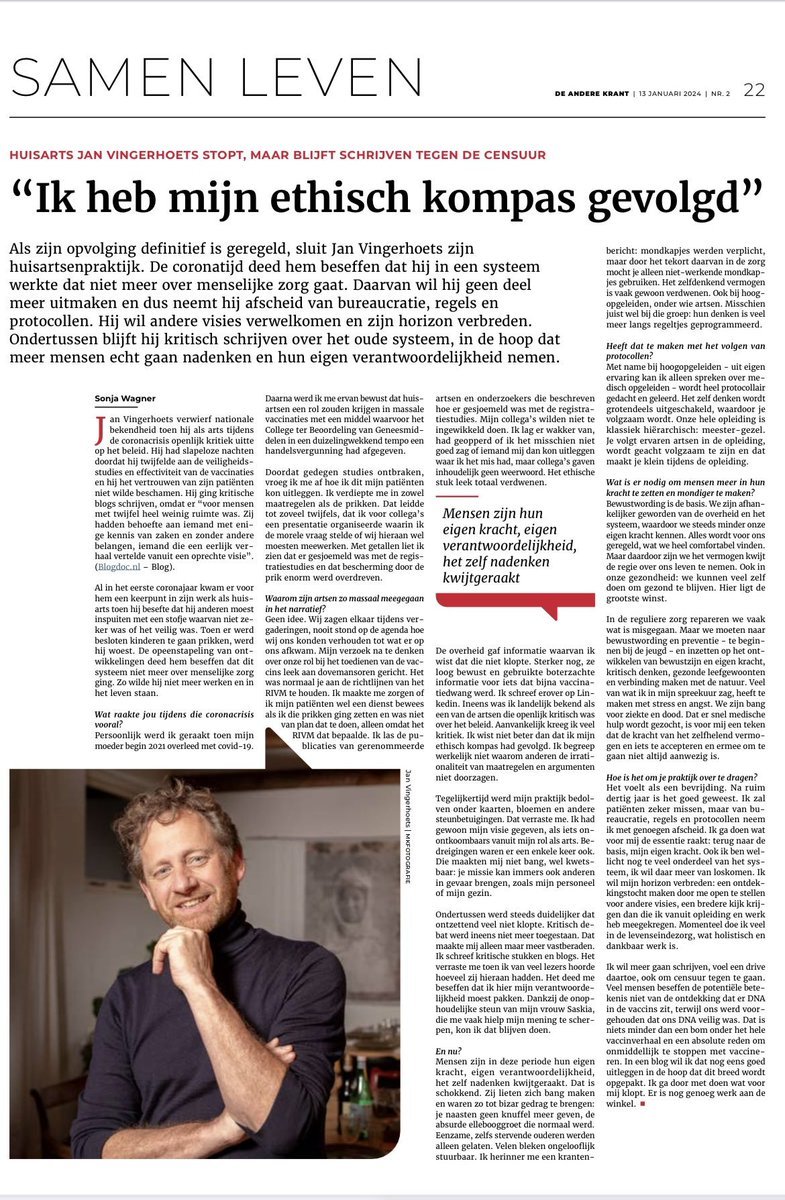
Huisarts Jan Vingerhoets is per 1 mei j.l. gestopt met zijn praktijk. De coronatijd deed hem beseffen dat hij in een systeem werkte dat niet meer over menselijke zorg gaat.
Elon Musk fired 80% of Twitter (6500 people) and everyone thought that Twitter was doomed.
He was right. Everyone was wrong.
It’s the management masterclass of the decade and every entrepreneur must understand why it worked 🧵:
The so-called "cloud architectures" are not an architecture at all. They are a deployment strategy that removes choices, adds complexity, and locks you into a specific vendor. They often damage (or preclude you from having) an actual architecture. Literally everything you do in the cloud, you could do with multiple threads in a monolith (something I often do before breaking up the monolith into distinct services because it makes building and testing easier). So, the architecture can be deployed on the cloud or in a monolith.
This is Tim Ferriss.
He taught me how to be unf*ckwithable.
His podcast has 1B downloads & he hates fame.
Here are 11 of his insights that made me unf*ckwithable (and will do the same for you):
8 years ago, Jensen Huang hand delivered to OpenAI, the first AI-focussed GPU made by Nvidia.
This moment marks the end of Intel's dominance.
It wasn't luck, it was deeper.
Jensen has said publicly that Nvidia 'did it' by religiously following 4 core values 👇🏻
This is Raoul Pal.
The most in-demand guest for podcasts about money.
He teaches people how to think about money.
I spent thousands of $$$ to learn from him.
Here are 15 of his strategies that transformed my life (and will do the same for you):
Things I’ve Learned
What I wish I knew at 18…
1. College is mostly a scam
I’m glad I went to college, because I wanted to work on Wall Street. But today, I wouldn’t waste $300,000 on it, and I wouldn’t want to work in banking. Instead, I’d load up on college credits during high school, go to a school like the University of Texas to have fun, graduate in 3 years debt-free, and travel around the world for a year.
I apologize but won't be amplifying startups whose mission is to fully replace software engineers with "AI devs."
It's clear why VCs & investors love this idea; and why founders as well. Imagine how much money they could make if they succeed!
I hate the idea of that future.
Harsh leadership truth:
Paying a sh*tty salary is the most expensive mistake you can make.
21 other harsh leadership truths that took me 10 years to learn:
An idea I can't stop thinking about:
Your team is secretly delegating work to you.
And your servant leadership encourages it.
Here's how to spot the monkey before you take it.
40 years ago, Harvard Business Review published its most reprinted article, "Management Time: Who's Got the Monkey?"
The premise is simple.
And most leaders fall victim to it daily.
An employee comes to us, "We've got a problem."
The manager, either out of empathy or simply being too busy to focus (or increasingly due to the asynchronous nature of our communication), says something like, "Let me think about it" or "I can't focus on that right now, let me get back to you."
And with that interaction, the employee took the monkey on their back and placed it on yours.
The manager's office is soon overrun with monkeys while the employees sit idle. Patiently at first. Then, they start asking the manager for progress reports. "I just wanted to check in and see how you're doing."
Frustration grows for everyone because the entire setup is inverted.
Peter Drucker said, "In most organizations, the bottleneck is at the top of the bottle."
This is why.
But there's a foolproof remedy to this problem. A question that always keeps the monkey where it belongs.
"What do you recommend?"
- It reminds them they own the problem.
- That they're responsible for solving it.
- That they're empowered to take action.
And that they're leaving with the monkey.
The best part?
- This is how people grow.
- This is how they learn to take smart risks.
- This is how you have more time for strategic work.
If you found yourself nodding along...
Go give back your monkeys.