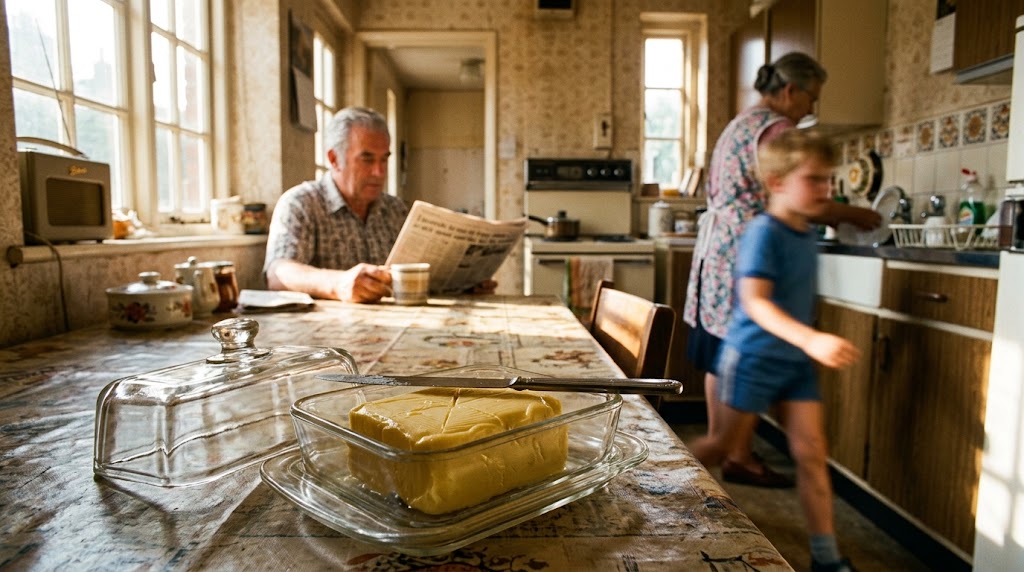
Butter did not live in the fridge in this country until the mid eighties.
It lived on the table. Under a little lid, or a bell of frosted glass, and it stayed put from breakfast to supper. It got a top-up, never a wash and a fresh pack. When it ran low, more went in. It was there the way the salt was there and the teapot was there, and nobody in that house gave it a second thought.
And it was soft. You pulled it straight across warm toast without tearing a hole in the middle, without the wait, without the cold shrapnel that comes off a fridge-hard block.
It sat out through a July afternoon and nothing happened. It sat out through Christmas week beside the cake and nothing happened. Your grandmother kept butter on the side for fifty years and buried nobody.
Butter is around eighty per cent fat, and the water in it is locked in droplets inside that fat with the salt dissolved in them. Bacteria need free water and there is almost none to be had. The fat is the thing keeping it safe.
The fat. The exact property they spent forty years telling your mother would kill her is the property that lets butter sit on a table all summer and behave itself.
She knew none of that and she was right anyway.
Then the government's committee on nutrition reported in 1984, the country was told to cut the fat out, and inside about three years the dish was in a cupboard and there was a tub in the fridge door with a sunflower on the lid.
Butter out of a fridge cannot be spread. It tears the bread and sits on the knife in a lump. The tub beat butter on exactly one thing, which was that it came out already soft, and it only had that advantage because the competition had just been sent somewhere cold on doctor's orders.
Clover launched in September 1983, made by Dairy Crest, which was the processing arm of the Milk Marketing Board. The dairy industry's own company sold Britain the tub.
Then it sold the fix. Spreadable butter is butter with rapeseed oil blended through it so it comes out of the fridge soft, and the market leader runs at sixty four per cent butter to twenty three per cent oil. It costs more than the block it is diluting.
There is a generation now that flinches at a fat left out at room temperature, and the same people will eat mayonnaise out of a jar that has been sat on a warehouse shelf since March.
Leave a dish of it out tomorrow. Watch it sit there all day doing absolutely nothing, then spread it without a fight.
Your fridge is full of things that would have you on the floor by Thursday. The butter was never one of them.
A man spends 50 years teaching at MIT. He knows his time is running out. So he records one last lecture — everything he knows, distilled into a single hour. He died 5 months later. This is that lecture. The most important hour you'll watch this week. Bookmark it for later!
Follow @Abhayaitech for more such content
I would really love to see middle and
high schools bring back sewing classes.
I really enjoyed learning to sew as a youngster.
Here are some great sewing tips that
you might want to bookmark and
practice at home. I’m definitely going
to review these stitches myself 🧵
In 2008, Malcolm Gladwell explained why some people succeed and some don't in a single 1-hour talk.
This will permanently change the way you think about talent, effort, and success.
Bookmark & watch today, no matter what.
On a freezing December morning in 1957, President Dwight D. Eisenhower was reviewing budget proposals when his secretary nervously informed him that a 73-year-old woman named Mrs. Eleanor Mitchell from Abilene, Kansas—his childhood Sunday school teacher—was in the White House lobby asking to see him without an appointment, and instead of having staff politely redirect her, Eisenhower literally ran down the hallway, swept this elderly woman into a huge bear hug, and cleared his entire afternoon to have tea with her in the residence.
What makes this moment so breathtakingly beautiful is that Mrs. Mitchell had taught a scrappy young Dwight Eisenhower Bible verses every Sunday from 1907 to 1911 in a tiny church basement, making him memorize Proverbs and Psalms when he'd rather be playing baseball, and she'd written him letters throughout his military career—through both world conflicts, through his rise to Supreme Commander, through his election—always addressing him simply as 'Dwight' and reminding him that 'character matters more than rank.' Eisenhower told his staff that Mrs. Mitchell once made him apologize to the entire Sunday school class for being prideful after he'd bragged about winning a spelling bee, teaching him a humility lesson that shaped his entire leadership philosophy, and he'd never forgotten how she'd pulled him aside afterward and said, 'Dwight, you're going to do important things someday, but never let success make you forget where you came from or who helped you along the way.'
During their White House tea, Eisenhower introduced Mrs. Mitchell to every cabinet member who passed by, saying with genuine reverence, 'This woman taught me everything that matters—respect this lady,' and she gently scolded him for not attending church regularly enough, which made the most powerful man in the world laugh and promise to do better.
When Mrs. Mitchell left that evening, Eisenhower walked her personally to her taxi, kissed her cheek, and pressed an envelope into her hand containing a check for her church and a note:
‘For the place that built my foundation—thank you for seeing potential in a troublemaker farm boy. Your student always, Dwight.'
What absolutely destroys you is understanding that Eisenhower commanded armies and led nations, but he never forgot the Sunday school teacher who taught him that true strength was moral courage, proving that the greatest leaders never outgrow gratitude and that honoring the people who shaped you when nobody knew your name is the most presidential thing you can do.
Finish something. Anything. Stop researching, planning, and preparing to do the work and just do the work. It doesn’t matter how good or how bad it is. You don’t need to set the world on fire with your first try. You just need to prove to yourself that you have what it takes to produce something.
There are no artists, athletes, entrepreneurs, or scientists who became great by half-finishing their work. Stop debating what you should make and just make something.
This video is a 40-min masterclass by David Lynch on creativity, intuition & ideas.
He reveals:
- How intuition beats intellect
- Why the idea dictates everything
- Why chasing careers mean nothing
12 lessons from Lynch that will change how you think about creativity forever:
It reads naturally. It all fits together well, with details illuminating each other, no dishonest fudging, nothing made up, no detail left out. That fact is itself an interesting argument.
Read (free) and share: https://t.co/OQ13Cir15e
This 4 hour masterclass of Warren Buffett and Charlie Munger will teach you more about investing than a $200,000 MBA from any business school on the planet.
Bookmark this & give it 4 hours this weekend, no matter what. It's the most productive thing you can give your weekend.
In 1977, Viktor Frankl revealed how some people survive unimaginable suffering & others don’t.
It’ll change how you see pain.
His ideas:
- You always have one last freedom
- Despair = suffering without meaning
- Why purpose keeps people alive
15 lessons on meaning & suffering:
Jack Dorsey: “When we started Square, we thought we were just building a piece of hardware”
In his blog post Product First, David Sacks explains that the founding of Square—described by Jack Dorsey in the clip below—resembled his own experience at PayPal.
Most people think startups begin with brilliant insight and the founders have it all figured out from the beginning. But startups are messier than that. As David explains in the blog post:
“Founders usually start with a product idea. They know users will like it but may be a bit hazy on the exact market, buyer, or business model. Those details get filled in over time. By launching the product first and learning from its adoption, founders discover the market insight, then build the organization they need to operationalize it.”
This is exactly what happened at Square. As Jack explains:
“When we started, we thought we were just building a piece of hardware to enable people to plug into their phone and swipe a credit card. And then as we talked with people and dug in some more, we found a consistent theme: many of them weren’t even allowed to process credit cards.”
David noticed that both Square and PayPal followed three steps:
1. Create the product hook: “the starting point was to conceive of a simple product that would create tangible value.” For PayPal, this was the ability to ‘email money.’
2. Discover the market insight: “the market is discovered as a result of seeing who uses the product and why.” PayPal stumbled upon eBay sellers who were unable or unwilling to go through the lengthy underwriting process to accept payments.
3. Operationalize the insight: “Once [Square] discovered the theme of access, it had the ‘north star’ to continually expand its offerings”
As David summarizes:
“The company starts with a product hook to grab users and a distribution trick to find them, pays attention to the organic use of the product to discover the market insight, then leans into that insight to build the company.”
Video source: @lexfridman (2020)
This 1 hour lecture from the "Father of Modern Marketing" will teach you more about consumer psychology than 2 years working at a Fortune 500.
Bookmark this & give it 1 hour today, no matter what. It’s the most productive start you can give your week.
This 1 hour talk from a 28-year-old Steve Jobs in 1983 predicted the next 50 years of technology.
Bookmark this & watch it today. It’ll be the most valuable hour you spend this week.
I’m not asking you, I’m telling you.
Take a moment and listen to this 81 second response from Victor Glover after being asked if he had any thoughts leading up to Easter.
I don’t quite think it can be overstated how perfect this crew is for the job.