THIS DOCUMENT FROM ANTHROPIC WILL LITERALLY GET YOU PROMOTED
> the fastest way to reach a senior position is to automate your current job
this technical paper shows how to encode your daily workflows into Claude
build custom "Skills" to force the AI to do the heavy lifting:
> package your routines into automated folders
> the agent executes your tasks flawlessly in the background
> it connects directly to your local tools via MCP servers
hand off the junior work to the agent and easily claim your promotion
grab the exact blueprint right here 👇
KARPATHY JUST KILLED THE PROMPT ERA WITH A SINGLE DOCUMENT
prompts are easy. loops are hard. and writing fifty prompts a day is the work nobody does twice.
he shifts the burden to the harness.
you define the contract once. the model writes, reviews, restarts, and reconciles. you keep judgment. it keeps the loop.
the throughline is the same in every rule: the human owns the spec and the boundary. the model owns the execution and the bookkeeping.
planner never touches code. generator never grades itself. state lives on disk, not in context.
9 rules. start with one feature, not ten. most people are still typing prompts. this turns Claude into an agent that finishes the job on its own.
here is the official document from Karpathy explaining the architecture
Karpathy just wrote the manual for Claude + Obsidian as a real second brain.
Most vaults die the same way. A year of saved articles and highlights. None of it linked. The graph rots while it still looks impressive.
So he moved the upkeep to the model. You curate sources and ask questions. Claude files, links, and reconciles. You keep judgment. It keeps the books.
raw belongs to you and never gets edited. wiki belongs to Claude. It isn't RAG. Your sources compile once into linked pages and compound from there.
9 rules. Start with 10 sources, not 10,000.
Most people hoard notes. This turns them into a brain that maintains itself.
Anthropic posted the best prompting lecture I've ever seen... and deleted it two days later.
I watched the recording last night and kept pausing it. Each time I opened Claude to test what they showed.
Two Anthropic engineers showed in 24 minutes how the Claude team actually uses it.
Not tips. Not hacks. The way they actually talk to Claude. Every day. For real work.
After 3 minutes you'll want to rewrite every prompt you've ever sent.
A senior Google engineer just dropped a 19-page PDF on "Loop Engineering" for LLM and agentic systems.
Act → Observe → Learn → Repeat
• Act: the LLM proposes a code transformation (tile this loop, parallelize that one).
• Observe: a compiler runs it and reports back - is it valid? faster? slower? by how much?
• Learn: the LLM reads that feedback and adjusts its next move.
• Repeat until it stops finding improvements.
The agent gets smarter purely from grounded feedback inside its own context window.
This 19-page PDF totally changed the way I’m building agentic systems today.
Read it now, then explore the article below.
Met a guy making $1.6 million a year.
Three days ago he was at a Meta conference. Told me he saw the best AI talk of his life.
Boris Cherny was on stage. Showed how the Anthropic team actually uses Claude day to day.
Boris deleted his IDE eight months ago. Now he codes from his phone.
I watched it last night. Had to pause it twice.
Not because it was hard. Because I realized I've been using Claude like a toy.
He sent me the recording. It was never published.
Posting it below.
Google Brain founder, Andrew Ng:
"100% of my tasks are done by ai agents, self-improving loops are next.
Give it 3-6 months and prompting is gone."
31 minutes of clear explanation on building self-improving agents from scratch.
Worth more than any $500 agentic course.
Watch it, then read the full guide on loops below.
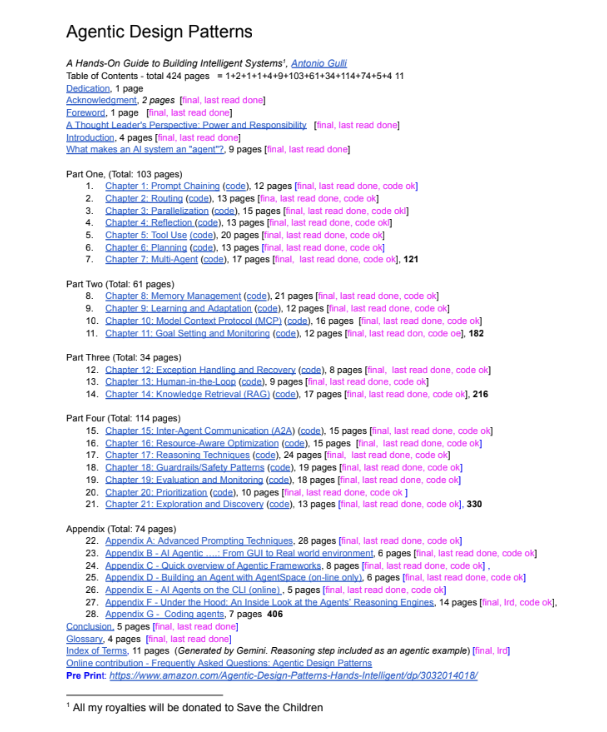
A senior Google engineer dropped a 424-page doc on agentic design patterns.
424 pages.
Most engineers bookmarked it and never opened it again.
I read the whole thing.
Here are the 15 patterns that actually matter — explained in plain English, with exactly when to use each one ↓
Andrej Karpathy spent 70 minutes breaking down how top AI users actually work with LLMs.
The reality is simpler than people expect. You tell the model what you want in plain language and let it run.
No 40-line system prompts. No secret tricks.
By 2026 the engineer who writes off LLMs loses to the junior who just set one up properly.
70 minutes. Free. A rare straight look from an OpenAI co-founder.
Bookmark it and watch.
Anthropic Product Lead:
"At Anthropic, our engineers are running swarms of 300+ agents daily.
Give your agents 100+ tools - just don’t load them all into context."
In a 30-minute talk, the Anthropic team shows how to deploy agents to production.
Claude + loops + routines + dynamic workflows - that’s the secret.
Watch the talk, then save the playbook below.
Andrej Karpathy's advice for beginners getting into AI:
"Put in 10,000 hours of work."
He's right.
But most builders waste the first 1,000 hours on the wrong things.
They write code before understanding context windows.
They build agents before understanding token limits.
They ship products before understanding what models can't do.
The builders who compound fastest aren't the ones who code the most.
They're the ones who understood the fundamentals before touching a single line.
These are the 6 AI concepts that make the first 1,000 hours count ↓
Bookmark this before you start.
If you want to become good at AI engineering
(in 3 weeks), then learn these 15 concepts:
1 AI Agents: Memory, State & Consistency
→ https://t.co/cuYBVuLImr
2 Machine Learning System Design 101
→ https://t.co/y2BSsjJAfe
3 Design Personal AI Chat Assistant
→ https://t.co/cX42Kwy8E2
4 How RAG Works
→ https://t.co/hrzGLwLMp9
5 LLM Concepts - A Deep Dive
→ https://t.co/NF9jZANl9D
6 How to Design an AI Agent
→ https://t.co/lJIBmdLkK3
7 What is Reinforcement Learning
→ https://t.co/T8Gy5TW59p
8 How Vector Databases Work
→ https://t.co/IMBsgbNbQU
9 Context Engineering 101
→ https://t.co/bhXDGZQNZ7
10 AI Coding Workflow 101
→ https://t.co/YqUXBuhmbD
11 LLM Evals Explained
→ https://t.co/tywC4QxUZz
12 How AI Agents Work
→ https://t.co/sBTUMzWcFV
13 How MCP Works
→ https://t.co/dlniQMaDZy
14 Agentic Patterns Explained
→ https://t.co/I9G02J8Mn6
15 Multi-Agent Architecture Explained
→ https://t.co/ziuK1gxG3O
What else should make this list?
===
💾 Save & restack to help others ace AI engineering.
A SENIOR GOOGLE ENGINEER DROPPED A 421-PAGE DOC THAT NO ONE IS TALKING ABOUT.
It is called Agentic Design Patterns. 100% FREE.
Every AI builder paying $200/month for courses just got obsoleted.
This is the most comprehensive AI systems guide I have seen in 2026.
Code-backed and production-ready.👇
YOUR FIRST BRAIN FORGETS EVERYTHING.
Your second brain does not have to.
Claude connected to Obsidian is the closest thing to a permanent intelligence layer built on top of everything you have ever thought, read, or built.
Your notes are not just stored. They are connected. Every idea linked to every related idea through a dynamic graph that reveals the shape of your thinking in real time.
Claude reads your vault. Surfaces connections you forgot you made. Writes alongside your thinking instead of replacing it. Populates your knowledge base from research without polluting your original ideas.
The setup takes one afternoon.
What compounds after that takes years to fully appreciate.
This is the complete guide to building it from scratch.
Follow @neil_xbt for more second brain and Claude builds.
Credit to Ray Fu on TikTok for this!
🚨 NotebookLM + Google Antigravity might be the most underrated AI combo right now.
Almost nobody is using it to its full potential—and that’s a huge missed opportunity.
Here’s how to set it up in under 2 minutes + what you can actually do with it 👇





![KirkDBorne's tweet photo. [Download 585-page PDF eBook]
Game Theory: https://t.co/DUxMDRc1Ll
—————
#GameTheory #Gamification #Mathematics #Statistics #Probability https://t.co/OuM1cwPhUw](https://pbs.twimg.com/media/HL3Bq77WwAA8krz.jpg)