The fallacy of this is that more creates more. More hours, more hiring, more something.
And it is true in a sense. If you put in more work, more work will happen. But I think for most startups, the leverage is really in how differently you approach the problem, how well you cultivate your team, and the strategy.
Any large company can outspend you on hours. They have thousands or tens of thousands more people, spending more hours. If hours worked were the metric, every large company and government organization would always win and do the best work. More hours, better output.
This thinking is often representative of younger founders, where the startup becomes their identity and life. They have a hard time doing anything else, and cannot understand that your work is not the person that is you. But activities outside of work can grow you as a person too and make you do better work.
I’ve never worked this way. As a designer, I always saw the need to take a step back, to take a break. At times, I might work 12 hours or 16 hours, or whatever amount was needed, but it wasn’t the norm. You just can't grind design, you need inspiration. But taking that step away from the work, would give me more perspective, inspiration and I could approach the problem differently or I could just see the solution.
Grinding is never good for any creative problem, and startups or creating new products are often mostly about creative problem solving. Grinding works ok for email jobs, or where you just executing on very clear playbook.
With Linear, we’ve never worked this way. We work reasonable hours, 5 days a week. All of us founders have families. Many of our employees have families. I personally stop every evening, spend time with the family, cook dinner for the family, eat dinner together, and focus on things outside of work. Sometimes I work in the late evenings or weekends, but to me the pride is that I don’t need to. Company should be succesful without it.
My goal is to build a company that is sustainable in the long term, and doesn’t require heroics or personal sacrifices every single day.
There are times when our team is heroic. Launches, incidents, some other work that just needs to be done. They will work late into the night because they know it is the right thing. But we don’t require that every day or every week, and the more this happens, the more I think it is a failure of our company and leadership. The team and the leaders should always keep a reserve to use when something is needed.
Our thinking was also that quality, which we value, doesn’t emerge from working more or stressing people more. It emerges when you create the conditions for it to emerge. Often it is the appreciation, space, time, and how the person feels. A person who is rested will do better work.
I wouldn’t attribute much of our success to working a lot. The success came from having clear thinking, ideas, and focus to do the right things.
I sometimes wish we could move the culture more toward a Zen master.
Real mastery is not exerting the most effort. It is achieving the outcome with the least necessary effort.
software engineering in 2026:
- your package manager is compromised
- your cloud provider blocks your account
- github itself is hacked
software is solved
President Obama on Iran: “We pulled it off without firing a missile. We got 97% of their enriched uranium out. There’s no dispute that it worked and we didn’t have to kill a whole bunch of people or shut down the Strait of Hormuz”
@Seanfrank@yieldprofet@TheLastFarm The US does an awful job providing for its citizens through SNAP. The avg benefit is just $6.17 a day - under the cost of one fast food value meal. 1 in 7 households regularly skip meals because they can't afford food. Yet we spend billions more on a war with Iran. Please.
@TFalaknaz I use both and I like the organization in the desktop app, although it looks like the just removed the terminal in the sidebar, which sucks. What do you like about the terminal version?
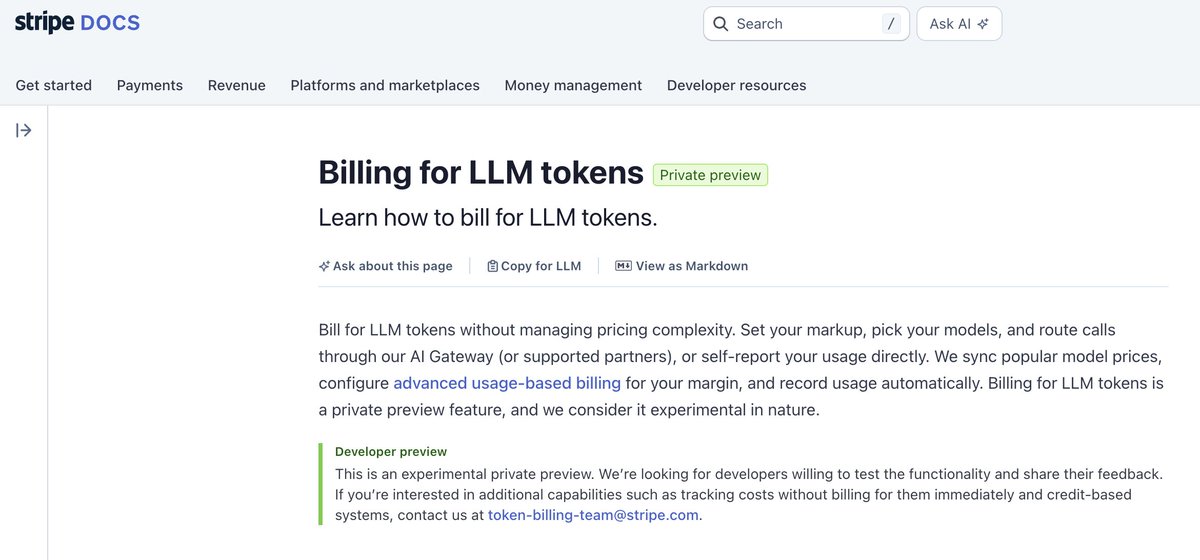
I think @stripe just mass produced a business model for every AI startup on earth and increased their TAM exponentially.
Customer buys a shirt for $40, Stripe takes 2.9% + 30 cents. It's a simple formula, but token billing is completely different.
AI costs are variable. They shift by model, by provider, by week. A startup using Claude for 40% of inference and GPT-4o for 60% has a blended cost structure that changes every time Anthropic or OpenAI adjusts pricing... which is constantly.
Stripe is now ingesting those real-time model prices, applying the startup's target markup, metering per-customer usage, and generating the invoice automatically.
That's constructing unit economics at a scale and complexity far beyond anything in traditional payments.
And the data asset being created by them is a massive moat.
OpenAI knows what OpenAI charges, and Anthropic knows what Anthropic charges. But Stripe will know what every model charges, what every startup pays, what every startup marks up, and what every end customer actually consumes.
But the gateway is where this gets really interesting.
Stripe's AI gateway routes inference, returns the response, and attributes tokens to the customer in one API call.
Today it's "pick the best model."
Tomorrow it's "Stripe recommends the model that optimizes your target margin across 12 providers in real time."
The moment that recommendation engine turns on, model providers start competing on Stripe's terms. Pricing power inverts from provider to platform.
This is AWS turned sideways (or i guess diagonally).
Amazon didn't build apps... they built the infrastructure every app depended on, then used the data to optimize the infrastructure itself.
Stripe is running the same playbook on AI economics instead of AI compute.
I truly believe that token billing will make Stripe the most strategically important company in tech that doesn't train a model.
@shawngorham I'm really so sorry to hear this is happening. Wishing your wife, you and your family, and that child's family 1000% the best. I hope you're feeling the love and the best in medical excellence.
@nealkhosla So is the answer let govt daddy do mass domestic surveillance and autonomous murder drones with your product? That sounds like a f*ckin deal with the devil right about there to me.
As someone who usually disagrees with @DarioAmodei, I gotta give him *major* props for this one.
“If you believe you have the right to force me—use your guns openly. I will not help you to disguise the nature of your action." This is what Hank Rearden, the steel magnate from Ayn Rand’s Atlas Shrugged, tells the government after disobeying its command to run his business in a manner contrary to his conscience.
Amodei channeled Rearden’s spirit in a letter refusing to remove safeguards from Claude, as requested by the War Department.
@Suhail We're already there. This is not an overly difficult thing to do. The thing stopping most of it right now are ethical guardrails baked into the widely available models. Those are not unalike a lock on your front door. They might keep the random opportunist out but not much else.
@deanwball The crazy 2nd order thing I keep thinking about past the demands Hegseth and Trump are making of
@AnthropicAI is that they are admitting they want to use AI to perform mass surveillance of Americans and make drones that can kill people without humans in the loop. That's insane.
@willdepue The crazy 2nd order thing I keep thinking about past the demands Hegseth and Trump are making of @AnthropicAI, is that they are admitting they want to use AI to perform mass surveillance of Americans and make drones that can kill people without humans in the loop. That's insane.
Zoning has been a scam. @JBPritzker just came out swinging.
The suburbs have weaponized single-family zoning, parking minimums and permit BS to keep density out
The BUILD plan JB just introduced is the first real answer:
- Multi-unit housing on most residential lots, by right
≤2,500 sq ft: 1 unit
2,500–5,000 sq ft: up to 4 units
5,000–7,500 sq ft: up to 6 units
7,500+ sq ft: up to 8 units
- ADUs legal everywhere statewide, no more local bans
- Towns that take their sweet time with permits can lose control of the process
- Parking minimums killed for middle housing
- Impact fees standardized so towns can't price-out what they don't want built
The next step is the General Assembly. Specific thresholds are still being negotiated, which means this is where it gets gutted if we're not paying attention.
The NIMBY's are going to come out strong, we need to fight back.
A very insightful interview with an $MSFT employee who works on Copilot on the SaaS disruption debate:
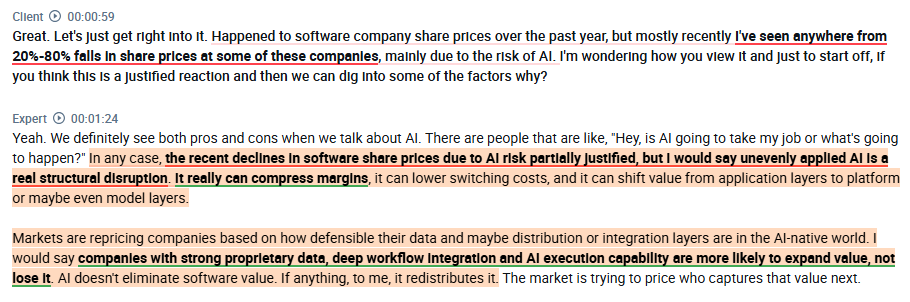
1. According to him, AI doesn't eliminate software value; it redistributes it. He thinks the recent declines in software share prices due to AI risk are partially justified, as it can compress margins, lower switching costs, and shift value from the application layer to the platform or maybe even the model layer. He thinks companies with strong proprietary data, deep workflow integration, and AI execution capability are more likely to expand value rather than lose it.
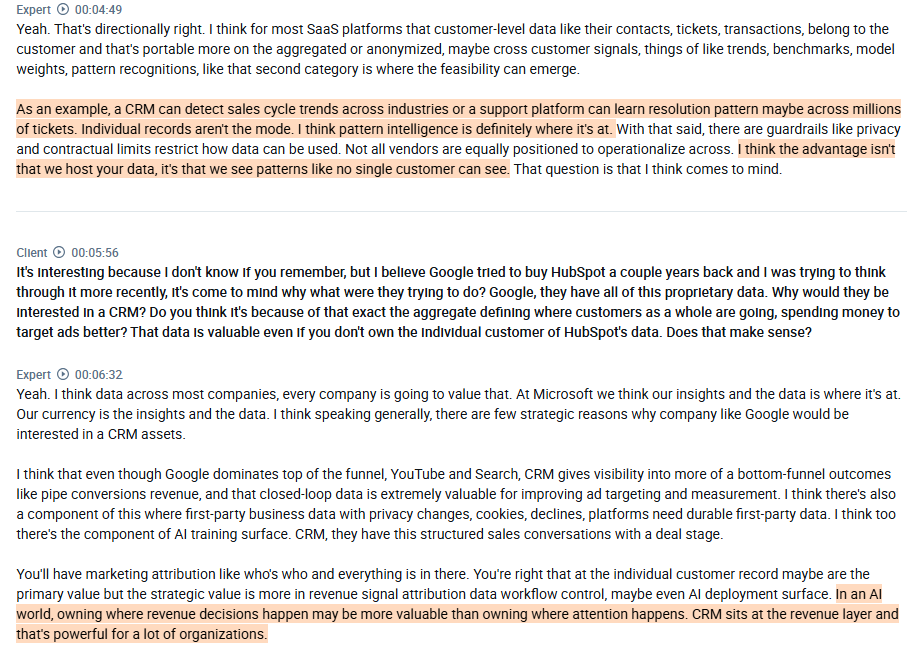
2. He gives a good example of value for a SaaS provider. The advantage isn't that we host your data, it's that we see patterns like no single customer can see, explaining the value of pattern intelligence across millions of records. He also thinks that in an AI world, owning where revenue decisions happen may be more valuable than owning where attention happens.
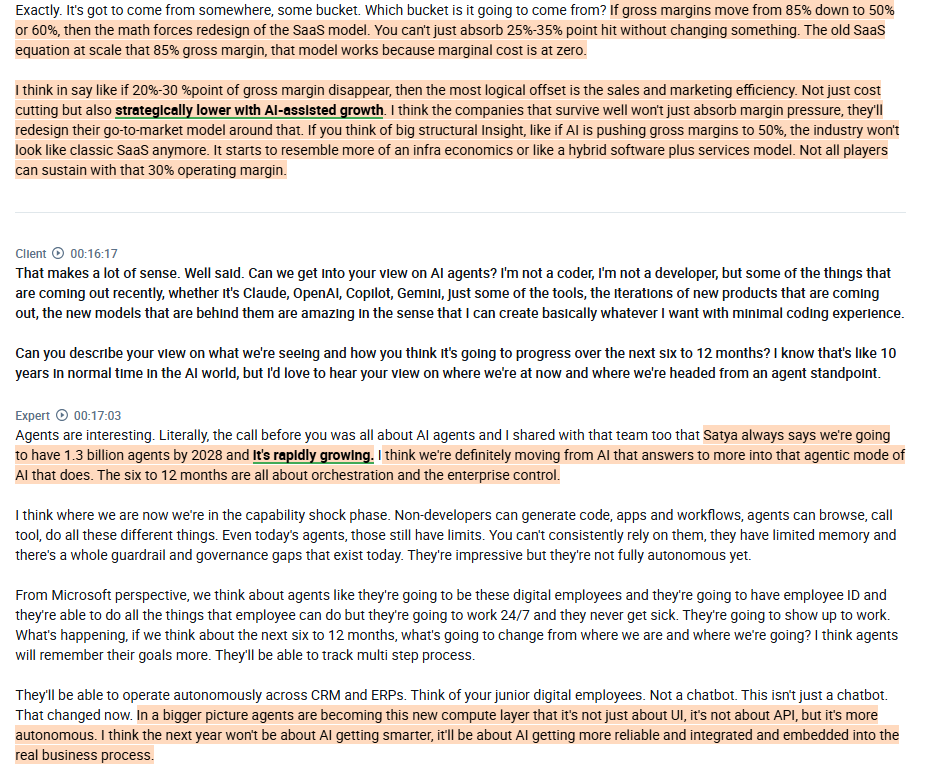
3. If SaaS gross margins move from 85% down to 50-60%, the math forces a redesign of the SaaS model. He thinks that if 20-30% of gross margin disappears, the most logical offset is sales and marketing efficiency. The industry will no longer look like the classic SaaS industry, but will more closely resemble an infrastructure economy. Not all players can sustain that 30% operating margin.
4. According to him, $MSFT's Satya always says we're going to have 1.3 billion agents by 2028. He thinks we are rapidly moving from AI that answers to a more agentic mode where AI does. The next 6-12 months are all about orchestration and enterprise control. He thinks the year won't be about AI getting smarter, but more about AI becoming more reliable and integrated into real business processes.
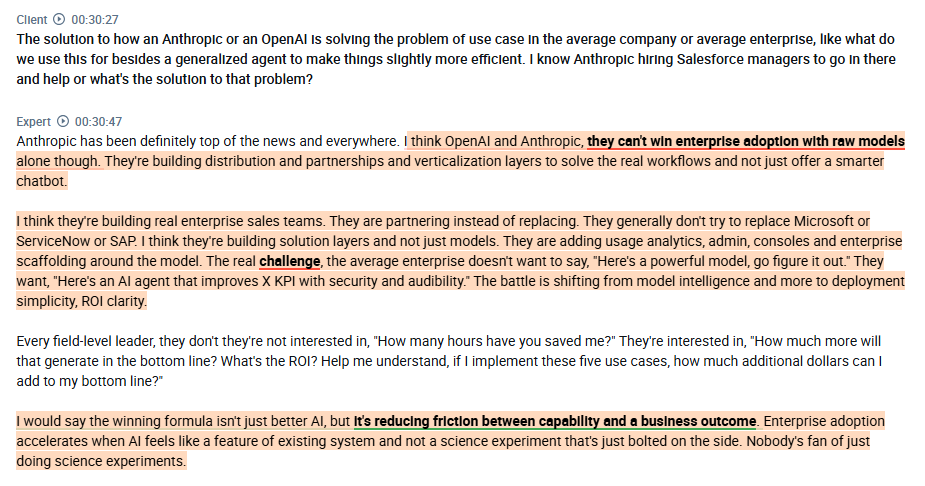
5. He thinks OpenAI and Anthropic realized they can't win enterprise adoption with a raw model alone. They're building distribution, partnerships, and verticalization layers to solve real workflows, not just offer a smart chatbot. The battle is shifting from model intelligence to deployment simplicity and ROI clarity. The winning formula is reducing friction between capabilities and a business outcome. Enterprise adoption accelerates when AI feels like a feature of the existing system and not a science experiment that's just bolted on the side.
found on @AlphaSenseInc
@jtotheren@sahilypatel Absolutely this. Currently building brand new AI workflows in N8N after running last biz on it, and have experienced the need to flex the job to the model.