Bitcoin’s power law (primarily in price vs. time) and S-curve adoption models are compatible, especially in early-to-mid stages of growth, due to mathematical similarities, network effects, and real-world dynamics. They aren’t mutually exclusive; the debate often comes down to modeling preferences, time horizons, and assumptions about long-term saturation.2223
Key Concepts
•S-curve (logistic or similar, e.g., Gompertz/Weibull CDF): Classic technology adoption pattern—slow initial growth (innovators/early adopters), rapid acceleration (early majority), then flattening/saturation as the market saturates (late majority/laggards). Common for phones, internet, etc. Adoption fraction often modeled as something like 1 / (1 + e^(-kt)) or variants.26
•Power law: Bitcoin’s price (and metrics like active addresses) scales as ~time raised to a power (e.g., price ~ t^5–6). On a log-log plot, this is a straight line. Giovanni Santostasi’s model is prominent here, with adoption (addresses/users) ~ t^3, price ~ addresses^2 (Metcalfe’s law: network value scales with the square of users), leading to overall ~t^6.232
Why They Align (Compatibility)
1Early-Stage Equivalence: Many S-curve variants (especially Weibull cumulative distribution) behave like power laws in their initial phases before the “knee” or inflection toward saturation. A Weibull CDF approximates (t/c)^k early on—exactly a power law. For Bitcoin’s ~15+ years of data, power law fits extremely well (high R²), and S-curve models with high asymptotic targets (e.g., $1M–$10M BTC) match it closely until far in the future.463
2Network Effects + Curbing Mechanisms: Bitcoin’s growth isn’t a simple logistic like consumer gadgets.
◦Metcalfe’s law drives super-linear value growth with users.
◦Viral/spread dynamics (addresses ~ t^3) combined with feedback loops (price → hash rate/security → more adoption).
◦Curbing factors (Bitcoin’s difficulty adjustment, investment risk/perceived volatility) turn what might start as exponential/S-curve into sustained power-law behavior. Santostasi notes phenomena like certain disease spreads follow power laws (not pure S-curves) when risk/decision-making is involved.2345
3This creates ongoing, scale-invariant growth (like cities or biological systems) rather than quick saturation.
4Empirical Fit: On-chain data (addresses, hash rate, price) shows tight power-law correlations over orders of magnitude. S-curve proponents (e.g., Willy Woo) project eventual flattening as adoption % of global population/assets rises, but current data hasn’t deviated much from power law. Models like Weibull can “explain” this by having the knee decades away.22
Points of Tension/Debate
•Power law advocates (e.g., Santostasi): Bitcoin acts more like a scaling complex system (city/organism) than a typical tech product. Predicts continued power-law trajectory (with cycles/bubbles as “punctuated” growth) for orders of magnitude more, due to scale invariance. No inherent saturation soon.45
•S-curve advocates: Expect eventual slowdown as Bitcoin captures major global value (e.g., store of value, remittances). Some see signs of transition already (e.g., institutional/ETF effects compressing cycles).54
•Hybrids exist: Power law now, possible S-curve-like bend much later (e.g., 20+ years out when approaching very high adoption). Power law is simpler (fewer parameters) and preferred by Occam’s razor for now.46
In short, they’re compatible because a power law can describe the observable portion of a (delayed or modified) S-curve driven by Bitcoin’s unique mechanics. The power law has strong historical and theoretical backing from network effects, while S-curve thinking captures the intuition that nothing grows forever at the same rate. Both suggest massive long-term upside, just with different emphases on when/how growth moderates. Data will decide which dominates as Bitcoin matures.
Two of the bigger questions for the #pcaga regarding an AI study committee is 1) do we as the PCA need to do this? and 2) why can't we simply use other available resources? I believe the answer to these questions lie within the advice from the Administrative Committee's advice.
"Again, we recognize that Artificial Intelligence is a significant part of learning, life, and work. Our goal is not to discourage its ethical use in professional or administrative contexts, nor to suggest that its use is inherently problematic, however, the Church must understand when a data processing tool acts as a helpful aid and where it oversteps its functional bounds. To that end, we affirm the following essential distinction:
We adhere to Scripture as the sole source of ultimate truth.
AI is a tool for work; AI is not a tool for truth.
Hence there is a need for direct engagement with the Bible. Because AI possesses extraordinary retrieval and processing capabilities, it may be viewed by some as an interpretive authority, acting as a sort of middleman between the believer and the Word of God. We should be cautious that the convenience of AI-generated summaries does not replace the believer’s direct, meditative engagement with the Word of God or the Spirit’s work through the historical witness of the Church."
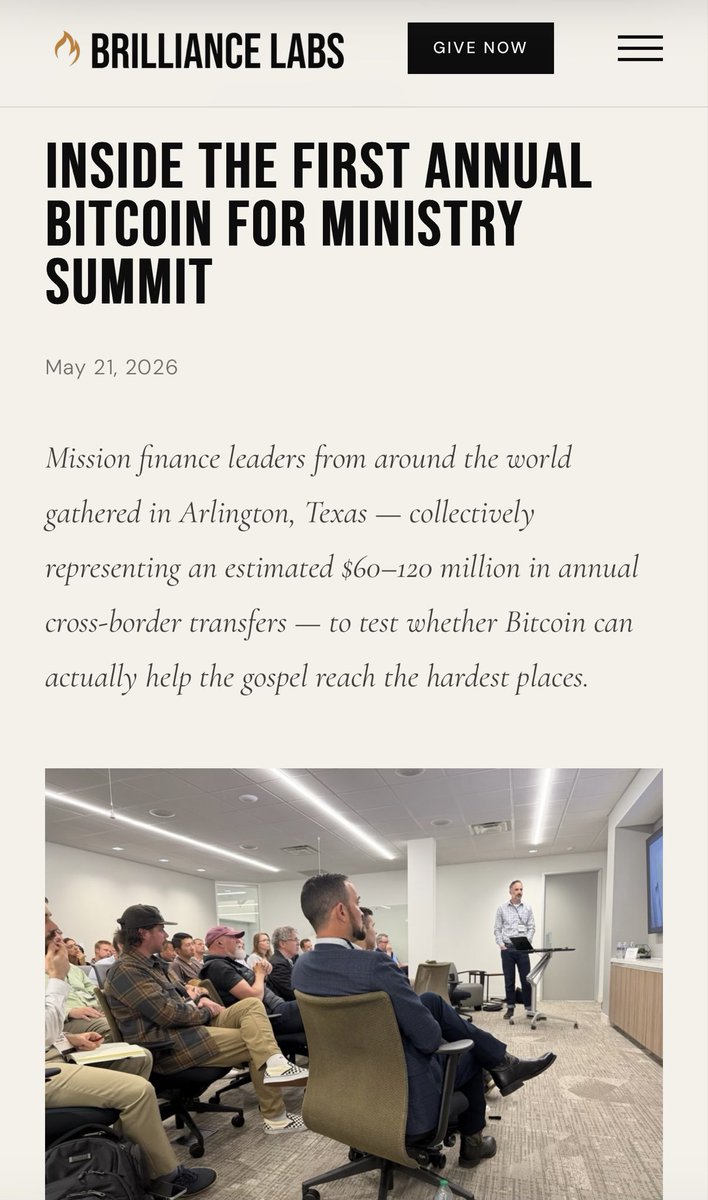
Last month @brilliance_labs had the privilege to host a closed door Bitcoin summit for some of the largest Christian non-profit orgs in the world. It was the most needle-moving event I have participated in during my 6 years in the Bitcoin world.
Read the event recap below.
@JoshuaTorrey yes, of course. I completely agree with you there. My question revolves around pastoring and shepherding our people through what you and I see as very significant economic, structural, societal changes and the impact across the board. So yes, AI study committee pronto.
@bitcoinwell Absolutely. For those wanting diversify their BTC risk profile as well as beef up security with traditional bank accounts, the Yubikeys are particularly helpful for protecting your main email addresses and (i)cloud accounts. @Yubico