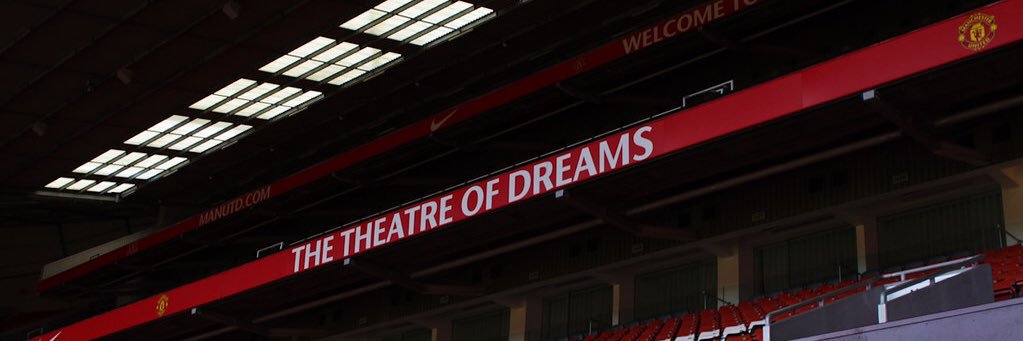
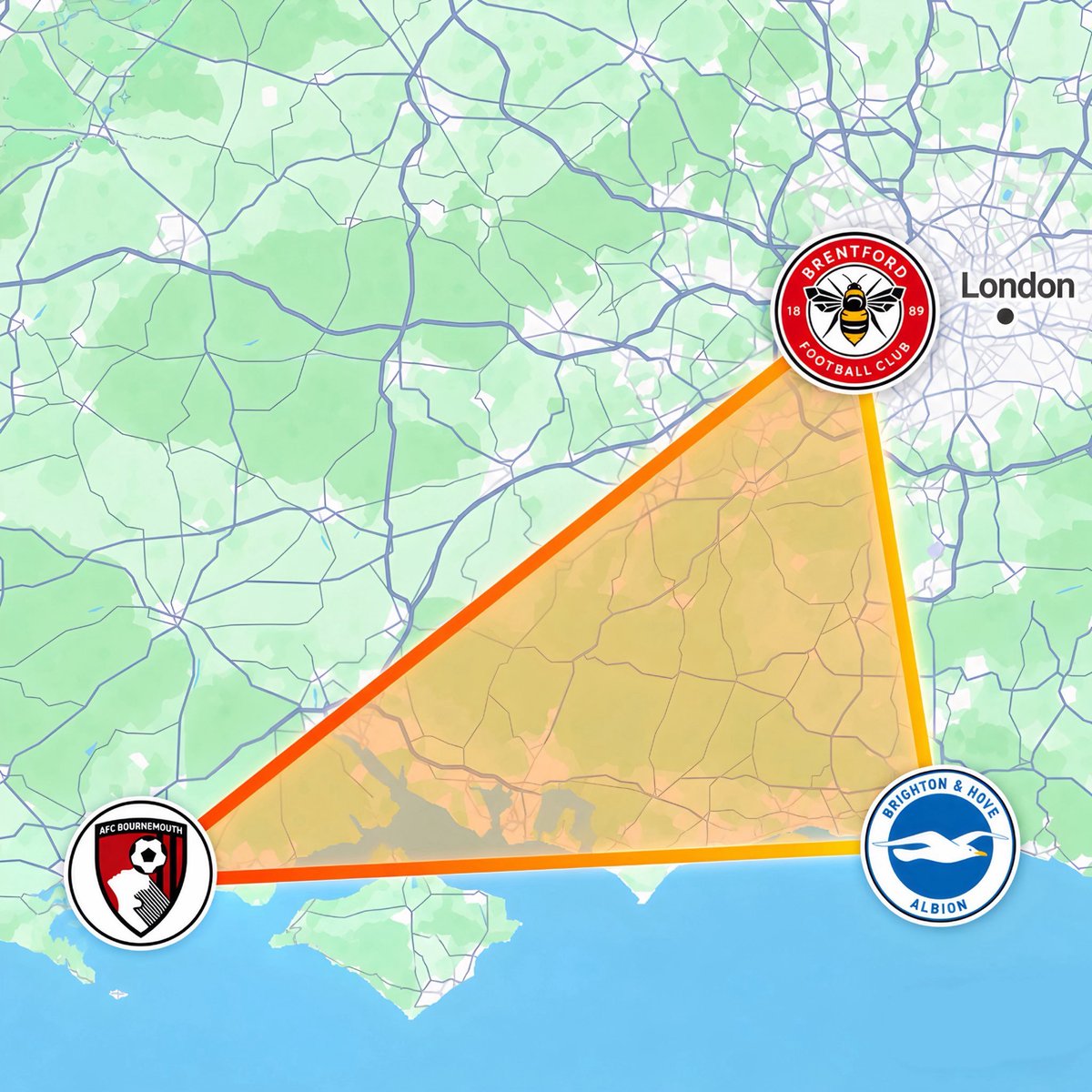
India playing high line against Vinicius & Estevao
Manvir dribbling past Brazilians
Sahal nutmegging them
India winning back to back corners
Brazil stopped pressing looking at our midfield passing
Those first 25 minutes of India vs Brazil 🥀
The manufacturing sector equivalent for uneconomical operation is in the ~$50-$150/MWh range. Makes you wonder if large compute loads can just pay for capacity in certain areas
Interesting... Compute Heat Rate (CHR) estimates the maximum electricity price an AI workload can economically support, in $/MWh.
Hans Royal’s Q3 2026 model distinguishes two decisions:
>Long-run CHR: ~$5,630/MWh. BEFORE building, expected revenue must cover electricity, other operating costs, repayment of the hardware investment and a required return.
>Dispatch CHR (CHR-D): ~$9,070/MWh. Once built, the investment is sunk. Running makes sense whenever revenue exceeds the costs avoided by switching off, even if earnings fall short of the original investment target.
Dispatch CHR is higher because shutting down saves electricity but doesn’t recover the hardware investment. Existing capacity can therefore tolerate power prices that wouldn’t justify new construction.
The model combines compute pricing and processing throughput with hardware costs and full-facility electricity consumption. Results are weighted by estimated electricity use across inference workloads; training is excluded.
Useful for assessing investment viability and incentives to curtail during expensive power hours. These are modeled thresholds, sensitive to pricing, utilization and throughput, rather than observed bids or power-price forecasts.
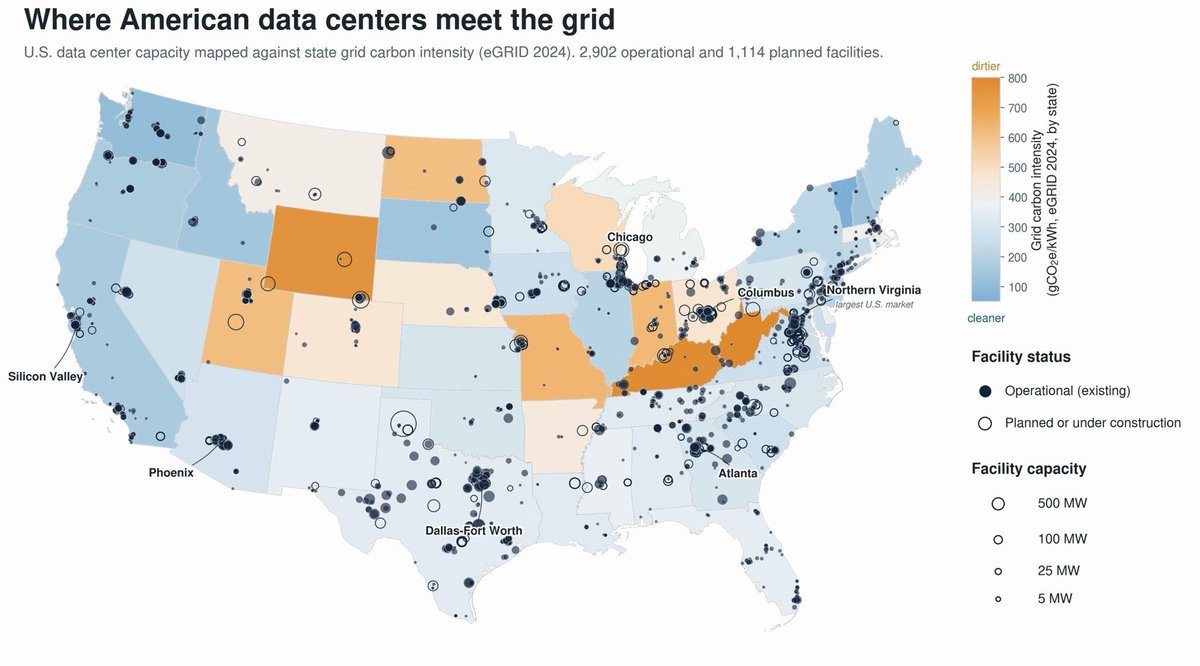
Wyoming and Kentucky are some of the dirtiest grids in the country. They also have data centers going up, both planned and operational. Nobody sited these for the climate.
Today, @Google@NVIDIA@EmeraldAI_ are launching the AI Energy Management Alliance (AEMA), joined by @AnthropicAI, @TheAESCorp, @ConstellationEG, @GenerateCapital, @NationalGrid, @NRGenergy, and a dozen other industry partners.
Our shared mission: modernize power system planning and operations for the 21st century to unlock the full potential of flexible data centers, enabling digital infrastructure to actively enhance system utilization, affordability, and reliability.
Instead of waiting 5-7+ years for traditional system upgrades, multiple studies have found that reducing net grid withdrawal for less than 100 hours per year can unlock dozens of gigawatts of capacity, via compute flexibility, storage, or generation. At Google, we’ve proven this model by integrating 1 gigawatt of demand response capacity nationwide.
To advance this mission, two new Google-commissioned reports are being released today that map actionable pathways forward:
1) @TheBrattleGroup: "Solutions for Timely Interconnection of Large Loads: Enabling Non-Firm Transmission Service," providing a technical blueprint to turn recent bipartisan direction from @FERC into operational reality.
2) @AuroraER_Oxford: "Curtailment Mitigation for Provisional Controllable Load Resources: Modeling the Effects of Front-of-Meter Netting," modeling flexible data centers in @ERCOT_ISO paired with front-of-meter resources.
With thanks to AEMA's additional launch partners, @ADI_News, @CalibrantEnergy, @CamusEnergy, @ClearPathFound, @fluenceenergy, @GridUnity, PassKey, RWE, Splight, @verrusdata, and @voltusinc.
Is new nuclear going to happen? At scale? Fast?
Finance & dev folks don't think so. Bearish comments here esp on SMRs
- SMRs 'long way off, early 2030s not realistic'
- Nuclear "not viable at scale w/o govt support"
- Btw NYSERDA modeling found even Fed support not enough, NY State must be involved
- Developer: "You have to pay nuclear $200/MWh at 2am, or it will not pay back its debt"
- But note best in class financial modeling shows $200/MWh is for a brownfield AP 1000 + federal ITC + debt support, greenfield is >$250/MWh. With no government subsidies >$400/MWh for greenfield 😳
- NYSERDA "initial nuclear projects are likely not commercially viable without any NY State support, even when incorporating existing federal supports such as the Investment Tax Credit and DOE-backed debt"
- "Economics continue to be the problem"
- Designs so early stage they have "not thought through the permitting risks"
Folks allocating capital simply do not think this is a financeable product, yet. How to create one is the main challenge, not a novel 'better' reactor design
Public Service Announcement to #EnergyTwitter worldwide--there now exists a Roller Coaster Tycoon style video game for power systems! A clip of me fooling around in the tutorial level below.
Power Network Tycoon, developed by a practicing power engineer @DavidMadeThis. Already available via early access, official release Sept 30!
🚨 🚨 If you are in the DER/VPP industry this world-class paper just dropped by Tom Nudell from Piq and @cpatdowling from Base Power Company.
It's a must read. If you're not technical, AI tools can help you understand line by line - there is no more excuses for not knowing. (I'm just a lowly MBA, and I was able to figure it out!)
My view is that this is a new high water mark: showing the math on your hardware solutions is game changing. You're no longer selling hardware: you're selling a solution to a specific problem.
And going forward, this is going to become the standard. If you can't show your work, then you'll be relegated to "programs" that constantly need PUC funding for unknown benefits.
Conversely, if you can do the work, you'll have near infinite scaling opportunity, because you will be selling real solutions to real physics-based problems on the grid. Your buyer is a utility's highly sophisticated electrical engineering team. You must be able to speak their language and show that your product is an actual solution to their highly technical problem. No more handwaving.
DER/VPP orgs: The industry is too marketing and regulatory centric. We must build out the hard technical team (beyond just software). If you don't have deep engineering talent that understands the physics of the grid on team, you're NGMI. At the very least go partner with Piq Energy and others to bridge that gap quickly.
https://t.co/iuymCjk2Lt
Just for fun…Balance The Grid. Operate a NYISO-style system for a 24-hour shift (about six minutes of real time), holding reserves and covering a 1,300 MW trip during the evening ramp. Best on a laptop. https://t.co/XWb1pNEpV3
Amazon is backing a 7.65 GW gas plant in West Texas.
I sorted all 14,036 operating U.S. power plants by size to see where that lands. It doesn't land anywhere (nothing on the American grid is that big).
US manufacturing is booming, expanding at the fastest pace since 2022 and beating expectations in many metrics for the month of July. Omar Sharif of Inflation Insights points out that the ISM production index rose by the most for any July since 1951. https://t.co/SiVnhJghQA
A study of 7,676 former professional footballers found defenders died of neurodegenerative disease at roughly 5 times the rate of the general population. Goalkeepers, same clubs, same training grounds, same 20 year careers, came in at population baseline.
Same sport. Same lifestyle. One group heads the ball.
The Glasgow FIELD study matched those players against 23,028 controls by age, sex and deprivation, then followed the records for 18 years. Outfield players ran about 4x. Forwards about 3x. Defenders about 5x. Alzheimer's specifically was 5x, motor neurone disease 4x, Parkinson's 2x. And it scaled with exposure. Shortest careers roughly double the risk, longest careers roughly five times. Dose response is what turns a correlation into a mechanism.
Careers in that cohort ran from 1930 to the late 1990s. Wet leather in the early decades, modern coated synthetics by the end. The risk never moved. Ball technology was never the variable, and that is the excuse that dies hardest in every argument about this.
Those same players were healthier than the public in almost every other way. Less heart disease. Less lung cancer. About half as likely to be hospitalized for anxiety or depression. They died at lower rates than the general population right up to age 70, then higher after it. Fitness bought them the extra decade and the head impacts took it back.
The damage comes from the headers nobody counts. Twenty or thirty in a single youth training session, thousands across a season, fifteen years of it before anyone signs a professional contract. None of it gets logged. None of it produces a symptom on the day.
Como's rules go straight at that. No heading under 11, so academy corners get taken as throw-ins played along the floor. From under 12 it returns with a light rubber ball, once a month, five headers in a session. Over-inflated balls banned across every age group.
Varane reported abnormal fatigue and eye strain after a heading-heavy match at United, was told to sit out, and missed the next game. He has told his own son not to head the ball. He played center back for fifteen years at Madrid and United. Of every position on the pitch, his is the one carrying the 5x.
Goalkeepers were standing on the same pitch for all of it. Their brains came out matching everyone else's.
When the world seems close to pear shaped,
When leaders fill you with despair
When things look dark and dreary
And love seems far too rare -
CUDDLE A DUCK
[ It works ...]
Alabama is launching a new large load tariff for data centers.
GENERIC PROCEEDING TO ESTABLISH A PROCESS FOR CONSIDERATION OF CONTRACTS FOR ELECTRIC SERVICE BETWEEN ALABAMA POWER AND LARGE LOAD DATA CENTER CUSTOMERS.
Here's the entire filing so far via @halcyon