#TechTuesday Researchers at @iitmadras are advancing sustainable engineering with a Bio-Chemo-Hydro-Mechanics (BCHM) model to optimise bio-cementation via Microbially Induced Calcite Precipitation (MICP). Led by Mr. Pavan Kumar Bhukya and Prof. Dali Naidu Arnepalli, Dept of Civil Engg this eco-friendly solution supports SDGs in #civilengineering.
Read the article here: https://t.co/mPLs7Zm0J3
Read the full research here: https://t.co/1DVufrmsEX
#IITMadras #SustainableEngineering #MICP
#TechTuesday, @iitmadras researchers developed an advanced numerical model to understand MICP, where soil bacteria produce calcium carbonate to strengthen soil. It accurately predicts calcite production, advancing MICP for eco-friendly construction.
More: https://t.co/hCOTTjOIGP
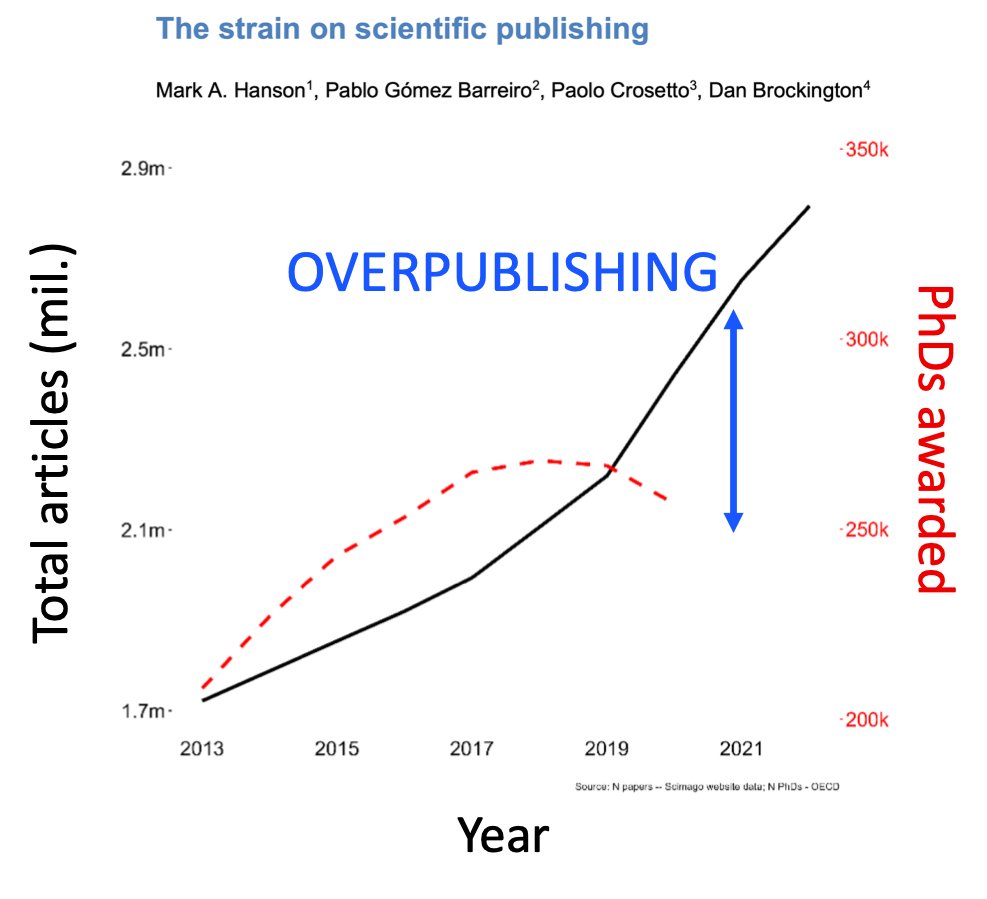
Overpublishing puts enormous stress on students and PIs.
And brings tons of money to publishers in STEM.
A new study shows that the number of papers is increasing FASTER than the number of #PhD graduates.
It’s an amazing work with very useful statistics. Huge kudos to the authors!
▫️
Main outcomes:
1️⃣ In 2022 the number of articles is 47% higher than in 2016. The amount of writing, reviewing and editing workload per scientist is increased enormously.
2️⃣ “Special issues” is a strategy for publishing lots of papers with reduced review time. This is possible due to the “publish or perish” pressure and clearly benefits the publishers.
3️⃣ The publishing time varies widely!
MDPI = 37 days. Frontiers = 72 days. Elsevier = 134 days. Springer = 157 days. Nature = 185 days.
4️⃣ The article rejection rates do not seem to correlate with publisher growth. However, rejection rates decline with increased use of special issue publishing.
5️⃣ Certain for-profit gold-open-access publishers create an increasing number of special issues, with uniquely reduced turnaround times, and in specific cases, high impact inflation and reduced rejection rates.
6️⃣ The authors suggest a new metric - Impact Inflation, which is reflected in self-citation within the same journal. For example, MDPI has a high impact inflation due to excessive self-citation compared to other publishers.
Conclusions and my opinion:
- Scientists have to spend a lot more time on reviewing and writing than before (on average).
- The more papers are published, the more the quality is compromised.
- Scientific progress has become partially bound to the business models of publishers and their revenue (a sad reality today).
- There is a huge lack of transparency. Much of these data had to be ‘web-scraped’ from numerous sources in order to get a full picture. We clearly need regulators to mandate open access to publisher’s statistics.
- Reduce the number of special issues! Those typically have low standards.
▫️
Science, publishing and funding make a trio that is very hard to disentangle.
However, research quality is controlled by the community.
This is why preprint + community review can make a big difference.
#AcademicTwitter #AcademicChatter
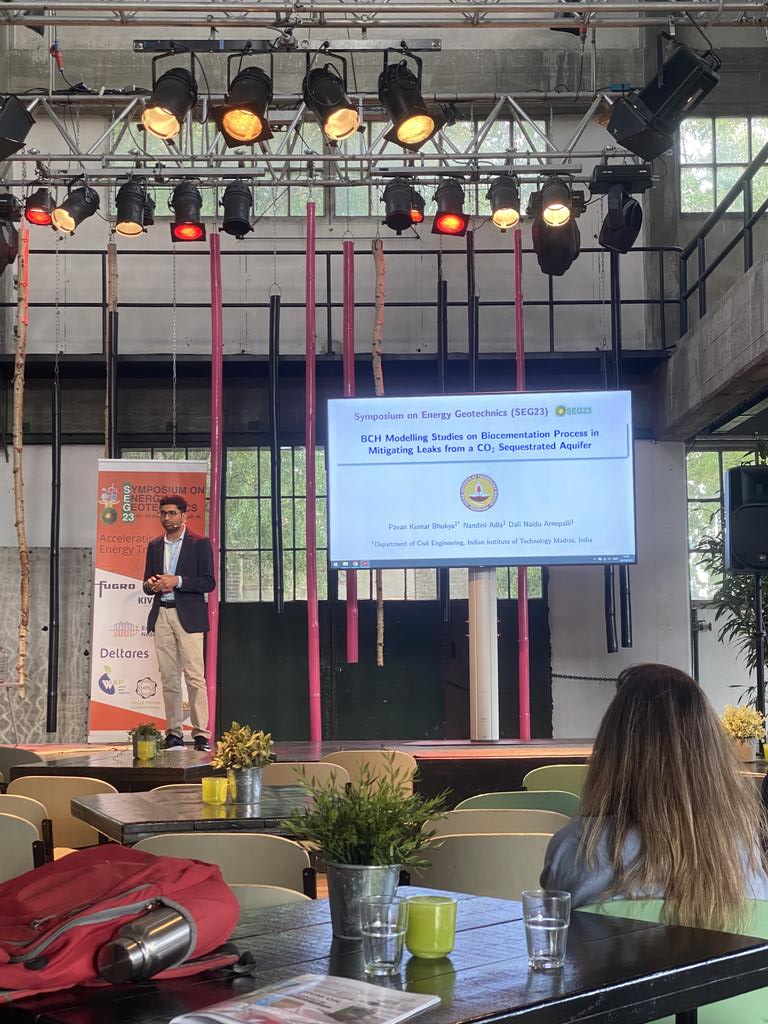
Enjoyed attending the conference #SEG23 in TU Delft, Netherlands.
Met several researchers working on carbon storage and nuclear waste disposal in deep geological formations.
I presented my work on utilising biocementation for mitigating leaks from a CO2 sequestrated aquifer.
Below is the 2-minute video abstract of our #KDD2023 paper on spatio-temporal forecasting.
https://t.co/rYU9saur0F
The most watched video will get an appreciation award. So a straightforward request. Please watch, and retweet! 😁
@500kmph@haribamsuri@kdd_news
#NEW#Postdoctoral Position at
@UTAustin in #CarbonMineralization#CCUS with co-supervision of Nicola Tisato and myself. The position requires expertise in rock physics/mechanics, high pressure/temperature testing, and X-ray tomography Apply here! https://t.co/wEapMmBWXS
Job Alert!!!
We have an 18-month Research Associate position to work on Upscaling of Immiscible Fluid Flow in Rocks using ML and multi-scale X-ray imaging data.
Full details on
https://t.co/WBW2uXLKFy
Interested candidates can contact us for further details
@HWU_IGE@IGE_PACESET
If you are interested in learning #FEM for #CFD as a (remote) summer project, email me your CV along with a short statement to [email protected].
Require some basic knowledge of FEM and programming.
Deadline: 30-Apr-2023.
An open position for a tenure-track associate professor in #Geohazards & #Geomechanics is available at the Department of Geosciences, University of #Oslo: https://t.co/LOIMj0RXUC
Young and early-career female researchers are encouraged to apply!
Deadline: May 1st, 2023
We're hiring!
The Laloui Group is currently offering a Ph.D position and two Master's projects exploring CO2 sequestration.
Interested in this emerging field and the vitally important role it could play in shaping our planet's future? This one is for you.
https://t.co/uBLwj4hX7V
Please ReTweet.
We have fully-funded PhD studentships in the Engineering and Mathematics group at @EdinburghNapier.
https://t.co/CNJR0pk4eX
These will cover full UK or international tuition fees and will include a standard living allowance at the RCUK rate (£17,668 pa)
1/
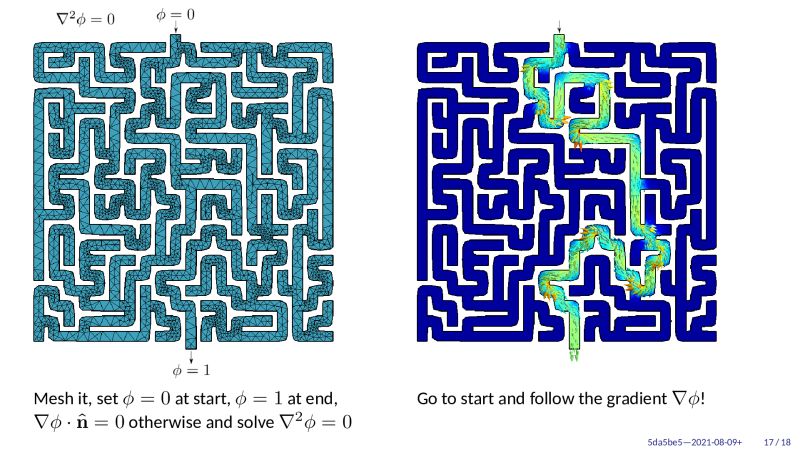
How to solve a maze using Laplace's equation by Jeremy Theler👇
1. Mesh the maze
2. Set Dirichlet BCs ϕ = 0 at start and ϕ = 1 at end
3. Set homogeneous Neumann BCs everywhere else
4. Solve ∇²ϕ = 0
5. Go to the start and follow the gradient
#physics#mathematics
The program of the international workshop on 'Bio- and Intelligent Geotechnics' is out now. @Raul__Fuentes @HansHenning_St @MartVAlejandro@JulianTao25 will give interesting talks.
Link: https://t.co/xFXyJ4IZRS
ID: 994 1618 2232
Passcode: 612944
Check out my recorded presentation at WCCM-APCOM 2022 conference.
"A Two-dimensional Bio-chemo-hydro-mechanical Model for In-situ Stabilization of Soils using Biochemical Processes"
https://t.co/wCqSp86aya
Note: Only the registered candidates can open the video.