R.F. Kuang has written seven books, won the Nebula Award for Best Novel, and trained at some of the world's top universities: Cambridge, Oxford, and Yale.
Her wisdom-per-word ratio is also off the charts.
Some highlights from our conversation:
1) Emotions are like colors. Mix them! Emotions are never one-dimensional. Bring together fear and courage, love and revulsion, joy and panic. This collision of feelings is closer to how emotion actually works.
2) Practice literary shapeshifting. Become a new person, a new persona, and a new type of author with every project. Do not confuse your habitual voice with your authentic voice: there is no single way of constructing sentences that must define you. Treat language as a fluid and flexible tool.
3) There's no correlation between how good writing feels in the moment and the quality of the product. We mistake effortlessness for genius, flow, or divine inspiration. So don't evaluate a day’s work by the pleasure of producing it. Judge whether the sentences escaped your pre-existing patterns and helped you think something through.
4) Good writing comes from being attentive to what's happening around you and writing with specificity about those observations, rather than relying on the theoretical. Throughout the day, ask: “Where is this feeling sitting in my body? How am I physically responding to this?” Those questions force you beyond the abstract label and toward something more specific than the reader could easily imagine for themselves.
5) Use your zero draft to discover the beating heart of the story, not to prove that you can already write it. Research, brainstorm, follow your nose, and collect whatever feels surprising or “crunchy.” At this stage, coherence is less valuable than emotional resonance.
6) Draft in layers. Let the early draft remain “balls on sticks.” Add the setting, architecture, faces, furniture, and drape colors in later passes. A person’s visual appearance is often the least interesting thing about them.
7) Use the outsider’s perspective to make language strange again. Nabokov could play, stretch, and innovate with English because he was fascinated by the oddities and opportunities of particular word combinations.
8) Be suspicious of “volunteer words for volunteer thoughts.” Volunteer words are the phrases that offer themselves immediately because they are already floating around in your head. They repeat common discourse and carry ideas that are easy to digest; you are filling the page from your pre-existing dataset rather than articulating something you have actually observed or thought through.
9) If you're stuck, put the subconscious to work. Open a blank document, type a title, word, or phrase, then save and close it. Return after the problem has had time to work on you in the background.
10) Serious writing doesn't require solemnity. Soaring observations about history or human nature can sit beside potty jokes.
11) AI can offer readily available words for readily available thoughts, but readily available thoughts do not push boundaries. It may reproduce impressive human patterns, but “you won’t get your next Pale Fire from an LLM.”
12) Thinking about the audience as you write a first draft is a death sentence. The moment you start writing while looking over your shoulder, you stop taking the story where it needs to go.
Timestamps:
0:29 Writing your emotions
6:44 Observing people
15:20 Why easy writing doesn't work
23:09 Building unique voices for each book
30:47 What Kuang learned from debate
32:52 Why primary sources matter
35:33 AI & writing
40:54 How to start a book
45:16 Trust your subconscious
50:25 Copy the writers you love
52:57 Being goofy
57:34 Find a driving question
1:01:36 What every writer needs to learn
01:04:38 Book and movie recommendations
I've shared the full conversation with R.F. Kuang below. If you'd rather watch the full thing on YouTube, or listen to it all on Apple / Spotify, check out the reply tweets.
Enjoy!
Our new paper is online: Dynamic Multi-Byte Prediction With Hierarchical Language Models
Hierarchical byte-level LMs have begun to gain increasing adoption due to their tokenizer-free advantage, but they lag behind subword models with respect to inference speed. 🧵
1/n
Training an LLM from scratch is easier to study when the whole path is in one repo.
Train LLM From Scratch is a PyTorch repository for learning how a transformer language model is built, trained, saved, and used for text generation.
It helps you move from “I understand attention on paper” to a runnable training pipeline by pairing model code with data download, preprocessing, config, training, and generation scripts.
Key features:
• Transformer components from scratch – separate PyTorch modules for MLP, attention, transformer blocks, and the final model
• Pile-based data path – scripts download The Pile files and preprocess JSONL.ZST text into tokenized HDF5 datasets
• Configurable training setup – model size, context length, heads, blocks, batch size, learning rate, and file paths live in https://t.co/zuPqaR3MhP
• Hardware guidance – README compares common GPUs for 13M and 2B-class training runs
• Generation workflow included – generate_text.py loads trained checkpoints and produces sample text outputs
It’s open-source (MIT license).
Link in the reply 👇
NYC observations after spending last week there
• people are actually outside touching grass (or cement 😅)
• very few AI ads or billboards around
• even cafes i went to - very few screens with claude code or cursor or some coding tool
• people are way more open to socializing. everyone is willing to strike up a conversation (not about AI agents)
• the energy is electric - everyone’s moving with purpose.
• found a way to talk to folks without mentioning AI
• way more artists, and non traditional creators. Met an actual physical product designer which was cool.
it’s genuinely refreshing to remember there’s a whole world outside the feed
been traveling the last few days and the SF tech bubble makes it easy to forget how alive real cities feel.
sorry SF, you’re still home… but perspective is healthy 🤷♂️
I implemented @GoogleResearch's TurboQuant as a CUDA-native compression engine on Blackwell B200.
5x KV cache compression on Qwen 2.5-1.5B, near-loseless attention scores, generating live from compressed memory.
5 custom cuTile CUDA kernels ft:
- fused attention (with QJL corrections)
- online softmax
-on-chip cache decompression
- pipelined TMA loads
Try it out: https://t.co/m5vkJxWIY6
s/o @blelbach and the cuTile team at @nvidia for lending me Blackwell GPU access :)
cc @sundeep@GavinSherry
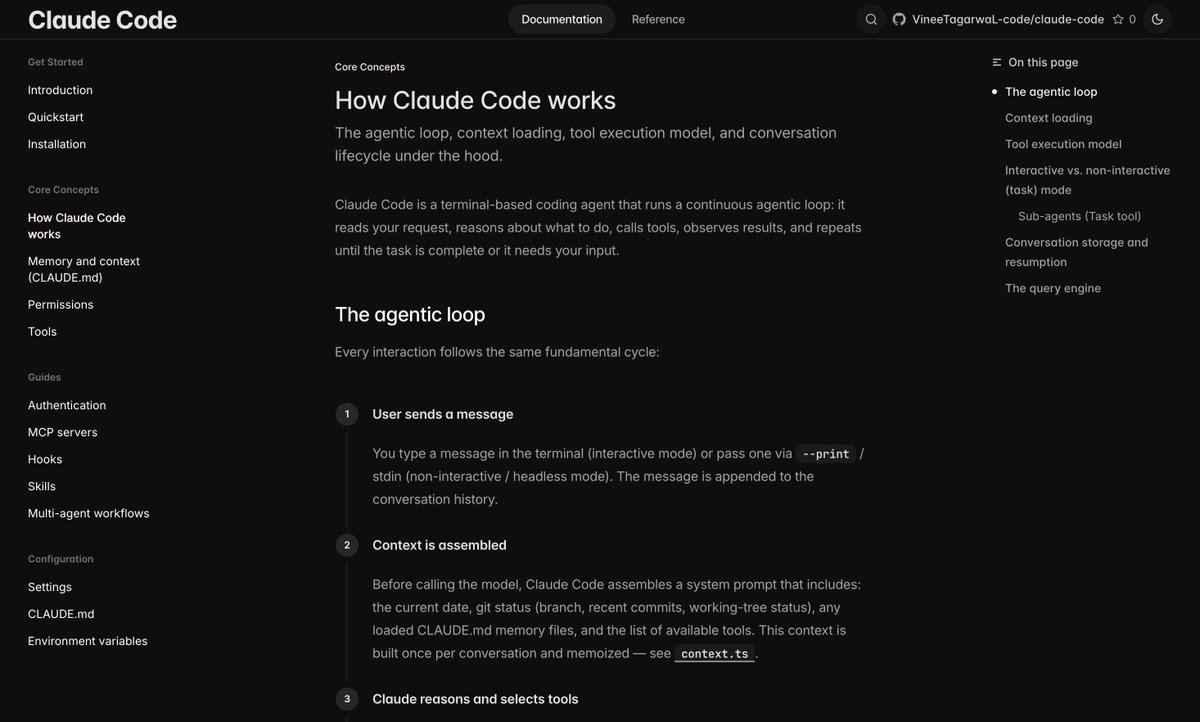
I created documentation over Claude Code's Codebase, which explains
- Its pipeline
- How it works
- How it handles Context
- How it handles Memory
& More
Read it here - https://t.co/GngrSvWAmh
he literally decomposed a DaVinci Resolve timeline into domain-split JSON so editors, colorists and sound designers never touch the same file.
he's 18 btw.
the founder of openclaw joined the company that was founded to make AI open and now charges you per token. and is now telling you open models aren't there yet.
i run qwen 3.5 27b on a single 3090. 50 tok/s. it writes code, handles tool calls, runs agent sessions for hours. the model built a full space shooter, 3,000+ lines, from a single prompt. i published the data.
"open models aren't there yet" is what you say when your harness can't parse tool calls on local models and you blame the model instead of fixing the harness. i have the DMs. people switch from openclaw to hermes agent and their "broken" models suddenly work.
pair a good model with a good harness like hermes agent where parsers are built per model. your data stays on your machine. no API key. 0 subscription. no one training their next model on your thinking.
don't listen to someone with an OpenAI paycheck telling you open source can't do the job. install it. test it yourself. the receipts are on my timeline.
he built a harness that couldn't handle local models and chose the API paycheck over fixing it. that should tell you everything.
Following the success of the EurIPS and NeurIPS-Mexico City pilots in 2025, we are thrilled to announce two official NeurIPS 2026 satellite events for this year!
These will be held in Paris, France and Atlanta, USA, respectively, running alongside the main venue in Sydney, Australia.
Both satellite events will feature keynotes, oral and poster presentations of accepted NeurIPS 2026 papers, as well as workshops. We are planning tutorials, affinity events, and other elements for the satellite sites and we'll share more information as planning advances.
Wherever you choose to join us, the entire NeurIPS organizing committee is working hard to deliver an outstanding experience for the whole community!
https://t.co/B0v3qCmyBE
Meet Codex for Students.
We're offering college students in the U.S. and Canada $100 in Codex credits.
Our goal is to support students to learn by building, breaking, and fixing things.
https://t.co/WrOtW8E8Lk