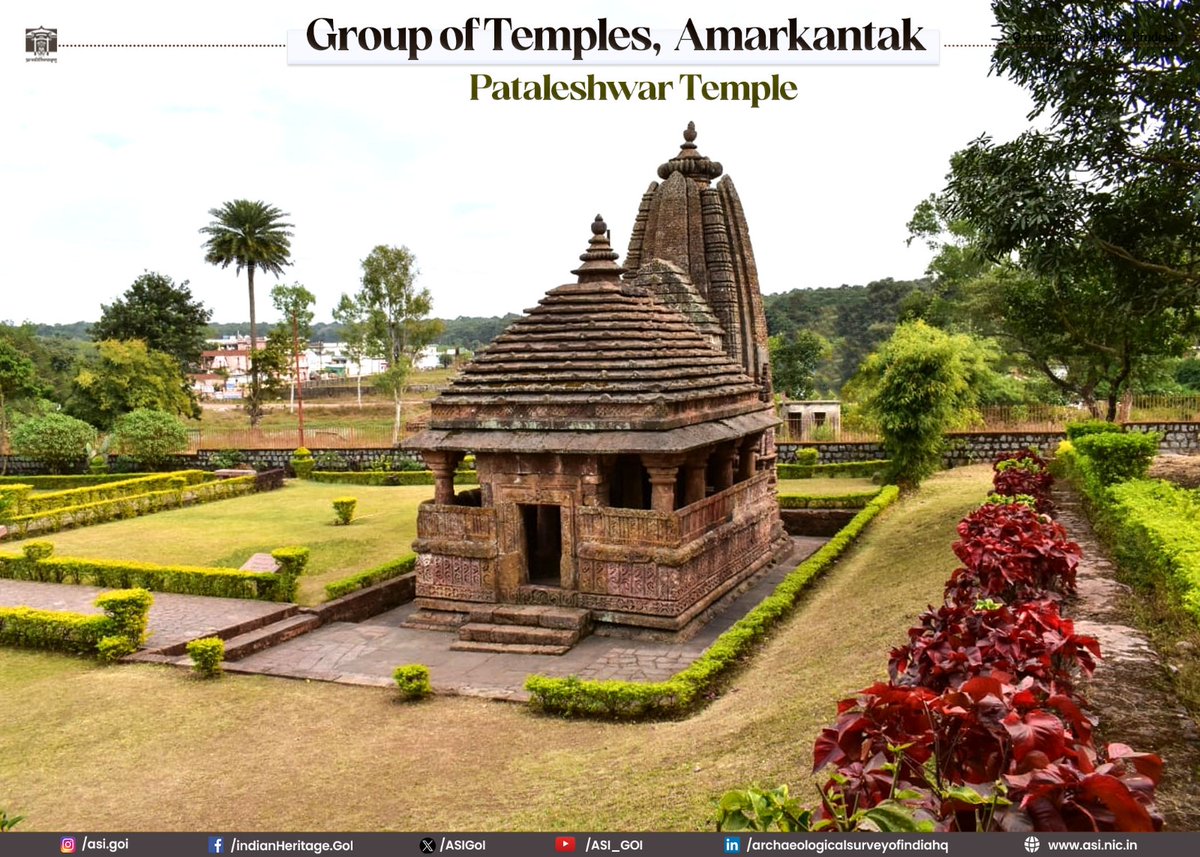
Dating back to the 11th century CE, the Group of Temples at Amarkantak in Anuppur district of Madhya Pradesh stand as enduring masterpieces of Kalachuri architecture. From the elegant Karan Temple to the intricately carved Pataleshwar Temple, and the serene Shiva Temple, these temples reflect a rich legacy of devotion, craftsmanship, and artistic excellence.
Here's a closer look at three remarkable temples:
a) Karan Temple
Karan Temple consists of a sanctum, an antarala, and a mandapa. Built on a high raised platform, it features a shikhara over the sanctum and pyramidal roofs over the antarala and mandapa. The outer walls are decorated with three ornamental bands and three tiers of small sanctums.
b) Pataleshwar Temple
Pataleshwar Temple is built on a pancharatha plan and is known for its beautifully carved outer walls, reflecting the excellence of Kalachuri art. It has a curvilinear shikhara, a simple doorframe, and a pillared hall topped with a pyramidal roof, amalaka, and ghata.
c) Shiva Temple
The Shiva Temple, also known as the Machhendranath Temple, is dedicated to Lord Shiva. It faces west and comprises a garbhagriha, an antarala, and a mandapa. The sanctum follows a pancharatha plan and is crowned with a conical (shankvakara) shikhara in the Nagara style. The mandapa originally had a Phamsana-style roof, though its upper portion is now damaged. Above the entrance to the garbhagriha, the lintel is adorned with a finely carved image of dancing Ganesha.
Located around 4 km southwest from the World Heritage Site of Nalanda Mahavihara, the site of Rukmini-Sthan was excavated by ASI during 2014–15 and 2015–16 to ascertain its relation with the monastic complex of Nalanda and to understand the cultural sequence of the site.
The large scale excavations revealed several votive stupas, brick walls, steps to the north of the temple containing the colossal Buddha image (situated over the mound), rammed floors, an enclosure wall, and a small monastic structure with three cells opening into a common corridor.
Among the most significant discoveries were around 390 terracotta sealings bearing symbols with inscriptions. Many depict the Dharmachakra flanked by deer, while some clay lumps bear multiple seal impressions.
The excavations also yielded a rich collection of animal and human figurines, terracotta beads, sling balls, gamesmen, dice, a weight, sculptural fragments apart from ceramic in form of Red Ware pottery from two identified cultural epochs - the *Gupta-Post Gupta period (5th–8th century CE)* and the Pala period (8th–12th century CE), including storage jars, basins, bowls, lamps, sprinklers, vases, handi, miniature pots, kulhads, pans, spouted vessels, etc.
Identifiable stone sculptures include Vishnu, Ganesha, two stone images of the Buddha, one in Dhyana Mudra and the other in Dharmachakra Pravartana Mudra, along with an attractive stone pranala depicting a human figure with a seven-hooded serpent canopy holding a kalasha.
#WATCH | New York, USA: External Affairs Minister Dr S Jaishankar says, "When India advocates 'Vasudhaiva Kutumbakam', that is, 'world as a family,' as an approach, we don't simply preach; we practice it as well... A few recent examples of our contribution to global well-being: One, in maritime security, India makes wide-ranging and regular contributions, including in anti-piracy, counter-narcotics, and anti-trafficking operations. Apart from the fusion center... our forces are protecting sea lanes across the Indo-Pacific, specifically the northern and southern Arabian Sea, Gulf of Aden, Malacca Straits, and even in the Gulf of Guinea. A long record of peacekeeping is today extended to offering training and capacity building to 98 nations in the Delhi Centre of Humanitarian Peacekeeping."
Last week, I was fortunate to visit the workshop (the Tamil word pattarai பட்டறை is so appropriate) of the leading motor designer in the world Morihiro Saito-san.
Saito-san is 80+ and still designing advanced motors, some of the most advanced in the world. His modest looking workshop is right next door to a company that builds out those motors in prototype quantities and he works closely with them to get them built. I visited as an industrial "pilgrim", with as much devotion as I go to the Thoranamalai Murugan Temple at home. When I saw him at work, I was moved to touch his feet.
Saito-san, the God of motors, is how Japan is able to retain its global prominence in so many foundational industries.
We need to learn from that spirit. We need to revive our "pattarai" culture of building things - every village in India needs such workshops!
My industrial pilgrimage to Japan has given me new vigor 🙏
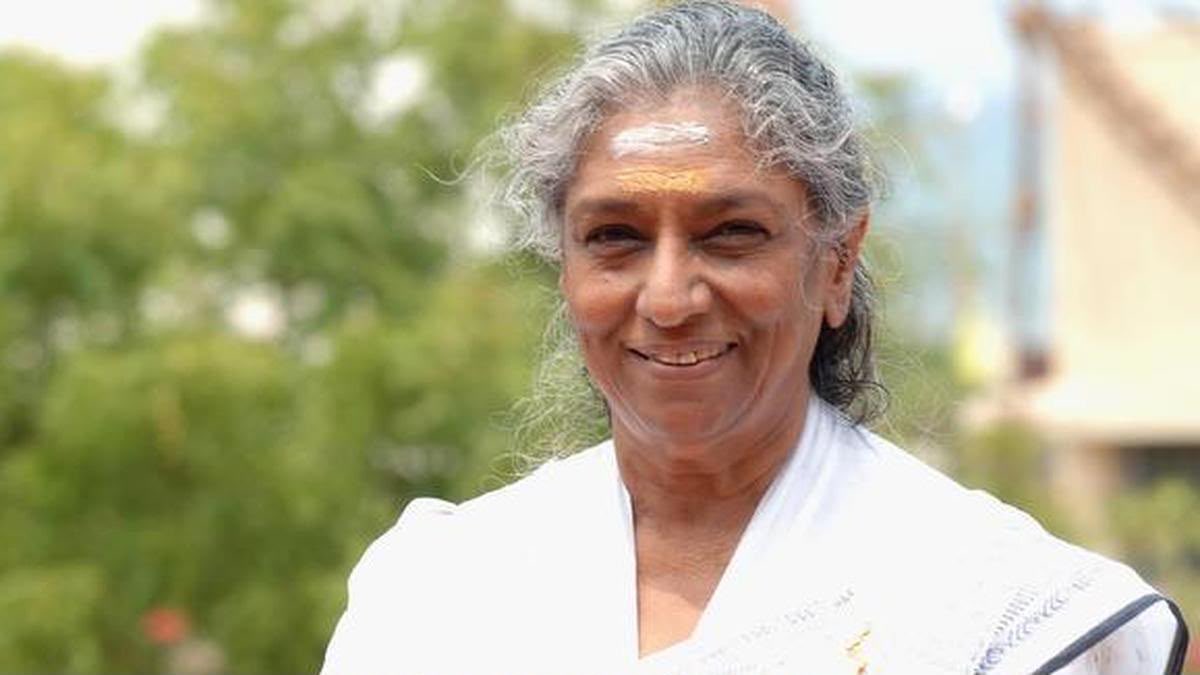
We pay tribute to the legendary singer S Janaki. Over a remarkable career spanning more than six decades, she recorded thousands of songs in multiple Indian languages, including Tamil, Telugu, Malayalam, Kannada, and Hindi. Fondly known as the ‘Nightingale of South India,’ her melodious voice has transcended generations.
Her extraordinary contributions to Indian music will continue to inspire music lovers across the globe for years to come 🙏💔
#CultureUnitesAll
#WATCH | Kanchipuram, Tamil Nadu: The inaugural procession of the new Golden Chariot was held at the historic Ekambareswarar Temple in Kanchipuram.
Large numbers of devotees gathered to witness the event. Visuals from the temple. (12.07)
Gift given by PM Narendra Modi to Indonesian President Prabowo Subianto: Uttarakhand Aipan Art Shiva
Aipan is a traditional folk art from the Kumaon region of Uttarakhand, created mainly by women during festivals on floors and walls using a terracotta-red base (Geru) and intricate white patterns made from rice paste (Biswar). Drawn freehand with remarkable precision, the art reflects centuries-old traditions passed down through generations.
This artwork is dedicated to Lord Shiva and features sacred geometric motifs symbolising cosmic energy, highlighting the deep bond between art and spirituality in India. It also celebrates the shared cultural heritage of India and Indonesia, making it a meaningful symbol of the close friendship and enduring cultural ties between the two countries.
In 1998, Devinder Pal Singh joined SBI Mutual Fund on deputation from SBI.
In 2006, he became a permanent employee and went on to rise to Deputy MD & Joint CEO.
Today, he holds 21.14 lakh equity shares and 5.19 lakh unexercised ESOPs, with a combined value of around ₹150 crore at the IPO price.
One of India's greatest employee wealth creation stories.
He skipped his 12th board exams.
Today, he leads an ₹18,000 crore company that helped reduce India's dependence on imported German and Japanese CNC machines.
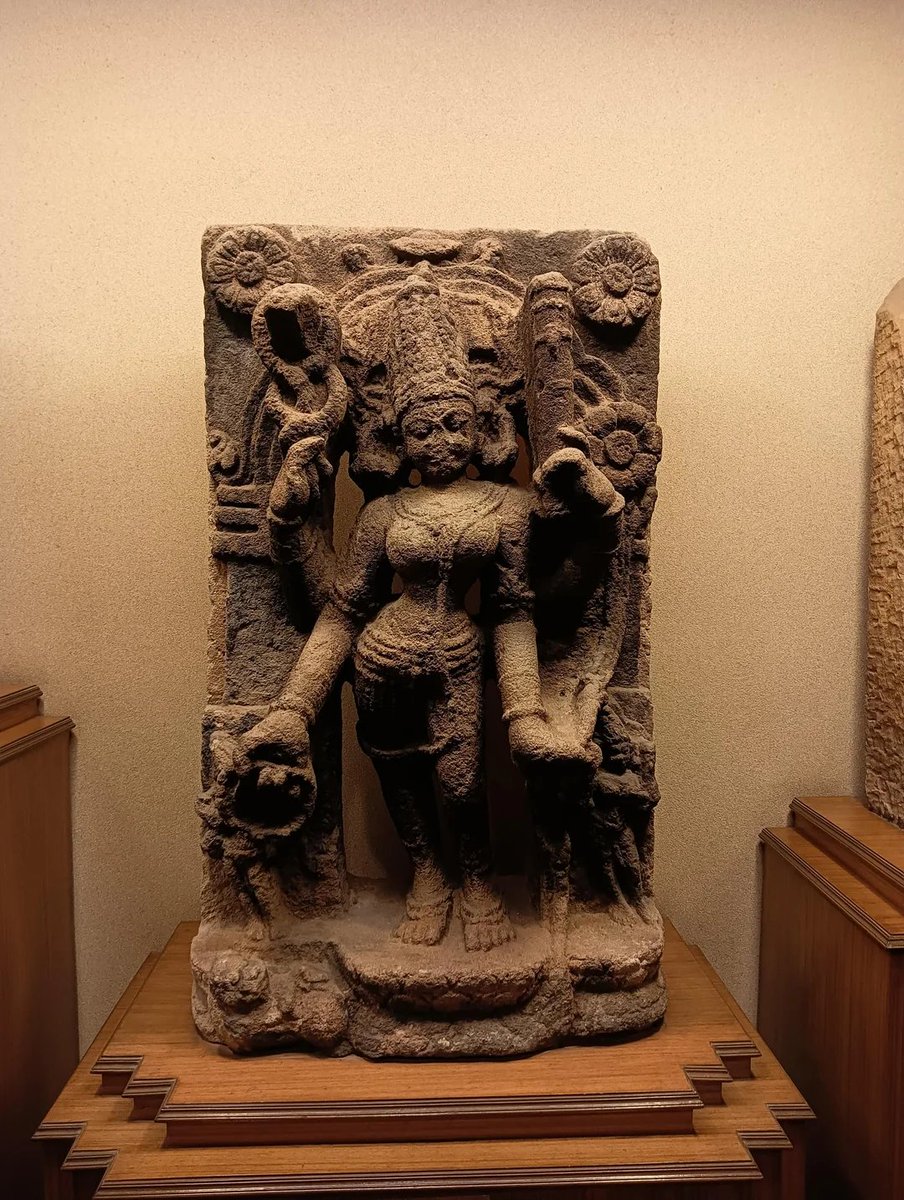
Saraswathi, the goddess of knowledge, learning, wisdom and the arts, has inspired devotion across India for centuries. When we think of Goddess Saraswathi, one image comes instantly to mind: a goddess seated on a lotus in serenity... holding a veena. But what if that familiar image we see in popular culture wasn’t always the way she was imagined?
Story and presentation: @SelvanKJ
Video: Vengadesh.R
Editing: @Shivaraj_vedhan
https://t.co/4040P1yAIW
🚨🇮🇳 How did ancient Indian craftsmen carve perfect concentric circles on a massive granite block in Hampi with such astonishing precision? 😱
Look at this massive granite artifact at Hampi.
🎯 The city of Vijayanagara was founded in 1336 CE—nearly 700 years ago—yet its craftsmen carved astonishingly precise concentric circles into hard stone with a symmetry that still captivates visitors today.
No CNC machines.
No lasers.
No electricity.
Just extraordinary skill, geometry, patience, and engineering.
India’s heritage is not just history—it is a masterclass in human ingenuity. 🇮🇳 🚩
Hands down Navi Mumbai is the Best Airport in the Country
Capacity Wise
Technically
Security
The Landscape Nearby
Ease of Flying
Adani has done a Superb Job by creating an Engineering Marvel @jeet_adani1@AdaniOnline
🚨 IIT-Madras researchers have come up with a clever way to treat industrial wastewater, using gas hydrates to pull out clean water, without all the usual energy-hungry steps like filtration or centrifugation.