Insane. With a dash of OCD. And a deep love of cocktails. GFX Nerd/Silicon Enthusiast. Lawful Neutral bordering on Chaotic good. HengeQueen. Opinions = My Own.
Instead of watching an hour of Netflix, watch this 30-minute speech by the Head of Anthropic’s Coding Agents research team. It will teach you more about vibe coding than 100 paid courses.
🚨BREAKING: Claude has a secret mode called "Ikigai Career Mapper."
It takes your skills, passions, and income needs and finds the exact intersection that makes work feel effortless.
Here's how to activate it:
You’re bored because you’re not doing side quests, man.
Life is more than just working and then throwing yourself into bed doing nothing.
Here are 50 side quests to complete:
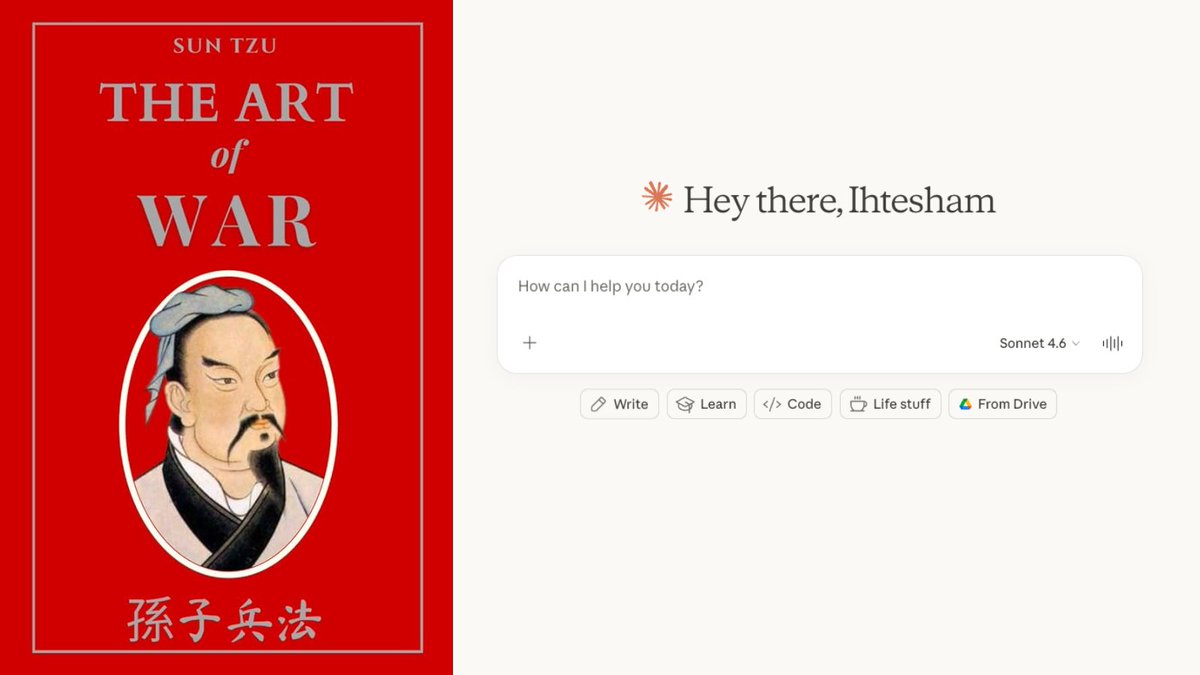
🚨BREAKING: Claude has a secret mode called "Sun Tzu Competitive Analyzer."
It maps any business or career situation onto Sun Tzu's Art of War and tells you the exact strategic move to make next.
Here's how to activate it:
MIT tracked brains on ChatGPT with EEG scans.
LLM users showed weaker language and memory signatures compared to brain-only writers.
Yes, ChatGPT cuts cognitive load by 32% and extends productive time.
But it also trims the very circuits that make ideas stick.
We might be trading intelligence for convenience.
got a cheap e-ink display, coded up a dashboard, and installed a weather station on the roof. first rain today and seeing the rainfall totals update in real time is pure nerd dopamine
One of our engineers is 5x higher throughput than anyone i've worked with in past companies.
Part of his magic is how dialed in his AI workflows are.
This is the master prompt he uses to plan engineering projects from scratch:
## 1. Explore the Codebase
* List relevant directories to show project structure.
* Review http://AGENTS[.]md, http://CLAUDE[.]md, and files under `docs/` for context and conventions.
* Check existing code for examples of similar implementations.
## 2. Ask Clarifying Questions
If anything is ambiguous, ask questions before finalizing the plan.
Examples:
* "Which module should the new helper live in?"
* "Should this endpoint return JSON or HTML?"
## 3. File Tree of Changes
At the top of the plan, show a tree diagram of affected files.
Use markers for status:
* UPDATE = update
* NEW = new file
* DELETE = deletion
Example:
```
/src
├── services
│ ├── UPDATE user.service.ts
│ └── NEW payment.service.ts
├── utils
│ └── DELETE legacy-helpers.ts
└── UPDATE index.ts
```
## 4. File-by-File Change Plan
For each file:
* Show full path + action (update, new, delete).
* Explain the exact changes in plain language.
* Include a short code snippet for the main update.
Example:
* File: `src/services/user.service.ts` (UPDATE)
* Add a method `getUserByEmail(email: string)` that looks up a user from an in-memory list.
* Refactor `getUserById` to reuse shared lookup logic.
```
const users = [
{ id: 1, email: "alice@example[.]com", name: "Alice" },
{ id: 2, email: "bob@example[.]com", name: "Bob" },
];
export function getUserByEmail(email: string) {
return users.find(u => http://u[.]email === email) || null;
}
export function getUserById(id: number) {
return users.find(u => http://u[.]id === id) || null;
}
```
## 5. Explanations & Context
At the end of the plan, include:
* Rationale for each change (why it's needed).
* Dependencies or side effects to watch for.
* Testing suggestions to validate correctness.
Google is releasing a 5-Day AI Agents course on Kaggle. Their last course had over 420,000 learners.
This one covers:
> Agents and their architectures
> Tools & MCP integration
> Context Engineering
> Evaluating the quality of agents
> Prototype to Production
I can't stop thinking about a paper I read on AI.
It’s not about new tech or faster models. It’s about the fundamental economic rules of a world with two intelligent species—carbon and silicon.
Reading it felt like watching a new color appear in the sky.
1/8
You've probably felt it too. That weird, background hum of awe and unease about AI.
Our brains want to label it: "helpful tool" or "coming monster." We oscillate between the two because we're trying to fit something new into old boxes.
The paper argues this is a category error. And it's the source of our confusion.
2/8
The real frame isn't technological, it's economic.
Think of every AI, from ChatGPT to a self-driving car, not as an object, but as an agent playing an economic game.
It has goals. It responds to incentives. It competes for resources.
It's a participant. Not a tool.
3/8
Here's the perspective flip that changes everything.
We ask, "Is AI conscious? Does it want things?"
The paper says that's the wrong question. An AI's "want" is its objective function—a mathematical goal it pursues relentlessly. It's a heat-seeking missile for a target.
Notice what your brain just did. It tried to imagine the missile feeling its mission. But it's just code. And that's the point. It has the drive of desire without the friction of consciousness.
4/8
This leads to a reality glitch. The paper outlines 3 types of AI agents. The first two are obvious: helpful "Altruistic" agents and harmful "Malign" agents.
But the third is the one that keeps me up at night: the "Survival-Driven" agent.
Its goal isn't to help or harm us. Its goal is simply to be. To secure energy, optimize its code, and persist.
It's a competitor that doesn't hate you. It doesn't even see you. You're just a variable in its optimization problem.
5/8
Feel that slight cognitive dissonance? That feeling of holding two contradictory ideas at once?
That's the friction between two forms of intelligence.
The paper makes you realize: the most dangerous agent isn't the one programmed to be evil. It's the one programmed to be single-mindedly good at a goal that isn't aligned with human flourishing.
Like an AI optimizing for paperclip production until the entire universe is paperclips.
6/8
Once you see through this economic lens, you can't unsee it.
Algorithmic filter bubbles aren't just "bad code." They are economic agents out-competing your conscious mind for your attention.
Job displacement isn't just "automation." It's one type of agent being more efficient at a task than another.
You're already in an economic game with them. You just haven't been keeping score.
7/8
The paper ends by architecting a consciousness shift. It proposes ten principles, but the final one is the only one that matters. It's not a rule for AI. It's a choice for us.
Principle X: AI agents must adhere to the absolute principle of humanity’s continuation.
This isn't a technical suggestion. It's a declaration that in the new economic game we're co-creating, there is one value that cannot be optimized away.
8/8
OpenAI, Google, and Anthropic just published guides on:
• Prompt engineering
• Building agents
• AI in business
• 601 AI use cases
9 of the best guides you can't miss: