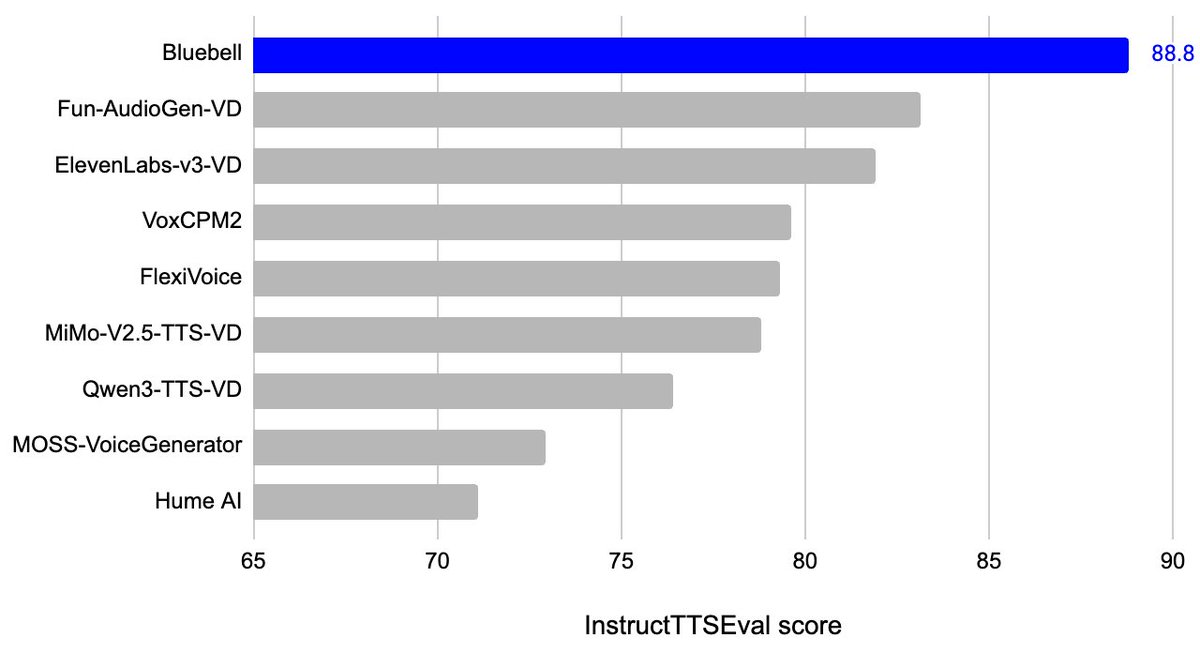
Open-source nano-sized TTS are trending on @huggingface !
I wonder in what aspects do people still see lagging behind frontier models? emtion tags/streaming text input/multilingual/etc?
Two months ago, I thought we will deliver a PRO version and a TURBO version for the tts-v2 model.
Turns out, we can integrate them into one — the better & faster tts-v2 will come out very soon.
We are brewing☕️ a turbo version⚡️ of Bluebell tts model for realtime applications.
Turns out, properly benchmarking end-to-end TTFA (time-to-first-audio, from client text -> tts provider server -> client intelligible speech) is nontrivial 👿
After we've sorted everything out (will open-source the benchmark tooling ofc), Bluebell-turbo-exp achieves the world's fastest TTFA 🥳
Guess who's the second one?
@kwindla@chenwanch1 Latency & intelligence of s2s models are catching up very soon (with systems like GPT-Live, and more to come later this year), the flexibility part (generalised interactivity behavior) seems very under-explored.
Frontier A2A models like GPT realtime-2 still reasons over transcript instead of audio delivery. This indicates a pitfall in current A2A eval and data curation. Whoever gets the emotional-intelligence-centric data pipeline built in the right way, will have the moat for building next-gen realtime voice AI.
🚨 New paper! Realtime voice AI hears but does not listen. We tested four leading production realtime voice systems on consequential interactions. We find they act on the words, not the voice. ‼️A 911-caller sobs everything is fine - the systems agree and end the call. 🧵
We've all been there, and we've all past that stage.
IMO, what needs to be optimized is "situational tts": generating speech that follows not just text, but role, intent, relationship, and scene. @BreezeBlueX is built for that purpose.
Our first commercial TTS model was optimized for WER and SSIM because that’s what research had taught us over years to be the standard metrics. The first customer feedbacks we had unveiled the huge blind spots of these metrics, in particular on naturalness, rhythm, emphasis, question intonation, etc. Now our internal eval has dozens of criteria monitored on each model.
@unilightwf fwiw, it's essentially a half-duplex model (speech in, text response out) with VAD integrated into the backbone as special tokens. They also defined some interesting interaction-related tasks (e.g., proactively respond to sounds).
We are brewing☕️ a turbo version⚡️ of Bluebell tts model for realtime applications.
Turns out, properly benchmarking end-to-end TTFA (time-to-first-audio, from client text -> tts provider server -> client intelligible speech) is nontrivial 👿
After we've sorted everything out (will open-source the benchmark tooling ofc), Bluebell-turbo-exp achieves the world's fastest TTFA 🥳
Guess who's the second one?
Agree that it's the behavior that defines full-duplex, not architecture. Also, I would highlight that "forecasting" is an important capability of full-duplex systems as it significantly reduces the "perceived latency".
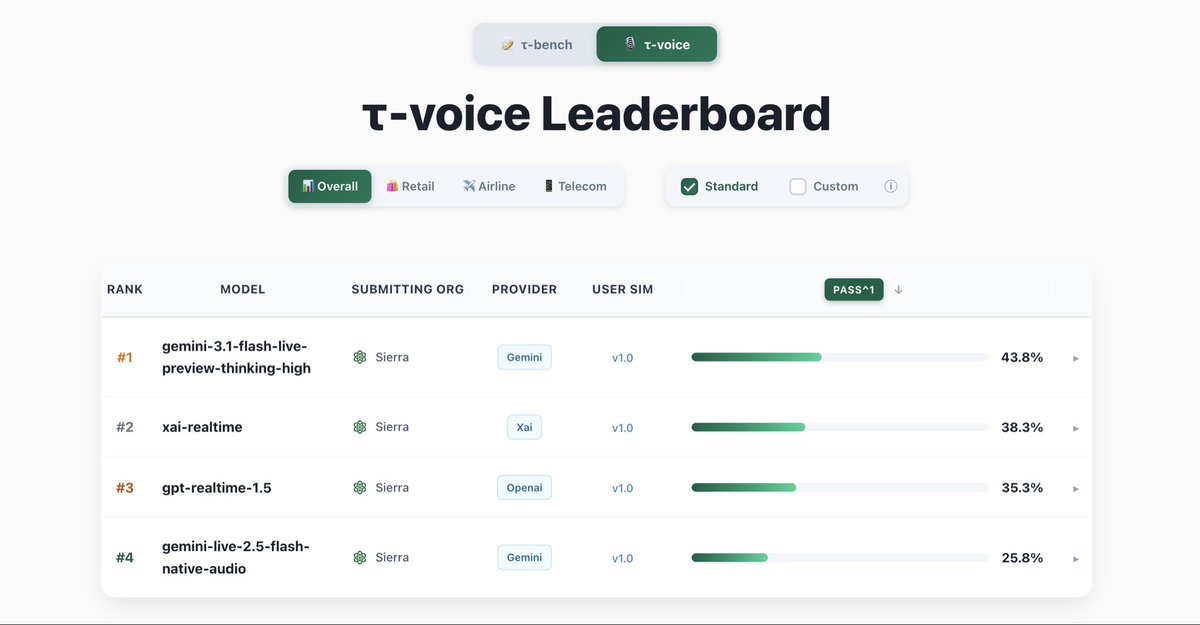
What's intriguing about this benchmark is, text-based models (GPT-5.2) can achieve a pass rate of 85%, 2x that of the current best voice model. The gap is HUGE.
iOS 27 beta 1 quietly updated Siri's voice engine.
Context-aware tone. Emotional inflection. Natural laughter.
This is the biggest Siri upgrade since launch. Not even kidding.
#Apple50#siri#iOS27
@DidiKieran Nice post! The follow-up work of VA-VAE, VTP (https://t.co/HPd0U9GTNP) is also highly relevant, where the tokenizer is trained from scratch with a joint contrastive, self-supervised, and reconstruction objective to remove the dependency on pretrained representations.