We put a lot of research and extensive co-design into making our encoder models powerful for classification and embedding tasks. Glad people have started noticing it.
Check out the models here: https://t.co/plK44NbBcd
Read the blog: https://t.co/ncPPM64vQa
📘 The Illustrated ModernELECTRA: a new pre-training recipe for BERT-like models that achieves frontier classification and embedding performance.
Our new article is out on the @huggingface blog. It explains in 9 animations how to pre-train a small encoder that is strong at classification and still works as a backbone for embeddings, and it comes with two open models trained this way.
BERT-base needs 110M parameters to get 84.7 on GLUE, while EdgeCoder gets 86.0 with only 31M. The same holds against newer multilingual models: mmBERT-small gets 84.7 with 140M parameters, and EdgeCoder-Multilingual gets 85.1 with 61M. On the multilingual XTREME benchmark, on the languages it covers, it is only about 2 points behind mmBERT-small (67.8 against 70.0) while being more than 2x smaller.
The article also includes the training data, the full result tables, and code for fine-tuning the models and for using them as a backbone in GLiNER and GLiClass.
Read it on Hugging Face: https://t.co/Raxzdy6aF0
The article is on the @huggingface blog: https://t.co/GifFvmlBt2
There is also the multilingual model for 46 languages in it, which beats mmBERT-small on GLUE while being more than 2x smaller, and on XTREME it's only about 2 points behind.
We wrote The Illustrated ModernELECTRA, basically it's our whole pre-training method shown in animations, so you can see why a 31M BERT-like model ends up better on GLUE than BERT-base with 110M (86.0 vs 84.7) without reading the paper 👇
ModernELECTRA: Replaced-Token Detection with Boundary-Window Reconstruction for Compact Encoders that Classify and Embed
@bioMikeee et al. add token reconstruction to ELECTRA to build small encoders that classify and embed.
📝 https://t.co/Z7eLu9NKme
🤗 https://t.co/TDTVMn2QpX
We are pushing the performance–size Pareto frontier with this release🚀
Meet a series of compact encoders trained from scratch that performs well for embedding and discriminative tasks.
More than a year of research at @knowledgator. Here is what we learned 👇
Everything is open, we did it at @knowledgator, and here are the links:
Paper: https://t.co/KZddWVUrM7
Blog: https://t.co/ZC9mTwHS5R
English: https://t.co/7GngKOsJFS
Multilingual: https://t.co/CnxCOPXn3P
ELECTRA is back, and this time it can embed.
We've been working on ModernELECTRA for a few months. Basically, it's a way to pre-train ELECTRA-style encoders so they are good not only at classification but also as backbones for embedding models, and today two models are out 👇
And the multilingual one, EdgeCoder-Multilingual-61M, covers 46 languages and beats mmBERT-small on GLUE while being less than half its size, and both models work with up to 8192 tokens of context.
So the problem is that ELECTRA and DeBERTaV3 are still some of the best classifiers for their size, but when you try to make an embedding model out of them they fall behind a lot, for example DeBERTaV3-base gets about half of what BERT-base gets on BEIR with the same fine-tuning.
As a result EdgeCoder-31M gets 86.0 on GLUE, which is more than the other encoders of this size we compared with and even more than BERT-base that is over 3x bigger, and on MTEB it's on the same level as them.
So we added one small task on top of that: for each token we take a window around it and predict the token using only the two states at the edges of this window, which means every state now has to know about its neighbours, and that's exactly what you need for embeddings.
And the reason is actually pretty simple, the model only learns to say for each token if it was replaced or not, which is one bit, so it never needs to remember what the token was or what is around it, and when you average such states into an embedding there is not much left.
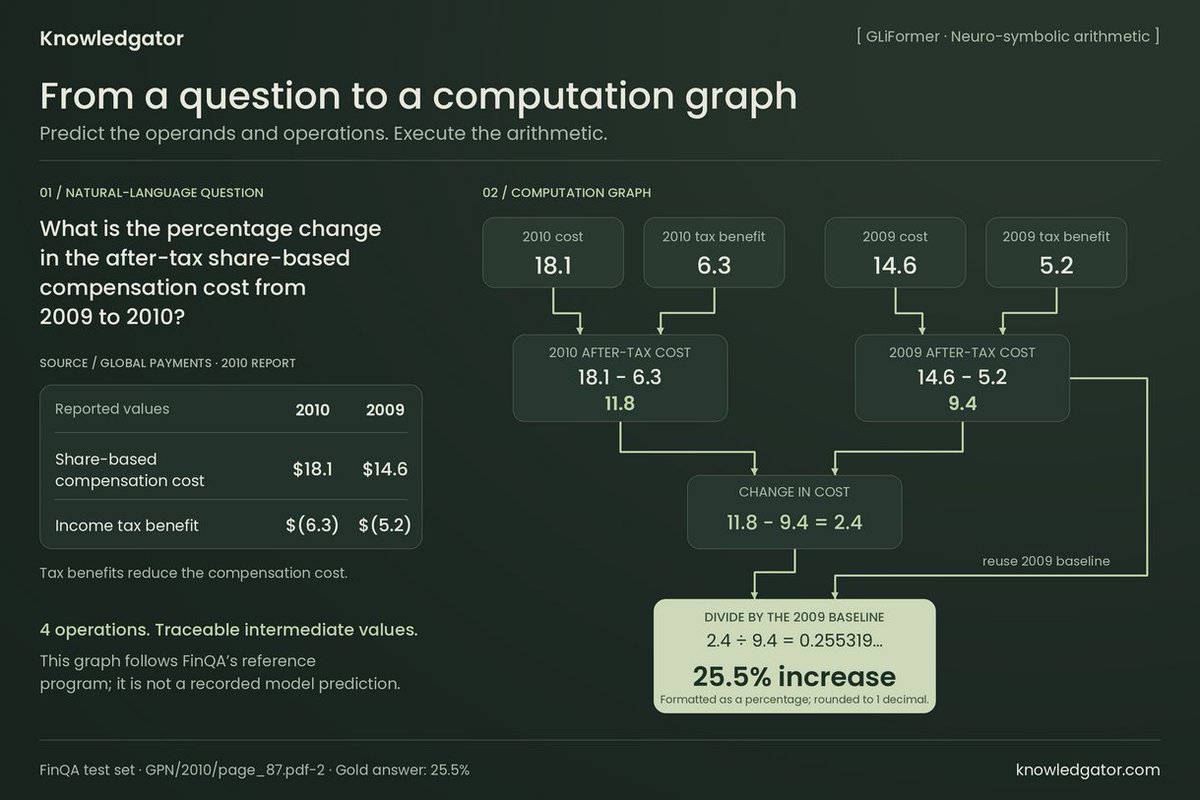
While Claude tackles the Riemann hypothesis, we went for something less ambitious but useful every day: arithmetic from natural language.
We built the most versatile system one model that can also solve arithmetic tasks from natural-language requests by reconstructing a computational graph. This approach is more reliable and accurate than the regression approach Clairic uses. As a result, the 500M model beats 27B in such tasks.
What is exciting is that we solve JSON information extraction with a similar architecture. We believe neuro-symbolic approaches are the way to ensure accurate, reliable systems.
Today we’re releasing the most versatile family of System 1 models🚀
Right now, you can instruction-tune the model and solve many tasks 100x faster and more reliably, including classification, hierarchical extraction, editing, computing, and more:
https://t.co/04uhJslqJT
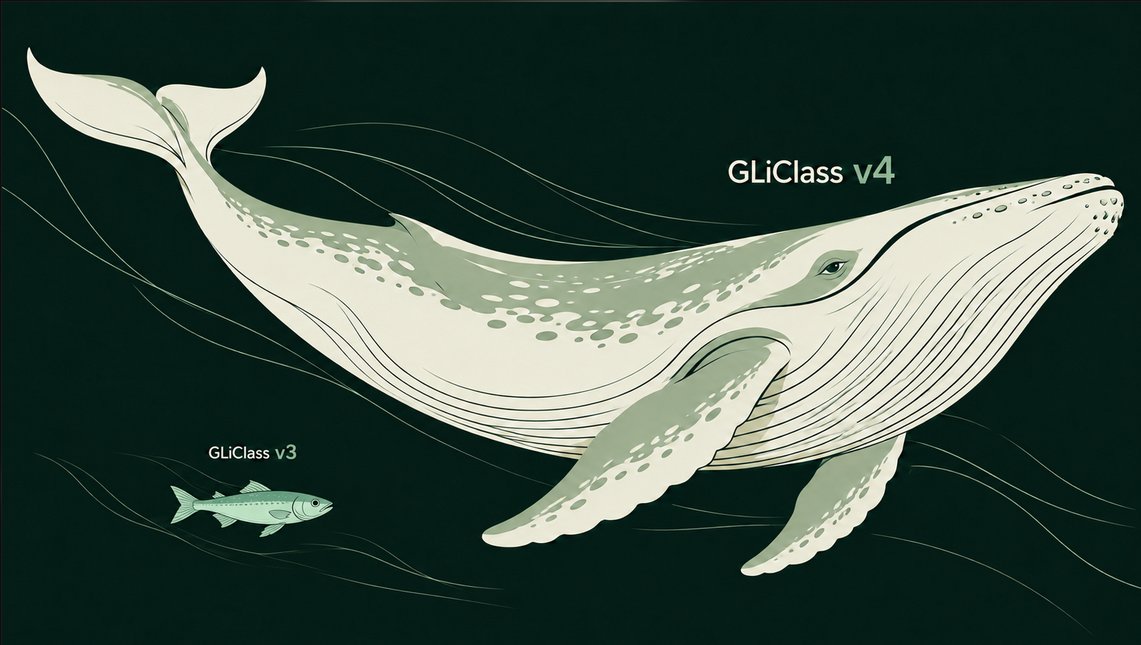
🚀 Introducing GLiClass v4: our most general and parameter-efficient model family.
The edge model reaches 4B-class accuracy on Decision Index with just 435M parameters, while the 27B version performs better than Jev on many of our benchmarks.
The release presents 3 ways to scale decision models: model size, latent reasoning, and graph reasoning.
Many people asked me about the GLi* evaluation tree, and this post is all about it.
Actually, the story starts before GLiNER.
In 2022–2023, Chinese research teams and international collaborators explored several complementary approaches. UniMC (2022) framed zero-shot classification as multiple-choice prediction, encoding text and candidate labels together. USM (2023) matched schemas with text through token-level links, unifying entity, relation and event extraction. UniEX (2023) combined span detection, classification and relation extraction within one schema-driven extraction framework.
On October 2023, Knowledgator published “As GPT4 but for token classification”, showing prompt-guided token classification for NER, question answering, relation extraction and other tasks.
In November 2023, Urchade Zaratiana, and colleagues introduced GLiNER, using a bidirectional encoder to match text spans with entity labels supplied at inference time. Trained on the UniversalNER team’s Pile-NER dataset, it reported strong zero-shot NER results against the evaluated LLM baselines. I was excited about it, subsequently joined its development, and continue to co-maintain the project.
In April 2024, Urchade and colleagues introduced GraphER, a related research direction that models entity and relation extraction jointly through graph structure.
That June, Mykhailo Shtopko and I introduced GLiNER multi-task, extending the approach to question answering, summarization, and relation extraction. Our team also released GLiClass and bi/poly-encoder variants in 2024.
In 2025, Jack Boylan and colleagues introduced GLiREL for zero-shot relation extraction; Robin Armingaud and Romaric Besançon developed GLiDRE. And Urchade and the Fastino team released GLiNER2, combining NER, classification, relation extraction, and structured extraction.
In 2026, our team introduced GLiNER-Relex for joint entity and relation extraction. Fastino continued with GLiNER2.5 in August, adding boundary-based extraction, longer context, and constrained joint decoding.
And this September, we released GLiFormer. It brings entities, relations, classification, PDF processing, and nested records into one framework with a shared encoder. For hierarchical extraction, it grounds values in the source, groups them into records, and predicts their relationships before assembling JSON.
I’m proud of our contribution and grateful to all researchers, contributors, and users helping this ecosystem grow. Looking forward to more exciting contributions from the community.
GLiClass (open-source Jev, before Jev existed) has landed in OpenClaw 🔥
Run it locally via ONNX for lightweight agent decisions instead of spending a full LLM call on every small choice.
Learn more about GLiClass here: https://t.co/GrFt7fwWKy
Jev is cool. But the hype is revealing: there are many other types of models other than the current general purpose LLMs.
Rebuilt the core browser-use loop with GLiClass (https://t.co/ZyZXCTmN3R) running on my Mac:
LAX → Tokyo in ~4s.