Together with @AlexSmechov, we are releasing Opir: an efficient family of multi-task safety classification models for toxicity, jailbreaks, hate speech, and harmful content.
https://t.co/Fo2apovAMG
8 months ago, we released our GLiNER PII models.
On the Nemotron-PII test dataset, evaluated independently using the PII Masking Benchmark methodology, our model shows the strongest NER-based performance among the evaluated models.
Nemotron-PII is especially interesting because NVIDIA open-sourced it 1 month after our release. For models released later, or trained on benchmark-related training data, data contamination is harder to rule out.
The dataset is diverse and realistic: plain text, invoices, transcripts, tables, and more.
Over the past 8 months, our models have been battle-tested in real-world deployments, including hospital environments, and used by thousands of developers.
Models:
https://t.co/jEpiDmFjhh
We are excited to share our new paper:
“GLiNER-Relex: A Unified Framework for Joint Named Entity Recognition and Relation Extraction.”
https://t.co/rblN2vvnsH
@m_newhaus@DataChaz Haha, maybe, and I actually helped a bit with it 😅. But it's fine for me, I am thinking more about getting GLiNER to the place it deserves.
@m_newhaus@DataChaz True, especially given how much more attention the OpenAI privacy filter model received, despite being much less flexible. We need some more creative ways to popularize GLiNER.
GLiClass Multilang extends GLiClass from English-first zero-shot classification into multilingual and cross-lingual classification without giving up the efficiency profile of the original design.
What changed:
- native training on 20 languages
- cross-lingual inputs and labels
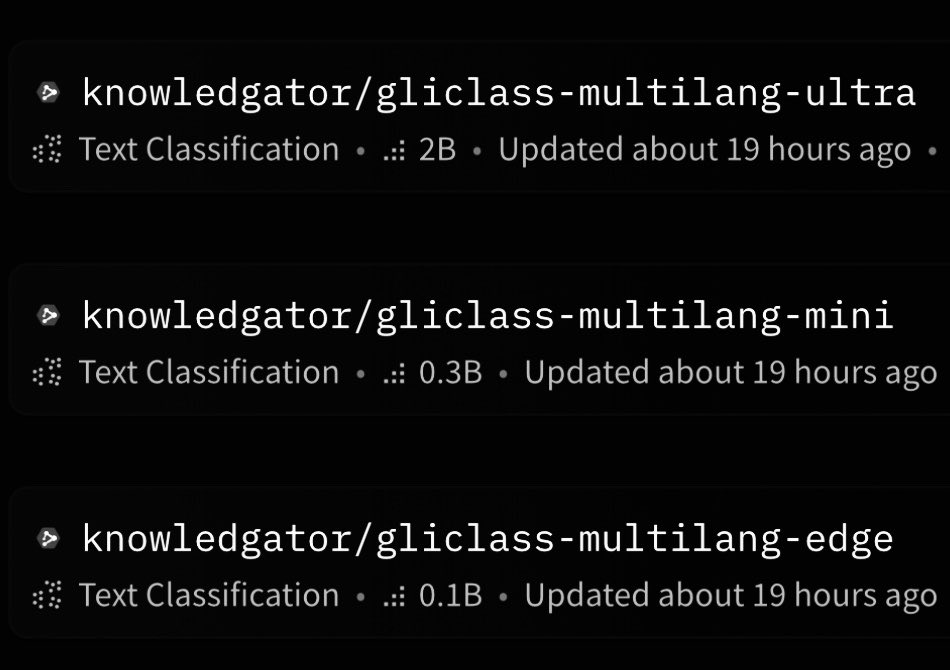
- 140M, 288M, and 1.72B model tiers
- new CrossAttn scorer with per-label pooling, unpadding, and flash-attn
- hierarchical labels through dot notation or dictionaries
- few-shot examples, label descriptions, and task prompts
- support for topic, sentiment, intent, reranking, hallucination detection, rule-following, safety classification, and NLI
The numbers are strong.
- multilang-ultra reaches 0.7212 English avg F1 and 0.5599 multilingual avg F1 at 200.7 samples/sec.
- multilang-mini gets 0.6827 English avg F1 and 0.5378 multilingual avg F1 at 513.4 samples/sec.
- multilang-edge keeps the footprint small at ~140M params while still hitting 553.6 samples/sec.
The important scaling detail: NLI-style baselines like bge-m3 and mDeBERTa need one forward pass per label, so throughput falls almost linearly as label count increases. GLiClass encodes all labels in one pass, so it remains usable for large taxonomies, multilingual moderation, routing, safety filters, and guardrail classification.
🌍 Meet SoTA Multilingual Classification Models at 140k tokens/s
We’re excited to release a new line of GLiClass models focused on the combination that matters most in practice: strong multilingual performance, zero-shot flexibility, and high inference efficiency.
We optimized the model implementation, introduced a new scoring mechanism, and improved our synthetic data generation approaches. All of it allowed us to achieve results better than those of all cross-encoders and GLiNER-based models we tested so far, while being many times faster.
This release includes 3 models with 100M, 300M, and 1.7B parameters, enabling them to run from mobile devices to production jobs on GPU machines.
The models were explicitly fine-tuned on 20 languages and can generalize beyond them, thanks to encoders pre-trained on 100+ languages. The model has strong cross-lingual abilities, meaning that your labels and input text can be in completely different languages.
On modern GPU hardware, our base model reaches up to 140k tokens/sec throughput, and remains highly efficient across larger label sets thanks to our single-pass classification architecture.
In addition to topic classification, the models support safety classification, sentiment analysis, and intent classification.
🔗 Find all models @huggingface : https://t.co/Bn951252Go
If you want a whole system built around anonymization, PII detection (even more categories than OAI’s), and privacy rewriting, check out NeMo Anonymizer and Nvidia GliNER PII!
@Pranav2278@cohere Thanks for sharing! Actually, there have been many new updates in the GLiNER world since then. It will be nice to organize a new lecture.
I’m hearing there’s renewed lobbying in DC and in state legislatures to ban or severely restrict open-source.
Like a few years ago, we’ll need everyone to help show policymakers why open-source matters: for startups, for competition, for economic growth, and for jobs.
If you build with open-source, now is the time to speak up!
@communicating@mervenoyann Thanks. In general, we are super open-minded and use various technologies to build highly accurate and efficient information extraction systems.