Looking for a cost effective way to track your brand AI Search Share of Voice? @RyanJones has launched FreeSOV for it: Free AI share of voice tool... just bring your own API keys 👇 It features everything you need to measure AI search visibility:
* Visibility Score: A single rolling metric, the % of AI executions where your brand appeared. Trend it daily, compare it to last month.
* Citation & mention share: Per-source breakdowns of how often you're cited as a source vs. mentioned by name and where competitors edge you out.
* Query fan-out: See the sub-queries each LLM internally rephrases your prompt into. See what topics/keywords AI mentions the most in answers.
* Sentiment: Each brand mention is scored positive / neutral / negative so you can spot when the tone of the AI's answer is working against you.
* Per-source cost: Daily API spend attributed to whoever bills you - DataForSEO vs. your direct OpenAI / Anthropic / Google / Perplexity keys.
High on features, light on cost.
Check it out: freesov(.)com
I’ve spent the last 18 months doing AI SEO / GEO / AEO for B2B SaaS companies... and here's the 10 biggest things I've learned:
1. Most companies do not have an "AEO problem." Most do not have an unfixable technical SEO problem either. They have a positioning, category alignment, and market validation problem.
2. I've spent too many hours in meetings explaining how the old-world SEO model is dying (clicks and rankings) and the new model is about being selected for AI-powered answer recommendations.
3. Brand selection depends on whether the market, your website, your customers, and third-party sources all tell the same story about why your brand belongs in the answer. This is not about llms.txt or paragraph chunking.
4. Bulldozing your way to the top with listicles and backlinks may help you rank, but not get recommended. Especially if your brand doesn't belong in that category.
5. The best AEO strategy starts with positioning and category alignment.
Here is the proper diagnostic framework for: “What's our AEO strategy?”
Do we have clear product positioning?
Do we have messaging that's aligned to the category?
Does the website make our category alignment obvious?
Do we have a BOFU content strategy aligned with the desired category?
Do we have an external authority gap?
6. AI referral traffic is negligible for most B2B SaaS companies.
For most of the companies I work with: ChatGPT / Perplexity / Gemini / Claude, etc. is a tiny fraction compared to Google.
It's common to see a range of 5% (AI) vs 95% (Google).
Why? Because AI SEO eliminates top of funnel, whereas traditional SEO sends mostly informational traffic.
7. Visitor to page conversion rates from AI referral traffic tend to be higher than traditional Google traffic.
This is because of personalization, long-tail BOFU intent, and the elimination of TOFU intent.
8. There's a "Dark SEO" funnel emerging where buyers are shortlisting vendor options with AI search, verifying the brands they want to evaluate with Google search, and then converting directly on the website from branded search much later in the buying process.
9. Off-site authority matters, but the GEO vendor claims are getting out of control. I'm skeptical on things like: “90% of AI visibility comes from third-party sources.” etc.
Claims like these are confusing and pulled out of context. This causes marketers to have the wrong reactions and think irrationally.
10. Buying AEO tools is not a strategy. I have personally worked with companies that purchased AEO tools with no strategy in-place. The mere fact that a tool was purchased only buys them time with the board... "we're working on it" ... but it's not a real strategy.
Bonus: There's a "research" study out there which fits any narrative you want to push. Be wary. And be skeptical.
25 AEO, GEO, LLM SEO facts 📠 (to stop you from wasting money on something that doesn’t work)
1. AI visibility can refer to mentions or citations. (Mentions = being named by AI in the answer, citations = being linked).
2. SEO directly influences AI citations. Want to show up for “explain x”. Well you need content that explains x so your website can be cited. Good luck being cited for anything competitive without implementing SEO basics
3. SEO, marketing, your reputation & just doing business can ALL influence AI mentions. Want to be known for something? Well you need to say it on your owned assets and then other sites need to say it too. think of AI as a parrot 🦜
4. the latter 3 can also influence SEO, but that’s for another day.
5. Being mentioned does not = automatic success. The clickable links within AI may lead websites that don’t link to you. This increases friction for customers to visit your website. (Also, if websites don’t link to you and just mention you, how will you be found) [✨links are still important ✨]
6. Being cited does not = automatic ai success. You could be the 17th citation (that’s like being on page 6 of Google). Doesn’t mean anything.
7. AI mentions and citations are infinite. You can be mentioned and cited for an infinite number of queries. Likewise, you can track an infinite number of prompts 🌌 (track your main keyword within a prompt, you’ll be fine)
8. One highly successful TOFU webpage could have 100s of citations in an AEO tool (what is y, why explained, explain y so a 5 year old can understand).
9. One highly successful BOFU page may only have a few citations (y software, what’s the best y, what’s the best y product that solves for z)
10. No one on this earth has proven ROI after implementing an llms.txt file
11. No one on this earth has proven ROI after implementing schema for LLMs
12. Being on Reddit does not guarantee AI visibility. Being mentioned on Reddit in a positive or negative way can influence sentiment of your brand in AI answers
13. Different AI systems behave differently. Showing up in Google AI Overviews does not automatically mean visibility in ChatGPT, Claude, Perplexity or Gemini
14. Don’t sacrifice your Google rankings just to chase AI visibility. It could take 2, 3 years to recover
15. AI search with web search enabled uses data from search engines to form an answer
16. It can take years to influence true LLM training data
17. A strong brand can outperform a technically “better optimized” website in AI answers because LLMs take into account the stuff mentioned in point 3
18. You cannot optimize for every prompt variation individually. Focus on topical depth and building out the stuff in point 3
19. Remember AI being a parrot? 🦜 AI systems can confidently repeat incorrect or outdated information if enough sources on the web repeat it, so control the narrative
20. You don’t need to chunk your content. Just make your content readable
21. Every heading does not need to be a question
22. there is no universally accepted attribution model for AI search. A user may discover a brand in AI, then convert weeks later through branded search, direct traffic or another channel.
23. That said, AI Search is both a brand and performance marketing channel
24. You don’t need a prompt tracking solution if you’re just getting started. Ask AI questions about your brand - now you have something to work with.
25. Mass publishing content is not the answer to winning in ai search
What did I miss?
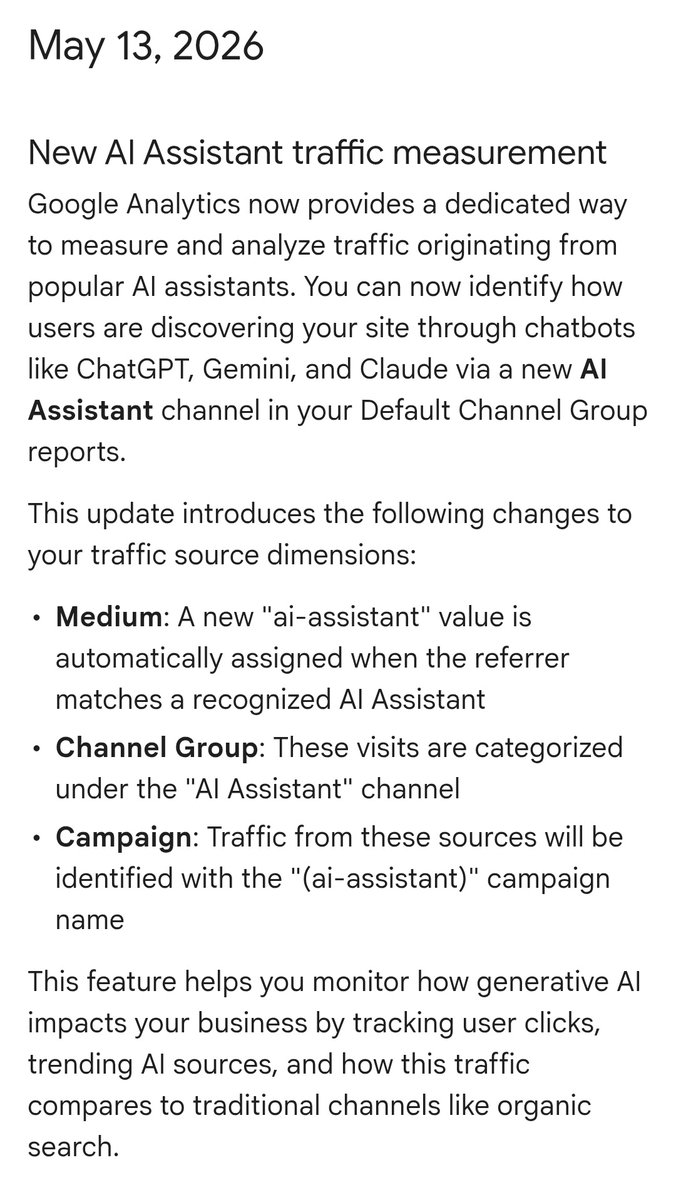
AI search is exploding, creating a massive blind spot for website traffic. While clicks are shifting, visibility shouldn't ✖️
GA is introducing automated AI Assistant traffic measurement. Track & trend human traffic from top chatbots directly in reports → https://t.co/9bwQ0yBLsY
This video is a call for help.
My mum is battling with stroke, and it is slowly taking her life. She needs urgent medical funds to stay alive, and I cannot do this alone anymore. Please, if you have it in your heart to help or retweet this to someone who can, I beg of you 🤲🏻🙏
What Moniepoint had done for the SME space is not talked about enough. So many merchants getting working capital loans without having to bring an arm and a leg.
Big shout out to @SycamoreNG as well.
In the last 6 months at @Ahrefs, we analyzed over 1 billion data points across 14 studies. Here's what we learned about AI search optimization:
1) "Best X" blog listicles are the single most prominent content format cited by AI chatbots. They make up 43.8% of all page types cited by ChatGPT specifically.
2) 67% of ChatGPT's top 1,000 citations come from sources marketers can't influence: Wikipedia (29.7%), homepages (23.8%), app stores (6.6%). Only 32.3% are influenceable content like educational pages, reviews, news, and blog posts.
3) 28.3% of ChatGPT's most-cited pages have zero Google organic visibility. These pages get cited repeatedly by ChatGPT despite not ranking in Google at all. A completely separate discovery layer.
4) ChatGPT only cites about 50% of the URLs it retrieves. It fetches dozens of pages per query but uses half as background context without attribution. This means that being retrieved and being cited are very different things.
5) Adding schema markup had zero meaningful impact on AI citations. AI Overviews actually dipped −4.6%, while AI Mode (+2.4%) and ChatGPT (+2.2%) showed changes indistinguishable from zero.
6) YouTube mentions have the highest correlation (0.737) with AI brand visibility out of all the factors we studied (including all the conventional SEO metrics like backlinks, page count, DR, etc). This held true for both Google-owned and OpenAI products.
7) AI Overviews reduce clicks to the #1 result by 58%. That’s up from 34.5% just 10 months earlier. The trend is accelerating.
8) 99.9% of AI Overviews appear on informational intent queries. Transactional, navigational, and local searches are almost entirely AIO-free. Shopping triggers AIOs just 3.2% of the time.
9) For a given search query, Google’s AI Mode and AI Overviews reach the same conclusions 86% of the time — but cite almost entirely different sources (only 13.7% citation overlap).
10) AI Overviews change every 2.15 days on average, with 70% of content differing between consecutive observations. But semantic similarity stays at 0.95. The words, sources, and entities constantly shuffle, but the actual meaning barely moves.
More evidence that the easiest and most reliable way to get your products cited in AI is by being mentioned in "Best X" listicles.
FYI something that's changed recently:
If you publish the "Best X" listicle on your site and rank yourself #1, AI Overviews and AI Mode have begun to ignore it.
So just publish those listicles on 3rd party sites.
And enjoy the AI mentions.
Three independent sources said the same thing: the GEO playbook doesn't work.
Frontier labs have already publicly hedged on what their systems can do. Ahrefs ran a controlled study and found no citation uplift. Last Friday, Google published documentation saying the prescriptions aren't needed.
The frameworks keep selling.
New on The Inference: Mt Stupid has a pricing page. 🔗👇🏻
https://t.co/MFcszV3NDO
In practice, I don’t really care what optimizing for AI Search is called: SEO, AI Search Optimization, AEO, GEO, or whatever the new acronym ends up being.
I’m the first one to adapt to the terminology clients use if it helps them understand the opportunity, get internal buy-in, and move faster.
However, the problem comes when a new label makes AI Search Optimization look like something completely separate from SEO.
Because this can backfire in two important ways:
First, it makes it less obvious to decision makers that SEO specialists are the best placed to own and grow this area.
And let’s be crystal clear: SEOs already understand how search systems discover, crawl, render, interpret, evaluate, rank, cite, and drive demand through content, links, entities, authority, technical accessibility, and brand signals.
Second, it makes it easier for tactics to be sold as “new” AI visibility solutions while being disconnected from SEO processes, quality standards, and search fundamentals… and this is where the risk becomes very real.
Google’s new guidance for optimizing for AI experiences makes it clear: SEO principles still apply in AI Search and has also clarified that its existing spam policies apply to AI Overviews and AI Mode.
Lily Ray’s recent analysis shows what can happen when AI-generated content is used as a scale shortcut to manipulate AI search visibility: it can backfire across both traditional search and the AI search experiences many sites are trying to win.
So yes, use the terminology that helps your stakeholders understand the opportunity, but don’t let the terminology make you forget what actually matters:
* AI Search doesn’t replace SEO, it expands where SEO needs to operate.
* Sustainable AI Search visibility won’t come from ignoring SEO best practices. It will come from applying them better across your own site and the wider ecosystem where AI systems learn, cite, validate, and recommend information.
PS: if you want to keep updated with the latest in SEO & AI search optimization without the fluff, subscribe to the free weekly #SEOFOMO newsletter and join almost 45K subscribers : seofomo(.)co
SEO Wins that brought 200K+ traffic:
1. Log in to Search Console.
2. Go to Performance ➟ Results.
3. Open any page URL.
4. Find keywords that are getting a lot of impressions, but aren't mentioned in your content.
5. Use them in your existing content.
You will see traffic growth...
Syndicating your branded content to as many social platforms as possible is the easiest "SEO hack" of 2026..
Every single brand weve tried this on during isolated tests has seen huge jumps in:
- Direct traffic
- Social traffic
- Name brand search queries
These are all ranking signals ^
Tertiary benefits:
- Parasite rankings for longtail keywords
- LLM citations from eating up top spots with parasites
- Increased indexing by adding links back to your website from social posts
If you arent doing this already, you REALLY need to get on it!
Google Analytics 4 indicará a partir de ahora el tráfico web que venga de la IA.
Google ha anunciado que la herramienta cuenta a partir de hoy con un nuevo canal para ello: 'AI Assistant'.
Así, desde ya será mucho más sencillo poder ver (y reportar) cuánto tráfico envía a tu web CharGPT, Gemini o Claude.
Puedes ver el anuncio en:
https://t.co/1w3Y08fTFv
What a time to be alive.
I now have an agent that will review my social traffic (big query) if it is lower than I like, it goes and finds older blog posts (greater than 12 months) that drove value, then it reviews all my recent highlights on the topic and generates questions for me, then it kicks off an AI interviewer to call me and interview me to get my perspective on what's changed since that post was published.
Then it mashes it up into a set of ideas and snippets for me to write a longer fresher post and try to get my social traffic (winning with humans) back where I want it to be.
This is how I want to push my team to use AI to scale content from subject matter experts with lived experience instead of low quality scaled content with Claude's "lived experience" + some brand guidelines.
Pattern I'm noticing with early stage companies I'm advising: VERY FEW THINGS ARE ACTUALLY WORKING.
I have to write that in caps. Because the marketing team is trying lots of things. More ideas. More experiments. More content. More campaigns. Stack the content schedule.
Ship more. Ship faster.
But instead, they would be better off shipping smarter.
When I dive into the analytics and numbers, you can see all the momentum comes from just a few high quality pages, or 1-2 campaigns that have real traction.
There's just so much noise happening.
I think teams need to dial down. Less noise, more signal.
Pretty sure Adam Goyette wrote something about this on his Substack... but can't find the post.
One of my pet peeves is that many SEOs haven't updated their mental model of how a mondern search engine works. So, I wrote it down for you.
https://t.co/8mTGPKqjOJ