💡 “It’s not what you make, it’s what you keep.”
— Robert Kiyosaki
Most investors focus on total return. 📈
I focus on sustainable income. 💰
What I want from an income ETF is:
✅ ~7% annual capital growth
✅ ~28% annualized yield
✅ Tax-efficient distributions
IS THAT TOO MUCH TO ASK FOR??? 🫣💯😬
What I don’t want is a 35% total return that comes from slowly eroding the capital base.
Why?
Because a fund can maintain a high yield percentage while the value of the asset declines. Over time, that means fewer dollars of income being generated from the same investment. 📉
A 28% yield on a stable or growing asset is far more valuable to me than a 35% total return that shrinks the machine producing the cash flow.
The goal isn’t the highest yield.
The goal isn’t the highest total return.
The goal is to build an income-producing machine that pays me today, tomorrow, and years from now. ⚙️💵
Protect the asset. 🛡️
Grow the asset. 🌱
Harvest the income. 💰
Thanks for sharing! Say’s Law in action: supply creates its own demand. The sewing machine made people desire full wardrobes they never needed before. LLMs are doing the same for learning. They make polished essays and correct answers so easy that students now crave something different. They’re creating demand for three things we didn’t teach as urgently before: judgment, originality, and synthesis.
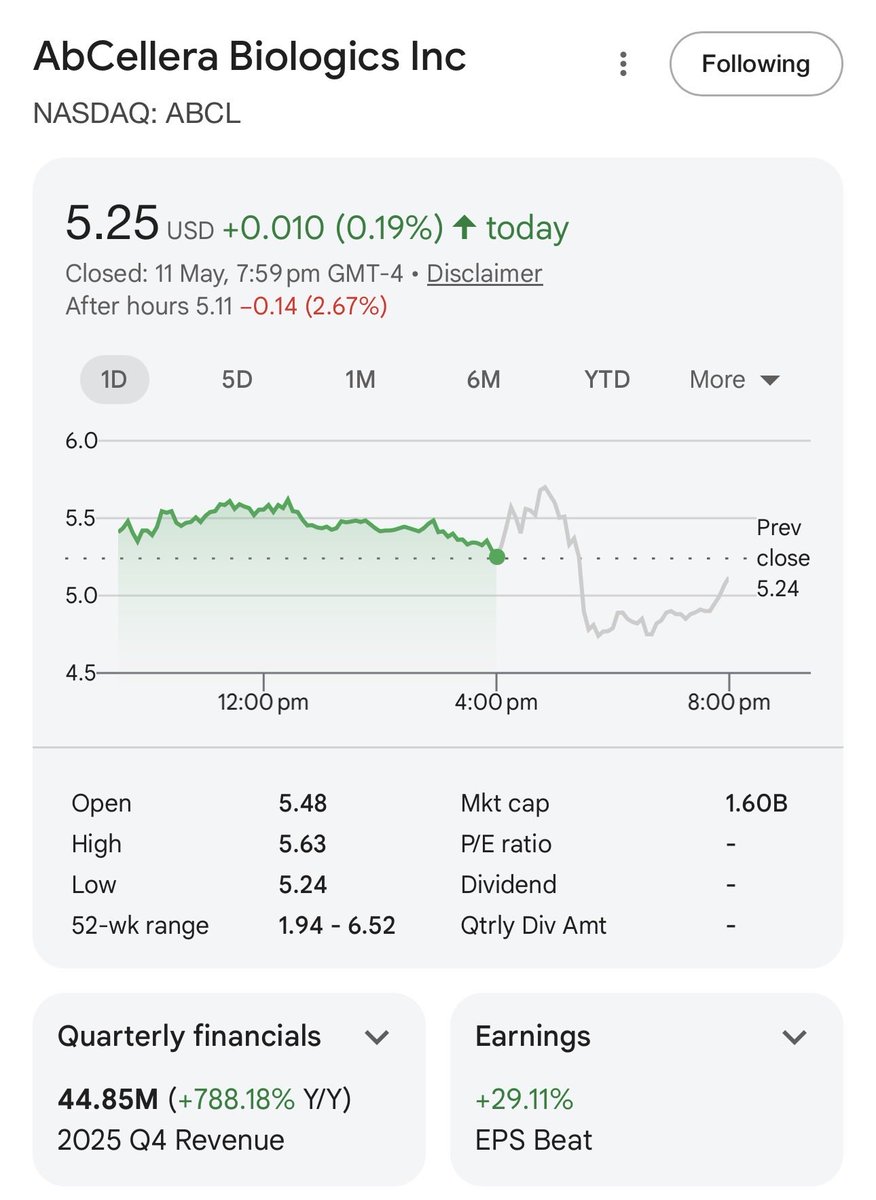
Do yourself a favor and read this over the weekend. Be prepared for your eyes to be opened and your mind to be blown. $ABCL has one of the best risk/reward profiles in the market. May it help us all attain generational wealth.
🚨 Emergency Funds Don’t Necessarily Have To Be “Dead Cash”
A Relatively Defensive Allocation Like This Could Generate Approximately:
• 8% Average Yield
• ~$4,000 Annual Income
• ~$333 Monthly Income
…On A $50K Emergency Fund
📂 Example Allocation Below 👇
This is genuinely the best and most useful peptide article on the internet right now.
By the end, you'll know more than 95% of people throwing the word "peptide" around.
$1,000,000 with the 4% rule = $40,000
$1,000,000 in $OVL = $105,000 annually.
Whats the tradeoff? It has to lose to the S&P right? Wrong.
$OVL wins on the 1 month, 3 month, 1 year, 5 year, and max timeframe.
Most people don’t know these funds exist. Don’t be most people.
A probiotic pill costs a dollar and contains dormant bacteria that stay asleep even after you swallow them.
If you take that pill and ferment it into yogurt, those billions of bacteria can turn into trillions.
This guy is putting up €1,800 to find out if this actually works:
How to Get Started in AI for Bio Research:
Sharing this old post from Nathan (now Anthropic's Head of Life Science) with my personal takes.
I summarized some key takeaways below:
1. Study whatever is "lowest in the stack" (fundamentals), e.g., Computer Science, Physics, Applied Math.
2. ML learning resources (These are my personal suggestions):
CS231N from Stanford: https://t.co/4MLWULpZ5h
Probabilistic Machine Learning: https://t.co/Kgv3YNnJFM
3. Biology learning resources:
Machine Learning in Computational Biology (MIT):
https://t.co/CqXlaTw67T
DeepChem tutorials (Deep Learning for Life Science): https://t.co/qmyI9a5LCz
4. Networking advice:
Get warm introductions via cold emails, meetups, and conferences.
Reach out and build connections before you need something. Build a reputation for doing and sharing good work.
"The premise required for the universe to function is the conservation of energy.
An object without energy is an image.
A person without energy is a ghost.
Money without energy is credit.
The cost to copy something is what creates scarcity. The idea of scarcity in money is that when money is conservative, everything else will be conservative. If money is non-conservative, the world goes insane.
The current problem is that there is no digital money—only digital credit. Politicians can create as much of it as they want, at any time, resulting in energy loss of anywhere from 10% to 90% a year.
For the first time in human history, we’ve invented a technology (Bitcoin) that allows individuals and corporations to bind economic energy to themselves.
This means you no longer have to suffer a premature and painful economic death."
—Michael Saylor