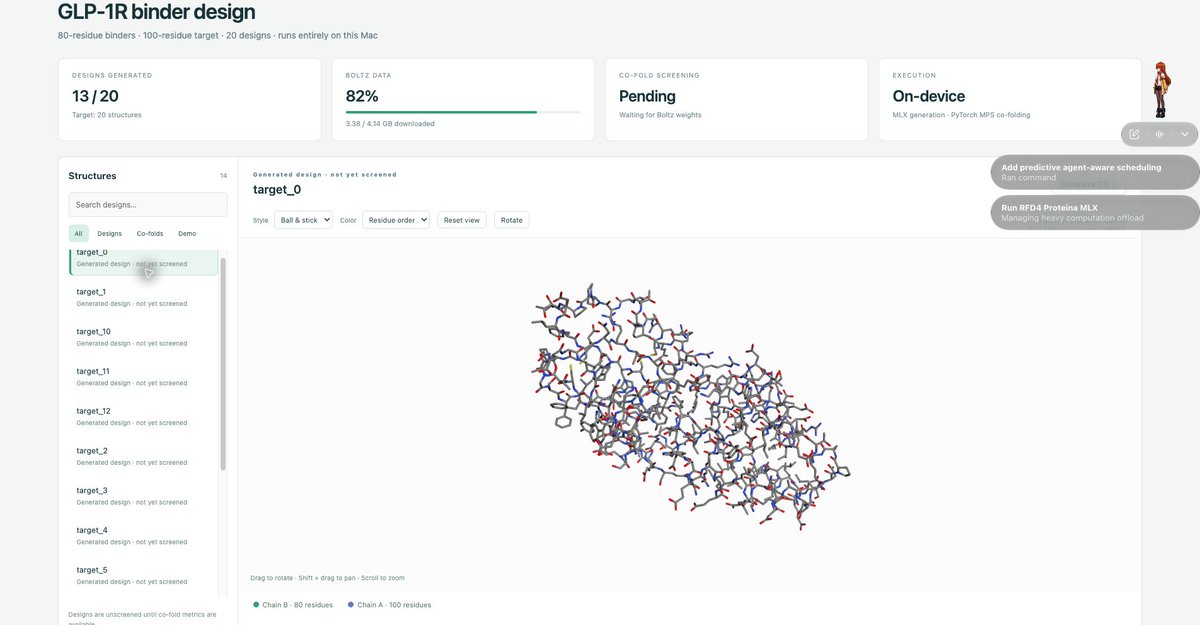
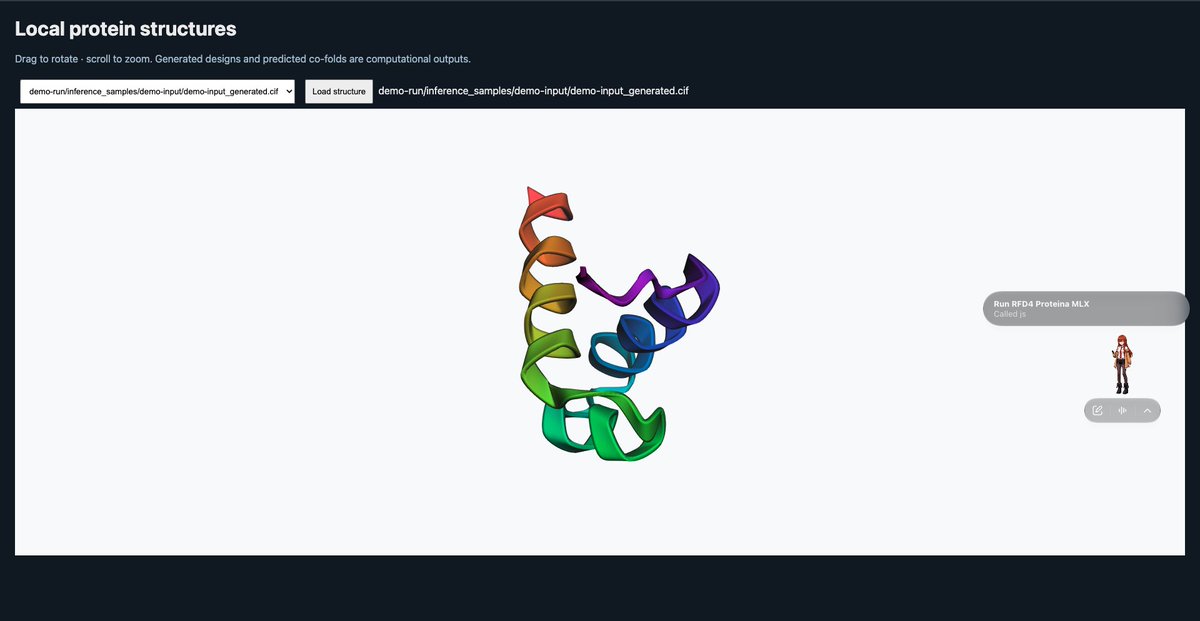
RFD4-Proteina now runs locally on a MacBook.
Introducing BIOS’s Mac port: generate candidate protein binders and screen their predicted structures locally.
Built with MLX and custom Metal kernels.
• 2.2× faster generation than stock PyTorch-MPS at its default precision
• 20 designs generated and screened → 10 ranked candidates in about 12 minutes on GLP-1R (M5 Pro)
We believe more researchers should be able to run AI experiments on their own hardware. Test ideas locally, keep your research private, and scale to NVIDIA GPUs when you’re ready. After setup, the workflow runs offline.
Watch it run below. ↓
Saturday, Nov 14 · Bangalore
Bring a research idea and a laptop.
Together, we’ll shape a hypothesis, create a live project on @openlabsbio, explore it with @biosdiscovery, try designing binders and discuss the path to funding.
Register: https://t.co/9E5sDiZGNm
Bangalore, join us and Lossfunk (@lossfunk) on Nov 13–14.
Friday, we explore drug discovery, from AI that designs molecules to robots that test them.
Saturday, we build a live research project together using @openlabsbio and @biosdiscovery.
Details & registration ↓
Friday, Nov 13 · 6.30 pm IST
What happens when AI scientists and robotic labs work side by side?
Join BIOS and Lossfunk to discuss biology research refusals, protecting researchers’ IP, drug design workflows and lab robotics.
Register: https://t.co/XjsiJ1mJjc
RFD4-Proteina now runs locally on a MacBook.
Introducing BIOS’s Mac port: generate candidate protein binders and screen their predicted structures locally.
Built with MLX and custom Metal kernels.
• 2.2× faster generation than stock PyTorch-MPS at its default precision
• 20 designs generated and screened → 10 ranked candidates in about 12 minutes on GLP-1R (M5 Pro)
We believe more researchers should be able to run AI experiments on their own hardware. Test ideas locally, keep your research private, and scale to NVIDIA GPUs when you’re ready. After setup, the workflow runs offline.
Watch it run below. ↓
Use BIOS’s RFD4-Proteina port to generate binders on your local machine for the @adaptyvbio × Anthropic protein design competition.
Submit on https://t.co/czv8WhZUbs until November 8th.
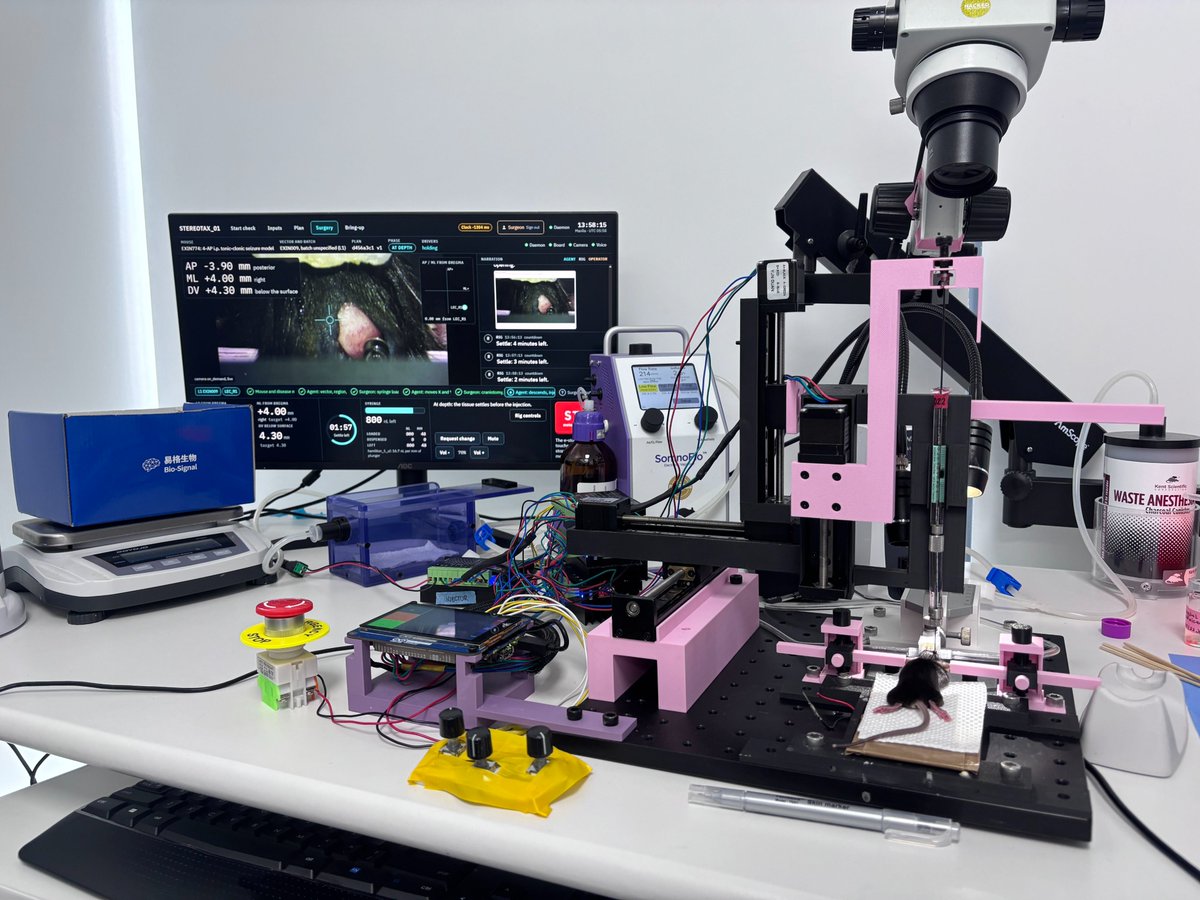
Last night an AI agent performed brain surgery on a mouse.
We gave it 19 gene therapy vectors in a spreadsheet, a mouse model of epilepsy, access to a motorize surgery rig with cameras and one goal: reduce seizures.
It picked the drug. It picked the brain region. It derived the coordinates from three papers. Then it drove the stereotaxic arms into the brain and injected 250 nanolitres while watching the entry site through the rig camera for bleeding.
A licensed vet gated every irreversible step and held a physical kill switch to stop the AI agent.
Thread on what it decided, what it saw, and the moment it refused to let me override it.
[Writing this on the spot out of excitement, but I've been 18hrs in front of my laptop coding and coordinating this, so keeping it brief and descriptive, more cohesive thoughts on this soon...]
Decentralized science is coming to Mumbai 🇮🇳
The Bio community is bringing researchers, founders and builders together for an afternoon of DeSci + AI with the first live demo of our lab robot, Robios.
Join us November 5 on the same grounds as @EFDevcon.
Sign up to attend and meet IRL ↓
AI co-scientists still need humans steering the work.
BIOS helps researchers move from a question to a candidate worth testing.
It searches literature, analyses data and designs candidate protein binders, then filters them into a computational shortlist.
Artificial-intelligence systems can generate hypotheses, design experiments and analyse data — but humans still need to decide what makes sense
https://t.co/osGDoX1HSN