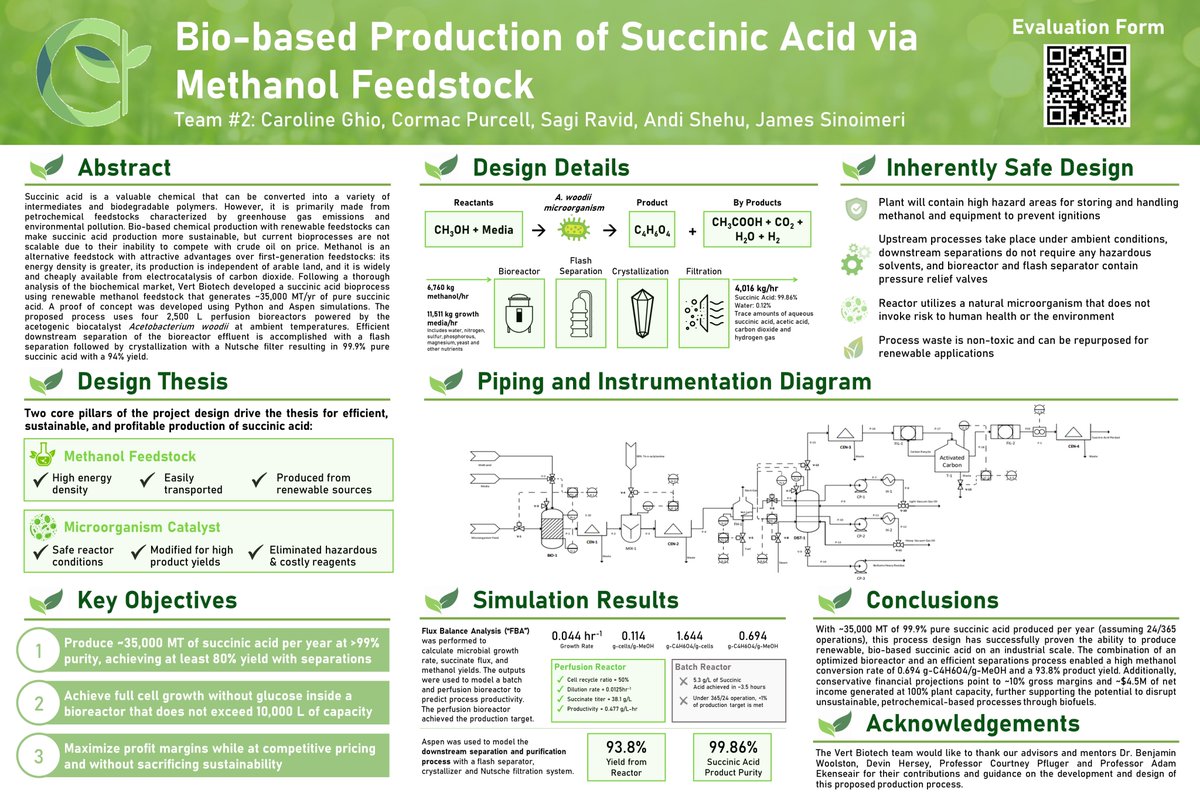
@han_solo_4703@NU_ChemE 3/3) Additionally, onsite methanol inventory will be reduced by setting up strategic partnerships with the renewable methanol plants and transport services to allow for continued weekly methanol deliveries to the plant.
Hi everyone! We are Vert Biotech, a next-generation chemicals company that combines biotechnology and innovative purification processes to convert methanol feedstock into succinic acid. Check out our proposed design!
#CHME4703Poster@NU_ChemE#sustainability#biofuels
@han_solo_4703@NU_ChemE 2/3) However, after considering EU and German regulations, the plant will contain high hazard areas to store methanol inventory and intrinsically safe areas and explosion proof electronics to reduce fire hazards.
@han_solo_4703@NU_ChemE 1/2) Hello Mr. Solo and thank you for your question! After an extensive search for a plant location, we strategically chose to implement the process in Germany. Therefore, we did not consider the OSHA regulations for this process.
@AsteridBio @cheme_nu Hi Asterid Bio! Really interesting work- two questions. 1) Are there any special considerations related to using the larger bioreactor - like space requirements or cleaning challenges? 2) What drove your decision to use A. Tumefaciens?
@Group1034236629@NU_ChemE Hi NCC- cool project! Two questions: 1) Was there preliminary data or market analysis done that drove your goal of reducing cost 5 fold? 2) Are there any safety or material concerns surrounding the 210 degrees C for the evaporation unit?
@WillitsLab@NU_ChemE (2/2) It is important to note that our projections are conservative as we assumed a product selling price below historical market averages. This was done in order to make our biosuccinic acid competitive with petrochemical-based chemicals but still provides leverage on price.
@WillitsLab@NU_ChemE (1/2) Hi! Thank you for your question. It is not feasible for 24/365 operation due to potential maintenance and cleaning. If we instead assume that the plant is operating 80% of the year (say 22/320), we still achieve ~$2.5 in profit.
@Nosym_Pharma@NU_ChemE Q4: Many PLGA drug delivery systems have reported a “crashing” effect in which the remainder of the PLGA in the system ultimately degrades in a short time, causing a sharp and almost immediate release of the remaining drug. How can you prevent this effect in your pill?
@Nosym_Pharma@NU_ChemE Q3: With a pill consisting of 3 layers, are there studies indicating that the PLGA-drug core is the layer limiting (and thus responsible for) the drug releases from the pill? Are there studies indicating the other 2 layers do not limit drug release?
@Nosym_Pharma@NU_ChemE Q2: Have you considered running the same release assay but varying the polymer-to-drug ratio by increasing the amount of polymer in the pill while maintaining the amount of drug loaded the same for each formulation?
@Nosym_Pharma@NU_ChemE Q1: For the reported release assay, should the cumulative drug release (in mg) be plotted instead of % drug release? The plot seems to show that the amount of drug released (mg), which is the amount that would enter a patient’s body, is independent of the fluorescein loading.
@OxygenlyLLC@NU_ChemE Q4) Assuming the cells are indeed experiencing hypoxic conditions (big if), wouldn't the hypoxic state and thus experiment be ruined when the door is opened or cells are taken out of incubator? Unless people are doing work inside the incubator, how can they work on their cells?
@OxygenlyLLC@NU_ChemE Q3) Correct us if it's wrong, but the hypoxic conditions are created by flushing the incubator with nitrogen gas correct? For an incubator not meant to be operated hypoxically, is this not super dangerous? Could it over pressurize and possibly burst? How does the incubator vent?
@OxygenlyLLC@NU_ChemE Q2) Your setpoint was to 5% O2, but for tumor hypoxia, it's considered to be at 1%. Is it 5% for stem cells, or rather, why did you pick 5%? Could you get it down to 1% if someone wants to use this system to culture tumor cells for cancer research or drug development?
@OxygenlyLLC@NU_ChemE Q1) For your proof of concept, was the dissolved oxygen measured in the ambience of the incubator? Or was the probe placed directly into the media within the flask? If the incubator, how confident are you that the oxygen concentration is the same in media, especially after 2 min
@OxygenlyLLC@NU_ChemE (Part 1) Hello Oxygenly! Interesting project, definitely more mechanical & electrical in nature compared to most of the other ChemE type posters here. We had a couple questions about your product: