In 2019 I said $NVDA would become the world's most valuable company. In 2021, that it would surpass $AAPL.
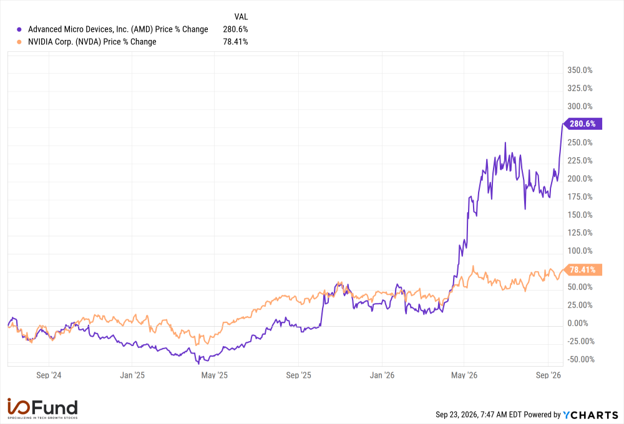
In July 2024, I said AMD's $AMD returns would outpace Nvidia's over five years. So far, so good.
This week, I cover why the next chapter could be AMD’s biggest. Link in bio.
“Compute is worthless if you can’t power it.”
With @cvpayne, I break down the I/O Fund’s early call on Bloom $BE at $16—and another company well positioned to meet the scale of power AI will require over the next decade.
IF YOU DIED TOMORROW, YOUR FAMILY WOULDN'T BE ABLE TO ACCESS A SINGLE THING YOU OWN DIGITALLY.
BANK ACCOUNTS. PASSWORDS. CLOUD STORAGE. ALL OF IT PERMANENTLY LOCKED AWAY.
HERE'S HOW TO FIX IT IN 30 MINUTES:
$SITM - $565.42, just keeps quietly ripping, long term, +650% since April 2024.
It's currently 38% off the high set back in May as it catches some support just above the 200d ma.
Fundamentals are solid.
The company develops and manufactures analog semiconductors.
Easy candidate for a watch list - near the accumulation zone now.
Meta $META is committing to pay up to $6 billion through 2030 to Corning $GLW for optical fiber and connectivity products for its AI data centers, including its 1GW Prometheus campus and its 5GW Hyperion campus.
Le glitch argent infini ?
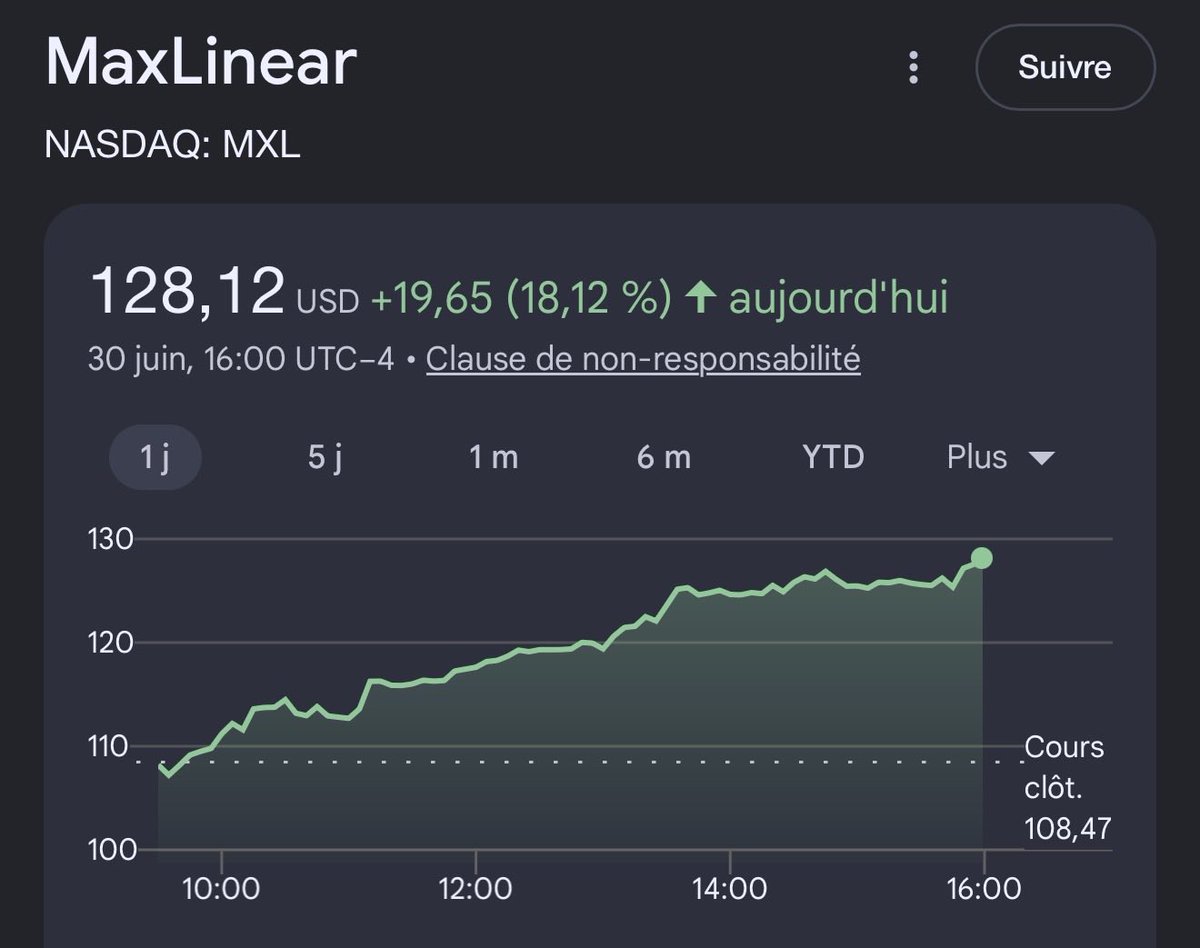
Bon parlons de Maxlinear $MXL car je crois qu’on assiste tout bonnement à un des repricing les plus importants du cycle
Pendant des années, le marché la voyait comme une boîte un peu ringarde (puces pour box internet, modems, 5G).
Le retournement : on la regarde désormais comme une valeur « IA » phare notamment sur leur produit phare la puce KEYSTONE
Pourquoi ça s’emballe, en 3 idées :
1. Des résultats qui cartonnent
Au dernier trimestre, ventes +43 %, et la partie datacenter/IA a fait +136 %. La direction a relevé ses prévisions.
2. Wall Street a changé d’avis
Plusieurs banques ont doublé leurs objectifs de cours (Stifel de 49 à 105 $, d’autres jusqu’à 125 $) en la requalifiant de « puces internet » à « infrastructure IA »
3. Effet boule de neige
Contrats avec les géants du cloud, plus cette semaine un coup de pouce technique : sa sortie des indices « value » Russell pour basculer sur l’indice « growth » force des rachats mécaniques
Quick note - Why the asymmetric upside in $AAOI is massive
Last quarter, they were generating roughly $50M in monthly revenue.
By the end of 2027, management is targeting $600M in monthly revenue.
How is that even possible?
Empty promises and hype?
Let's look at the hard facts.
1. Massive Capacity Scaling (Nearly 7x)
They are vertically integrated with a trusted Western supply chain.
They are aggressively expanding and upgrading their fabrication facilities (reaching ~900k sq. ft. in Texas and Taiwan).
Scaling production from ~90k to over 600k advanced units/month is the real engine here.
2. A Deep Paradigm Shift in Product Mix
We are in the middle of a massive architectural transition.
Legacy 100G/200G/400G modules are being rapidly phased out by hyperscalers, heavily replaced by high-density 800G and 1.6T transceivers with much higher Average Selling Prices (ASP of $800–$1,200+ per unit).
3. Demand is Absolutely Drowning Supply
Their main competitor, Lumentum, just announced that their 2027 transceiver capacity is already completely sold out and they are actively booking 2028 orders.
The AI datacenter infrastructure demand is insatiable. If the optical transceiver market bottlenecks similarly to the HBM memory shortage, component prices and margins could easily overshoot expectations.
4. The Elephant in the Room: Historical Execution Risk
Let's be completely transparent - a very valid and frequent bear case on $AAOI is the perceived bad/inconsistent management team.
Historically, they have struggled with execution, delayed product qualifications, and burning cash.
Hitting a $7.2B annualized run-rate requires flawless execution.
If they drop the ball on scaling yields or operational efficiency, this target slips.
5. The Risk-Reward Asymmetry
12 months x $600M = $7.2B annualized revenue run-rate by EOY 2027.
Even if they stumble operationally and only deliver 50% of this target, the current valuation remains incredibly defensive and fundamentally safe.
A portion of this exponential growth is already priced in after the YTD rally, but I still see a highly conservative 3x upside over the next 2 years, with a very realistic path to 5x from current levels if execution holds.
Heads you win big, tails you don’t lose much. To me, $AAOI is the definition of a highly asymmetric, unlosable long-term bet.
Disclaimer: Not financial advice. Always DYOR and evaluate your own risk tolerance. ⚠️
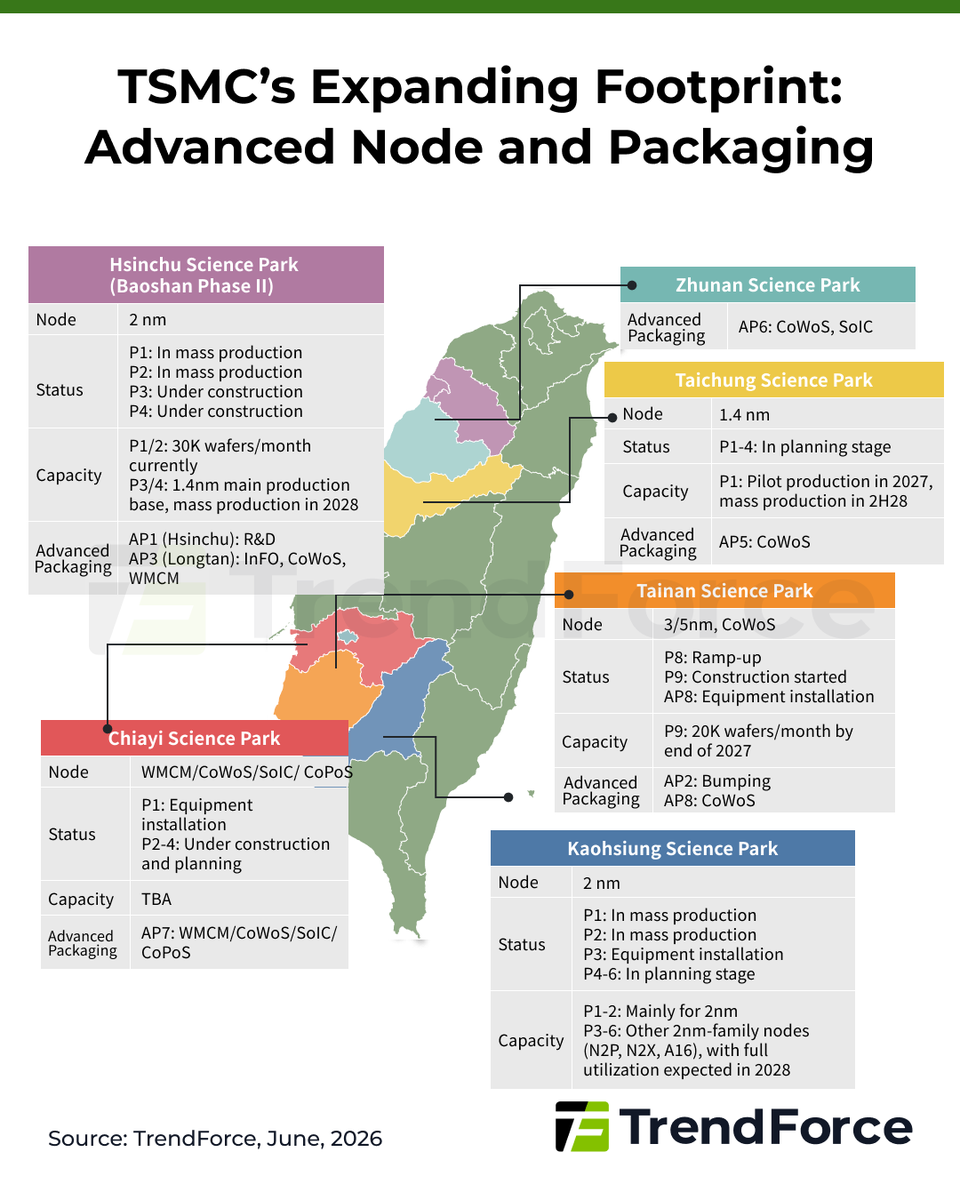
AI demand is surging, and TSMC is scaling both engines to keep up, with Taiwan as the main stage. 🇹🇼⚡
🔹 Advanced Node: 2nm ramping now, 3nm capacity still tight
🔹 Advanced Packaging: 5 sites operational across Taiwan, Chiayi (largest packaging and test facility) under construction 🏗️
📈 CoWoS capacity CAGR >80% (2022–27)
📈 SoIC capacity CAGR >90% (2022–27) 🚀
#TSMC #2nm #AdvancedPackaging
Rep. Thomas Kean Jr. (R) just bought $EQT
$EQT is the biggest natural gas company in America
Meanwhile, he sits on the House Energy and Commerce Committee
That committee has oversight of FERC, the agency that regulates natural gas pipelines
In May, FERC proposed rules to speed up pipeline approvals
Easier pipeline approvals are the single best thing that can happen to $EQT
Why Silicon Motion $SIMO is Evolving from Consumer Tech to Enterprise Powerhouse
While the attention of financial markets and investors remains entirely dominated by the manufacturers of memory chips themselves, a fundamental component of data infrastructure is developing in the shadows: the memory controllers.
Silicon Motion (SIMO) is a global leader in this segment, currently undergoing a structural transformation of its business model - shifting from mass consumer markets (PCs, smartphones) toward high-margin enterprise solutions for data centers and the AI Edge segment.
In the context of the upcoming era of Agentic AI (autonomous AI agents operating both locally and in the cloud), the role of advanced storage is growing drastically.
Unlike simple chatbots, AI agents continuously process, write, and search massive local knowledge bases, such as vector databases in RAG (Retrieval-Augmented Generation) architectures.
For an agent to run seamlessly directly on a user's device without freezing the interface, the NAND flash controller must manage gigantic data transfers with minimal power consumption and zero thermal throttling.
This places SIMO's technology at the very heart of the new wave of innovation.
1. Business Segments and Portfolio Transformation
Silicon Motion operates on a fabless model (it designs the microchips and outsources manufacturing to TSMC).
The company divides its operations into three main pillars, with one beginning to completely dominate its growth trajectory:
>eMMC + UFS (Smartphones & IoT):
Serves the mobile device market.
This segment is experiencing a massive resurgence - growing by 30% to 35% sequentially (Q/Q) and 140% to 145% year-over-year (Y/Y).
This growth is driven by the need to integrate local LLMs into next-generation flagship smartphones, requiring significantly faster and higher-capacity UFS storage.
>SSD Controllers (PC & Client):
The traditional segment for personal computers.
Despite general market maturity, it recorded a stable 45% Y/Y growth, supported by the rollout of the next-generation PCIe Gen 5 standard.
To optimize costs for OEMs, SIMO introduced innovations like the SM2524XT - a Gen5 DRAMless controller.
Instead of placing expensive, dedicated DRAM on the SSD board, it utilizes Host Memory Buffer (HMB) technology, safely borrowing a fraction of the system's main RAM to maintain blistering read/write performance at a much lower cost.
> Ferri Solutions & Boot Drives (Enterprise & Automotive):
This is where the heart of SIMO’s hyper-growth beats today.
The segment posted an explosive increase of 205% to 210% Q/Q and an astronomical 755% to 760% Y/Y.
This is not a temporary statistical anomaly, but the beginning of a multi-year megatrend that is redefining the company's fundamentals.
The Potential of the Ferri & Boot Drive Segment
The Ferri family (FerriSSD, Ferri-eMMC, Ferri-UFS) consists of highly integrated, rugged storage systems designed for industrial automation and automotive applications.
Modern autonomous and electric vehicles (Level 3+ autonomy) are turning into data centers on wheels, generating terabytes of telemetry from sensors and cameras that must be processed instantly.
SIMO has secured key design wins with Tier-1 automotive manufacturers, creating a multi-year, high-margin revenue stream locked behind strict automotive safety qualifications (ASIL-D).
Meanwhile, Boot Drive solutions for data centers are revolutionizing hyperscaler server architectures.
Servers powering large-scale AI training clusters require dedicated, ultra-reliable boot drives to completely isolate system startup and diagnostic routines from the heavy, high-bandwidth data streams processed by GPUs.
By eliminating the "noisy neighbor effect," SIMO’s enterprise controllers offer hardware encryption, robust power-loss protection, and advanced Error-Correcting Code (ECC) mechanisms, making them indispensable for every newly deployed AI server rack.
2. Hard Financials and Operating Leverage
Silicon Motion’s latest financial reports demonstrate the immense operating leverage at the company's disposal.
Historically, the opening quarter of the year has been seasonally the weakest for SIMO due to post-holiday electronics cool-downs. However, relentless infrastructure demand completely shattered past cyclicality.
> Revenue:
Reached a record $342.11 million in Q1, representing a 23% Q/Q sequential increase and a stunning 105.5% Y/Y jump, comfortably beating consensus estimates of $299.53 million.
> Margins & Profitability:
Non-GAAP gross margin landed at 47.2%.
Operating margin expanded dramatically from 11.4% in Q4 to 18.2%, driven by scaling volume over fixed costs.
> Earnings:
GAAP Net Income reached $52.90 million (up from $16.31 million in the prior year), yielding a Non-GAAP EPS of $1.60 per ADS, crushing the Wall Street consensus of $1.31.
> Guidance:
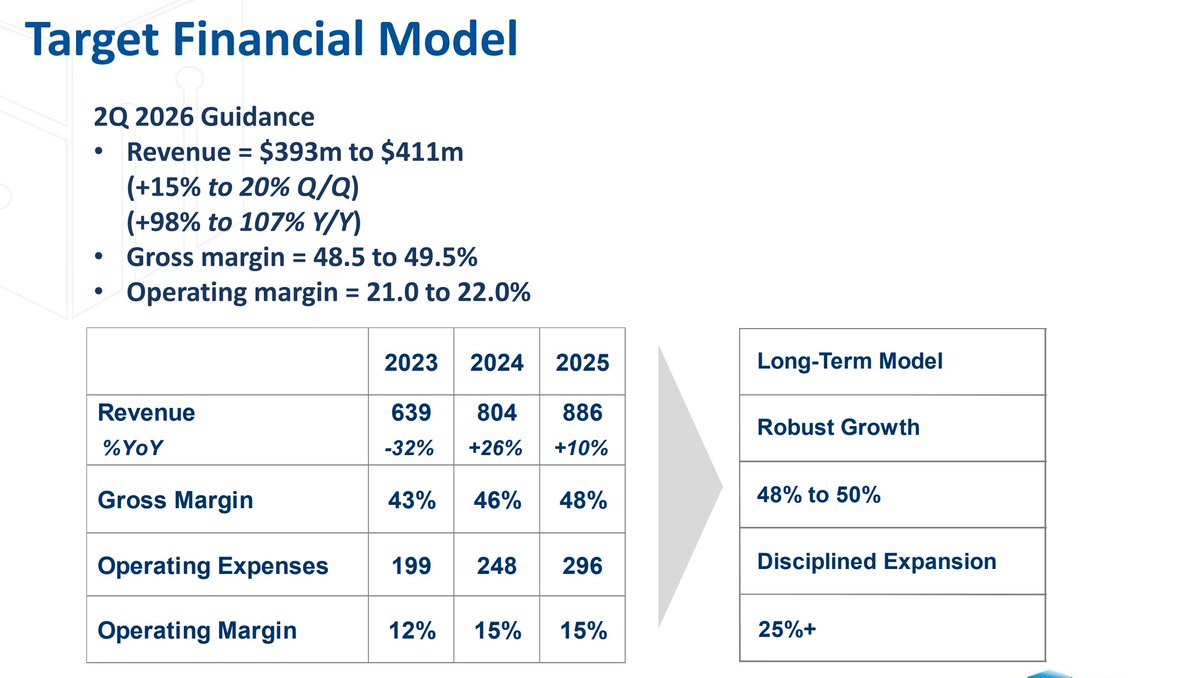
Management has guided Q2 revenue to a stunning $393 million to $411 million range (implying a ~20% sequential increase), with operating margins expected to climb further to 21.0% – 22.0%.
The Cost of Innovation: R&D Dynamics
Investors must track a critical financial trade-off: to maintain its competitive edge, SIMO’s Research and Development (R&D) expenses scaled up to $86.24 million in Q1.
Migrating to advanced PCIe Gen5 architectures forces the company to use TSMC's premium 5nm and 6nm process nodes.
While these surging tape-out costs and Electronic Design Automation (EDA) tool expenses temporarily weigh on short-term cash flows, they act as a massive barrier to entry, preventing lower-tier competitors from invading SIMO’s premium enterprise territory.
3. Technological Catalysts: The MonTitan Enterprise Architecture
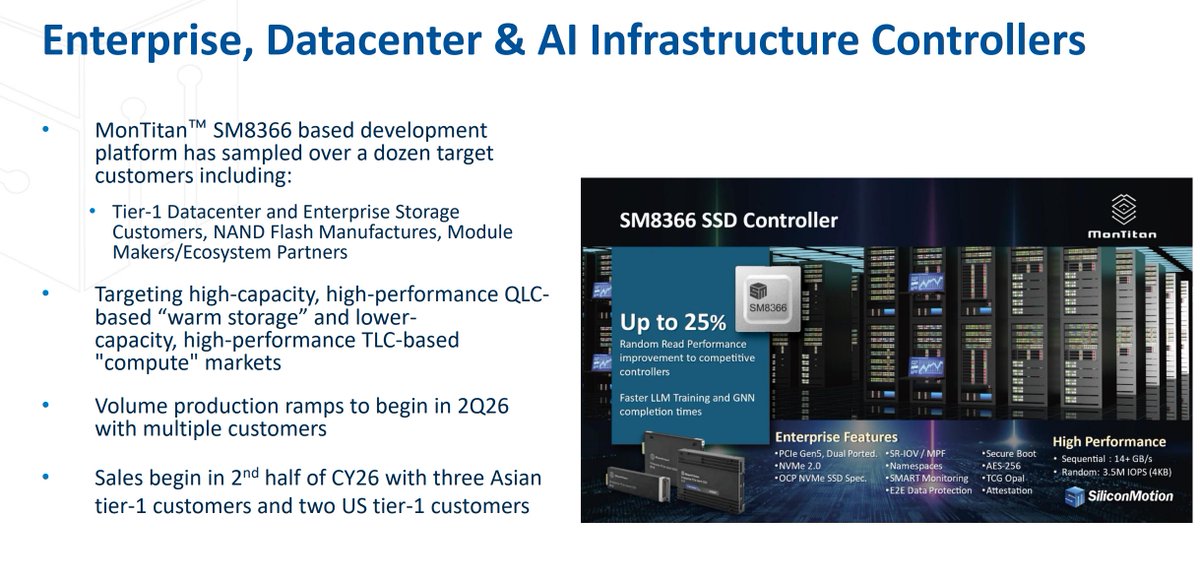
A key element of SIMO's high-margin enterprise expansion is its MonTitan platform.
This is a family of highly customizable, programmable PCIe Gen5 SSD controllers engineered specifically for hyperscale data centers.
Unlike off-the-shelf controllers, MonTitan features a unique layered firmware architecture.
This allows cloud architects to tune the SSD’s behavior based on specific AI workloads - optimizing for sustained read-heavy tasks or mixed random read/write bursts.
By maximizing Quality of Service (QoS) and keeping latency ultra-low under maximum strain, MonTitan has successfully penetrated the supply chains of leading AI hardware vendors, proving that SIMO can compete on pure technological merit at the highest tier.
4. Competitive Analysis with Phison and Market Positioning
SIMO's primary rival in the merchant controller space is Taiwan-based Phison Electronics (8299.TWO).
While both companies capture tailwinds from the same secular megatrend, their financial profiles and market valuations diverge significantly, directly explaining the current valuation spread between them.
> Phison (Market Cap: ~$17.26B USD / 559.348B TWD):
Trading at 2,530.00 TWD with an intraday gain of +8.58%, Phison is heavily favored by the market.
Following its recent performance, Phison demonstrated the sheer power of its enterprise expansion, capitalizing on custom silicon designs for data centers and its high-margin server deployments.
Wall Street and Asian markets grant Phison a steep valuation premium due to its massive, proven profitability in the enterprise tier.
> Silicon Motion (Market Cap: ~$10.91B USD):
Trading on NASDAQ at $321.66 per ADS (up +4.73%), SIMO has officially broke back toward its historical peaks. |
With its non-GAAP operating margin sitting at 18.2% and quarterly operating expenses (OpEx) scaling up to $99.2 million due to heavy engineering tape-out costs, SIMO trades at a noticeable market cap discount relative to Phison ($10.91B vs. $17.26B).
The market continues to view SIMO as a highly promising but early-stage challenger in the premium enterprise tier, requiring the company to prove that its MonTitan platform can consistently close the profitability and margin gap with its Taiwanese peer.
The major macroeconomic risk for both players remains the volatile pricing of the raw material itself (NAND Flash), which saw price hikes of 55% to 60% in early 2026.
While expensive NAND incentivizes hardware builders to buy advanced controllers to maximize flash efficiency and lifespan, an overly aggressive price rally threatens to compress margins for device manufacturers and temporarily cool down mass-market volume demand in the consumer PC and mobile spaces.
5. Long-Term Strategic Outlook (2028–2030)
Looking toward the 2028–2030 horizon, Silicon Motion’s primary strategic objective is to eliminate its margin discount relative to Phison.
Over this period, the technology market will mature from raw hardware infrastructure building to the mass-scale execution of Agentic AI at the edge.
> Stabilizing the Consumer Baseline:
The traditional, cyclical segments (PC and smartphone controllers) are modeled to stabilize following the initial replacement waves of early AI PCs.
This segment is projected to grow at a steady long-term CAGR of 8% to 10%, converting into a highly predictable, stable free-cash-flow (FCF) engine.
> Scaling Enterprise & Automotive:
This is where the battle for SIMO's valuation premium will be won or lost.
Full production ramps of the MonTitan platform within hyperscaler clusters, combined with the integration of Ferri computing systems into Level 3+ autonomous vehicles, must maintain a multi-year CAGR of 30% to 35%.
The Structural Inversion
The ultimate turning point for long-term investors is modeled to occur around 2029.
This is when the high-margin Enterprise & Automotive segment is projected to cross the 50% threshold, overtaking consumer electronics as SIMO’s largest revenue contributor.
If this mix transformation successfully drives SIMO's overall operating margins from the high teens toward Phison's territory, the company will experience a major institutional re-rating.
> Summary
Silicon Motion is successfully shedding its legacy reputation as a cyclical commodity supplier dependent on PC shipment numbers.
Its latest performance proves that the company can achieve triple-digit growth under the right macro conditions, while its entry into server boot drives and the MonTitan platform secures an elite enterprise pipeline.
While a market capitalization of $10.91 billion indicates that the market is now aggressively pricing in its recent breakout, the true long-term upside rests on its product-mix evolution.
For investors with a 2028–2030 horizon, the current level offers a fundamentally sound entry point into a business transforming from a consumer electronics vendor into an indispensable pillar of infrastructure for the AI era.
>> What's your thoughts about $SIMO? Let's talk.