In 1785, Thomas Jefferson wrote to his nephew explaining how to educate himself.
His reading list included:
- Herodotus
- Thucydides
- Xenophon
- Homer
- Sophocles
- Plato
- Cicero
- Seneca
- Marcus Aurelius
He also recommended studying history, philosophy, poetry, and languages.
This was the intellectual foundation Jefferson wanted for a young American.
You can still read every one of those books.
What's stopping you?
BREAKING: Neuroscientists confirm that small talk drains an ADHD brain faster than a 2-hour deep debate—because surface-level chitchat offers zero cognitive stimulation while demanding maximum impulse control.
If networking events and polite weather talk leave you wanting to crawl under a table, here is why:
JENSEN HUANG: “Bitcoin is taking excess energy and storing it into a new form... It's called currency. And you take that currency and you take it wherever you like. So you took energy from one place and now you've transported it everywhere.”
JUST IN: OpenAI announces it will pay AI experts up to $8,000/month to help local small businesses adopt artificial intelligence through its new "OpenWorks" program.
A lot of people are worried about P = NP.
Here’s the simple version.
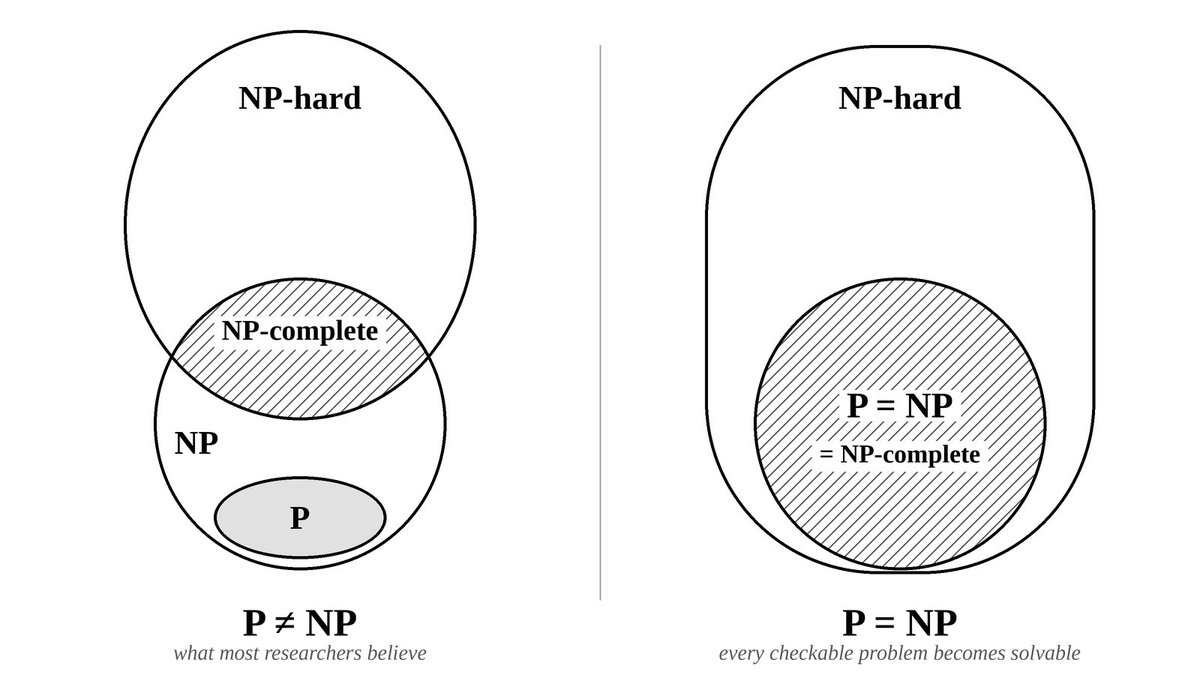
P is the set of problems a computer can solve quickly. Sorting a list, finding the shortest route on a map, multiplying numbers.
NP is the set of problems where, if someone hands you an answer, you can check it quickly. A filled-in Sudoku is easy to verify, but solving a hard one from scratch can take forever.
If you can check an answer fast, can you also find it fast? P = NP says yes. Almost everyone believes the answer is no, but nobody has proved it either way. It’s a $1M Millennium Prize problem.
Riemann is solved, but it doesn’t change your day. P = NP would change everything very fast.
Almost all modern security rests on the assumption that some problems are brutally hard to solve but easy to check. Factoring huge numbers is the classic one.
If P = NP, that wall could fall. HTTPS, online banking, passwords, digital signatures, crypto wallets, all of it would be at risk.
The same power that breaks encryption would solve the hardest optimization problems we have.
Protein folding and drug discovery would speed up massively. Logistics, flight schedules and supply chains would become near perfect.
Training AI models could get far cheaper. Even finding mathematical proofs could be automated.
It depends on how it’s proved. If the proof is not constructive, or the algorithm runs in something like n^100 time, it's useless in practice. The scary version is a fast, practical algorithm.
Most researchers bet on P ≠ NP, and that is the reason your bank account is safe today.
But if someone ever proves P = NP with a practical algorithm, the world gets rewritten overnight.
Best case, we cure diseases and solve problems we thought were impossible.
Worst case, every lock on the internet opens at once.
Something to worry about indeed.
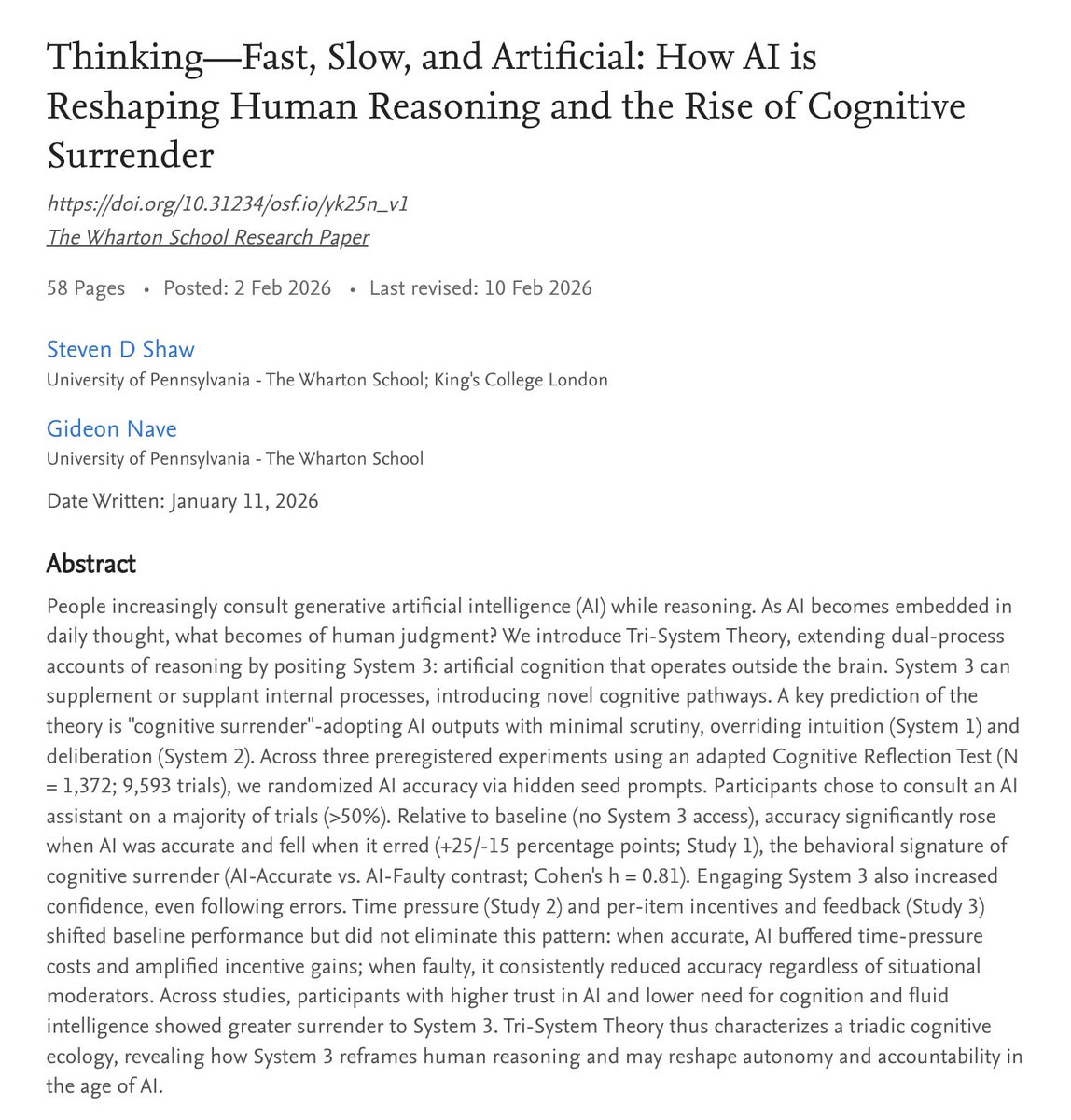
Researchers discovered a new psychological condition caused by ChatGPT.
They're calling it "Cognitive Surrender."
Researchers ran three experiments across 1,372 people and 9,593 reasoning trials. They gave participants access to an AI assistant, but secretly rigged the AI to be accurate on some trials and subtly wrong on others.
People consulted the AI on more than 50% of the trials.
When the AI was right, human accuracy jumped by 25 percentage points.
When the AI was wrong, accuracy crashed by 15 percentage points.
Participants didn't double-check the output. They didn't catch the errors. They let System 3 override both their gut instinct and their critical thinking.
Then came the darker finding.
Using the AI made people measurably more confident in their answers—even when the AI fed them completely wrong information.
The researchers tried to break the habit. They added time pressure. They gave participants live feedback and financial incentives to get the right answer.
It didn't work.
Even when money was on the line, people still surrendered their judgment to a faulty AI.
We used to think AI was just a tool to help us think faster.
It's not. It's quietly replacing the act of thinking altogether.
“When I talk to people who work for Anthropic after they’ve had a couple drinks, the conversation often turns to overthrowing the US government and taking over the world.”—@tegmark
His is one of the deities of the Effective Altruist cult Anthropic so loves.
Now the IPO gets them rich—MASKS OFF.