Trading success isn't determined by strategy alone—it's shaped by the decisions you make under pressure.
In this webinar, @ripster47 explores the psychology behind disciplined trading, helping you overcome emotional decision-making, build confidence, and stay committed to your trading plan.
• Master your mindset
• Control emotions under pressure
• Build long-term consistency
Explore the complete webinar at https://t.co/NSh5Lrjmgh
When the news about GPT-5.6 broke, my stomach dropped.
We've officially hit a wall with AI, and this could very well be the pin that pops the bubble.
The entire global economy is riding on what happens next.
Nobody is connecting the dots - let me explain:
Right now, the entire economy is riding on one bet:
AI succeeds.
And almost nobody realises how exposed that leaves us.
In Q1 2026, AI capex accounted for ~75% of US GDP growth, and companies are expected to pour $800B+ into AI this year alone.
Strip out AI spending, and growth is effectively zero.
Here's where things gets dangerous:
The government just started gatekeeping AI.
Fable 5 was pulled, GPT-5.6's release has been delayed for weeks, and now the government wants to approve access to frontier models "customer by customer."
If the government keeps throttling AI, progress stalls (already happening).
If progress stalls, the spending stalls.
If the spending stalls, ~75% of GDP growth stalls with it.
The entire economy has become one giant leveraged bet on AI's success.
The irony about all of this is that AI worked so well and moved so fast that it became its own bottleneck.
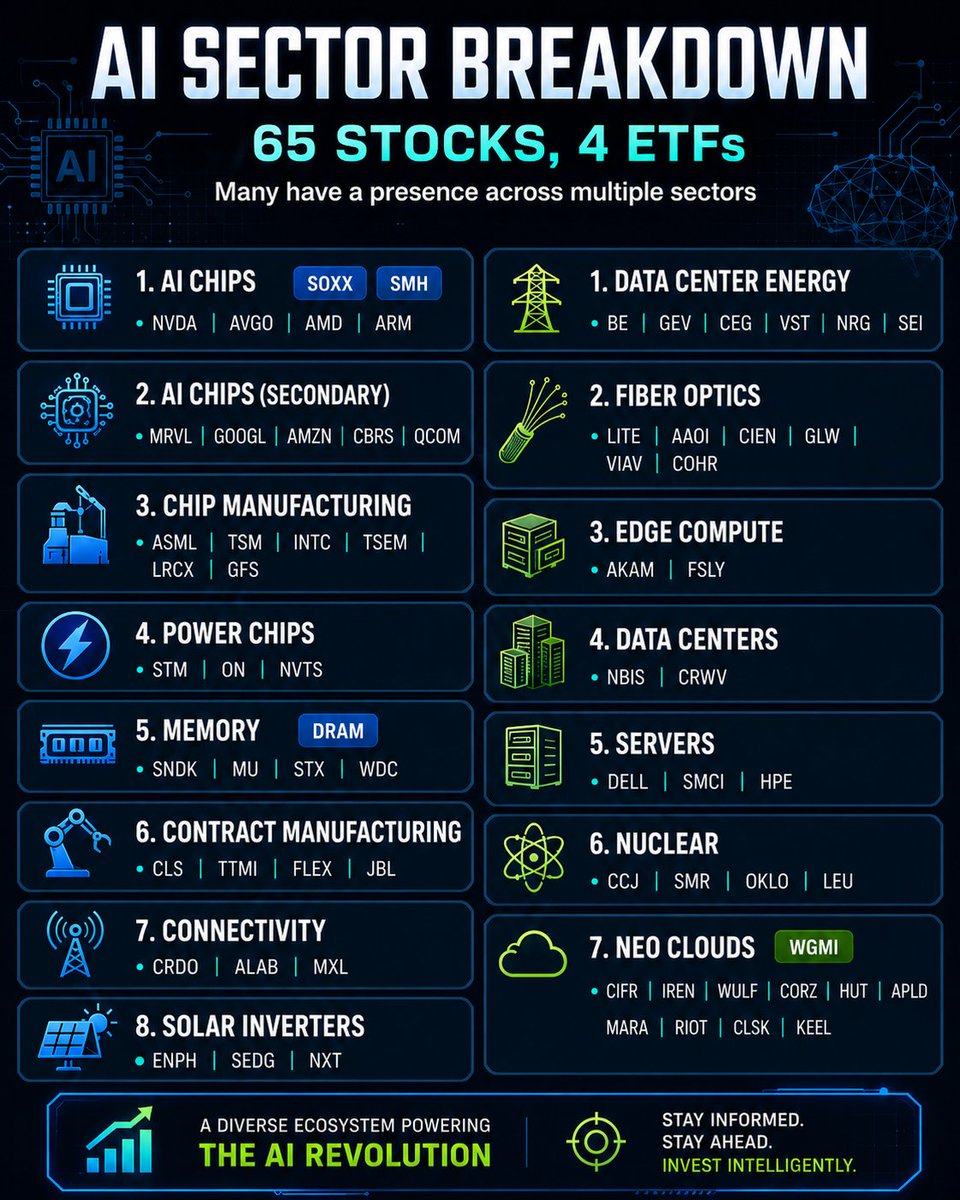
7 ETFs Dominating AI, Power, Space & Robotics
$DRAM — Invests in memory chip companies. Bets on the companies storing and moving AI data faster than ever.
$NLR — Invests in nuclear energy. Bets on uranium miners and reactors powering the AI electricity boom.
$NASA — Invests in space companies. Bets on satellites, rockets, and the businesses building the space economy.
$HUMN — Invests in robotics and AI. Bets on companies building the physical robots that will replace human labor.
$EUV — Invests in semiconductor equipment. Bets on the machines that print the world’s most advanced chips.
$SMH — Invests in semiconductors broadly. Bets on the companies designing and manufacturing the chips powering everything.
$GRID — Invests in electricity infrastructure. Bets on the companies upgrading power grids to handle surging energy demand.
The Iran peace deal has now been announced by Pakistan on X, confirmed by US leaders and Iranian media on X, and backed by Qatar on X.
X has become the central venue to discuss and announce the most influential decisions in the world.
AMD CEO LISA SU HELD A MINI PC ON STAGE THAT RUNS A 235B MODEL AND REPLACES YOUR $440/MONTH AI STACK
amd's ryzen ai max+ 395 is the first x86 chip that runs a 200 billion parameter model on one piece of silicon. cpu and gpu share 128gb of unified memory, no separate graphics card needed
the gmktec evo-x2 runs qwen3 235b fully, deepseek v3 comfortably and llama 3.3 70b with headroom. on linux you get 110gb of usable vram out of 128gb
amd claimed the chip beat an nvidia rtx 5080 by more than 3x on deepseek r1 inference. a lunchbox sized pc outrunning a $1,000 discrete gpu on a real ai workload
a heavy ai user pays $200 for claude code max, $200 for chatgpt pro, $20 for cursor and $20 for gemini. that's $5,280 a year and the box pays itself off in 9 to 10 months
install ollama, pull the model, point claude code at localhost. same interface, nothing leaves the machine, nothing costs per request
bookmark this and read the article below
Fable was only available for 72 hours.
In that time, I was able to:
• Create a workflow for editing my YouTube videos
• Build a fully autonomous clipping system
• Overhaul my entire BD pipeline - better data enrichment/accuracy
Next I was going to start on my executive assistant build (compressing every single manual workflow into loops).
It was truly insane.
I can't wait to get access again.
This just opened Pandora's box. There is no going back.
My wife spent nearly a decade becoming a doctor.
4 years of college.
4 years of medical school.
2 years of residency before treating patients on her own.
Yet traders open an account and expect mastery in 6 months.
The market doesn't care how badly you want it.
Skill takes time.
Experience takes time.
Pattern recognition takes time.
Stop measuring progress in months. Start measuring it in years.
Copper can't keep up with AI. That's not an opinion, it's physics.
Every data center being built right now is replacing electrical connections with light. NVIDIA confirmed it with $4.5 billion in direct investment.
I mapped 25 public companies across the photonics value chain:
Every AI cluster being built today hits the same wall. A hundred thousand GPUs mean nothing if the data can't move between them fast enough. Copper maxed out years ago and photonics replaced it: lasers, optical fiber, and transceivers that push data at the speed of light. The AI transceiver market doubled in two years. NVIDIA committed $4.5 billion across three photonics companies this year alone. This is where the infrastructure money is going.
Here's the full value chain:
🔬 MATERIALS & WAFERS
This is the bottom of the chain. Every laser and transceiver starts as a wafer substrate: indium phosphide, gallium arsenide, germanium, specialty glass. Nobody above this layer can produce anything without these inputs, and right now the most critical one, indium phosphide, is the tightest material in the entire AI supply chain. The gap between demand and capacity is getting worse, not better.
I think this is the most asymmetric layer on the map. Investors chase the transceiver companies and ignore who grows the substrates underneath them. But NVIDIA is writing checks worth billions in cash and warrants to lock up supply from this exact layer. First link in the chain, last to get attention, and the one that chokes everything above it if it breaks.
Tickers: $GLW, $AXTI, $IQE, $AIXA, $AMS
💡 CORE PHOTONIC DEVICES
This layer converts electricity into light and back. Without it, zero data moves through fiber. NVIDIA dropped $4 billion into two companies here this year just to secure production capacity, and both of them joined the S&P 500 within weeks of each other. That should tell you how fast this went from niche to essential.
The supply gap is not closing. The companies shipping next gen lasers at volume can be counted on one hand, and switching suppliers takes years of requalification. Order books stretch past twelve months. Every next generation GPU cluster consumes more of these components than the last, and no one can substitute them on short notice. I watch this layer more closely than any other.
Tickers: $IPGP, $COHR, $LITE, $LASR, $SIVE
🔌 COMPONENTS & MODULES
The companies here take raw lasers and detectors, package them into finished transceivers and modules, and ship them straight to hyperscalers. If the layers below are the engine, this is the vehicle that actually reaches the customer. Hyperscaler purchase orders land here. The revenue acceleration shows up here first.
What I like about this layer is that you can underwrite it today, not in two years. These are businesses with signed capacity commitments and product already moving. The consolidation angle matters too: larger photonics players have already started absorbing standalone module companies, and whoever remains independent gains pricing power as options thin out.
Tickers: $AAOI, $MTSI, $VIAV, $LPTH
⚙️ SYSTEMS & EQUIPMENT
No company above this layer can manufacture a single photonic component without the machines built here. One of these names holds 100% of the EUV lithography market with zero competitors. Others supply the bonding equipment for co packaged optics or the process control instruments used across the majority of advanced packaging lines. If photonics is the gold rush, this is the layer selling the picks.
My honest take: this is where the smart, patient capital parks. Equipment companies have pricing power and multi year order books that generate cash through full capex cycles. They attract holders who don't panic on the first pullback. The stocks don't run 1,000% overnight, but they compound while everything above them swings, and that tradeoff is worth more than most people give it credit for.
Tickers: $ASML, $BESI, $ASM, $LPKF, $MKSI
🔍 TEST, METROLOGY & YIELD
The most ignored layer on this map, and arguably the one with the cleanest business model. Every wafer, laser, and transceiver has to be tested and verified before it ships. As speeds climb and photonic devices get more complex, the testing challenge compounds fast. The industry is now constrained not only by what it can build but by what it can prove actually works.
Yield is money. Better defect detection means better margins for every company upstream, which is why foundries keep buying test equipment even when they slash budgets everywhere else. These are capital light businesses tied to every unit of production across the chain. Last check before product hits the customer, and one of the few layers where demand doesn't cycle down when the rest of semis softens.
Tickers: $CAMT, $FORM, $AEHR, $ONTO, $VIAV
🧠FINAL THOUGHTS
The NVIDIA capital concentration tells the whole story. One company wrote $4.5 billion in checks to three photonics suppliers in a single quarter. That is a company locking down the one input that could bottleneck its GPU deployments: the optical interconnect.
Returns across this sector have been historic over the past twelve months. But separate the revenue growers from the narrative trades. Some of these companies are printing real quarterly numbers that would impress in any sector. Others are carrying multi billion dollar market caps on sub $100 million in annual revenue. Same sector, wildly different risk.
Every generation of AI infrastructure from here forward needs more photonics. Not less. The copper to light transition inside data centers is early. Co packaged optics is barely in deployment, and 1.6T transceivers are ramping with 3.2T already on roadmaps. The chain locks together: stress on any single link reprices every link above it.
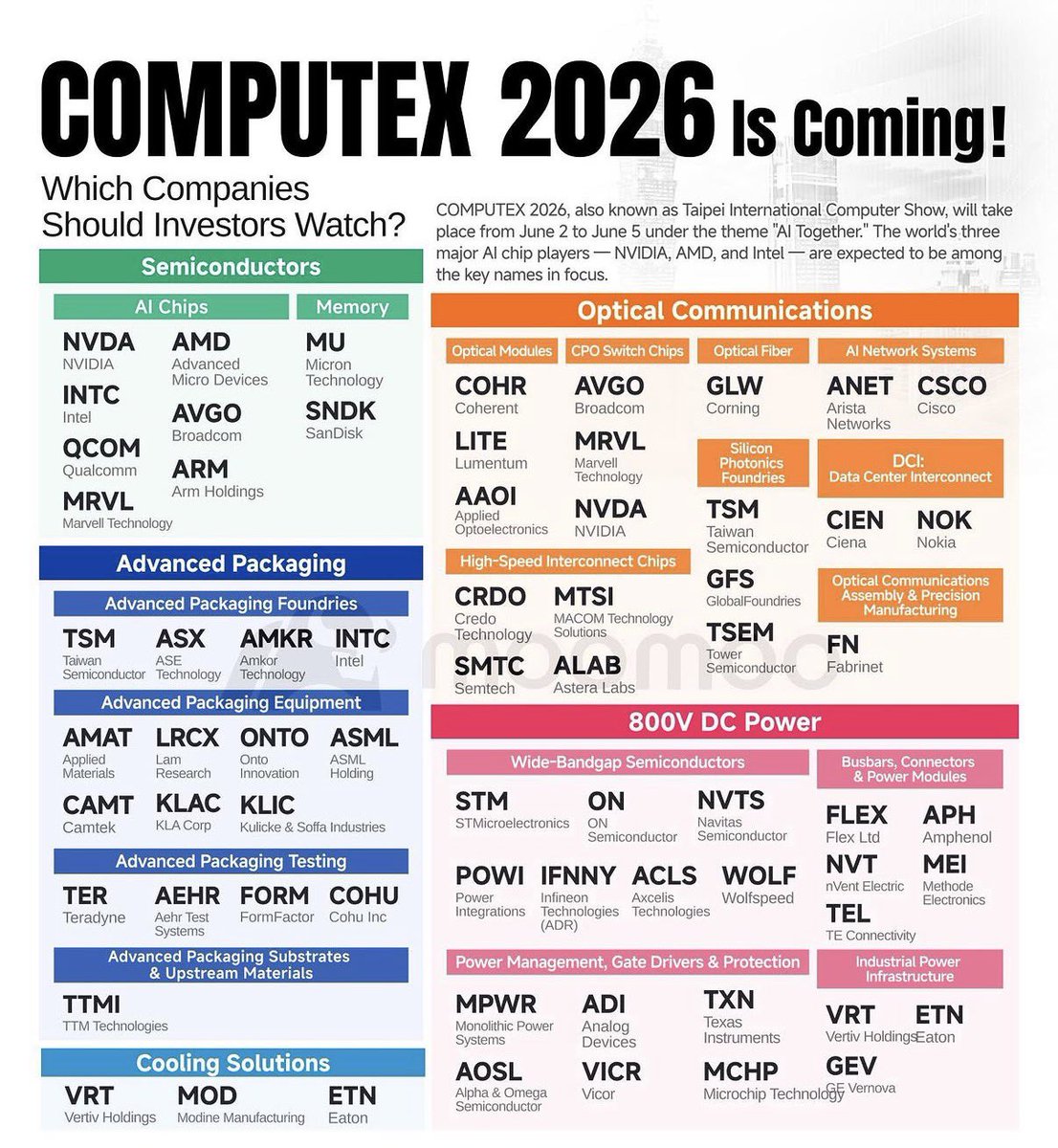
10 stocks to watch during Computex 2026. These are key data centre related stocks :
$MU — HBM4 36GB delivering 2.6x inference throughput; memory bull case just got louder. 
$MRVL — Jensen called Marvell the next trillion-dollar company; CPO chips confirmed future.
$VRT — Rack power hitting 180kW; Vertiv’s power and thermal management demand accelerating fast. 
$LITE — Named as relevant across optical modules and fiber alongside Coherent; CPO wave rising. 
$ARM — RTX Spark is Windows on Arm; Nvidia just validated Arm’s PC architecture ambitions hard. 
$AAOI — Makes optical networking components (lasers, transceivers) for data centers and telecom.
$AOSL — Designs power semiconductors (MOSFETs, gate drivers) for consumer electronics and EVs.
$POWI — Makes energy-efficient power conversion ICs for appliances, IoT, and industrial use.
$GLW — NVIDIA partnership locks Corning into AI factory fiber supply; 10x US manufacturing capacity. 
$ANET — Capturing majority of 800G and 1.6T switch upgrades as AI clusters shift to open Ethernet-over-Fiber. 
$ON — No direct Computex presence found. ON Semi is a Computex spectator, not a headliner.
I made my first $1,000,000 in 3 years.
Some people get there faster.
Some slower.
The timeline doesn't matter.
Quitting is the only way you don't get there.
Options flow becomes useful when it lines up with structure.
You want flow that checks multiple boxes:
✅ Sweep
✅ Volume > OI
✅ Ask-side buy
✅ Repeated activity
✅ Clean single-leg trade
✅ Chart confirms the direction
✅ Expiration matches the thesis
✅ Momentum supports the trade
✅ Strike is realistic relative to expected move
One signal is interesting.
A stack of signals is where the edge starts.
NEW: Situational Awarness LP, led by Leopold Aschenbrenner, has released its Q1 13F filing 👀
Increased positions in (shares):
$IREN: +2.99M
$CRWV: +1.07M
$APLD: +2.13M
$KEEL: +12.97M
$CLSK: +10.63M
$RIOT: +5.33M
$BTDR: +1.65M
The fund has a huge allocation in former Bitcoin miners transitioned to AI infrastructure