In Daml, access control is defined at the contract level, not applied on top.
A detailed breakdown from @HackenClub of every core security pattern, how the mechanics work, where the risks are, and what to verify before mainnet.
Full analysis: https://t.co/3VegaYT4Ue
Rust/Soroban smart contract audits are part of what we do at Hacken.
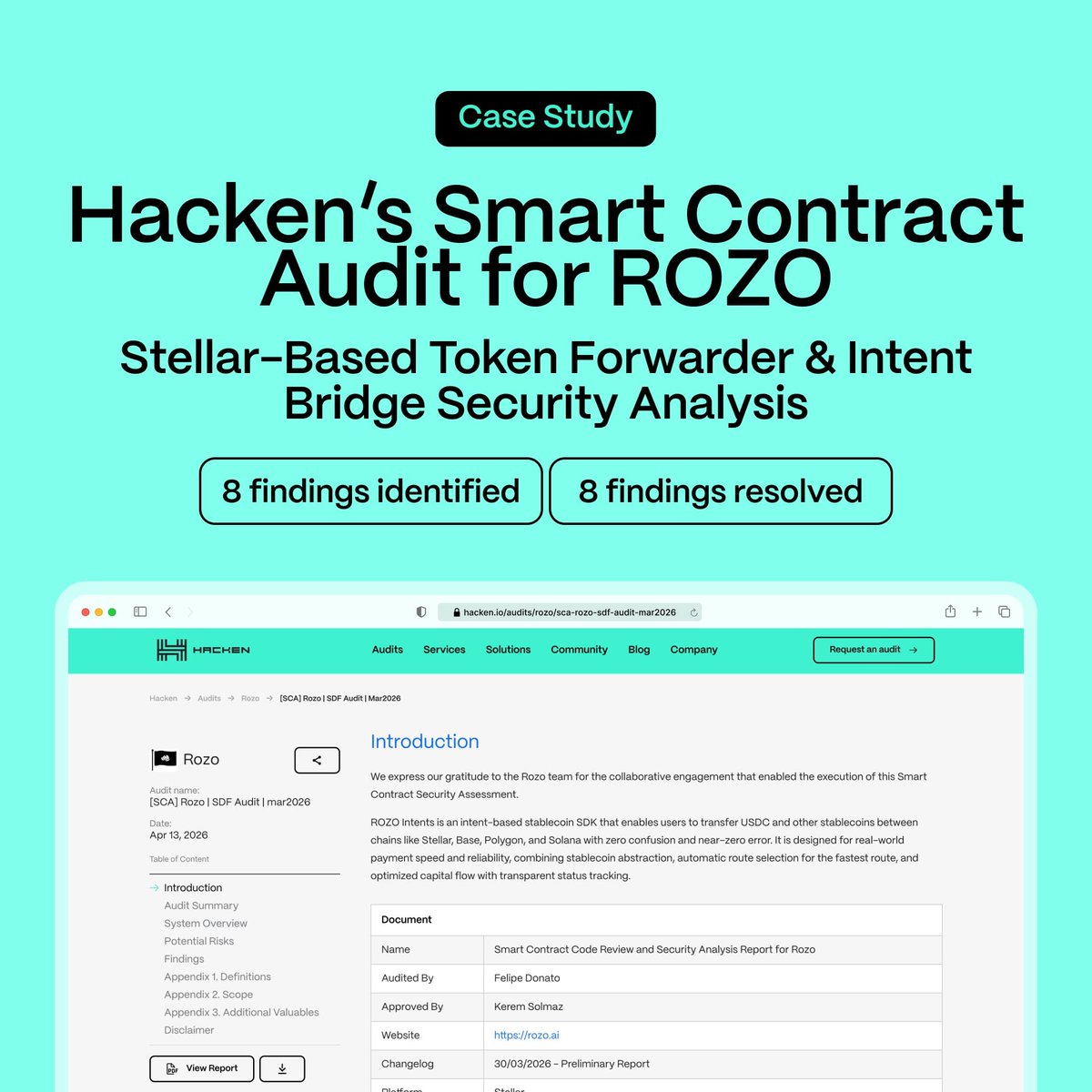
We assessed @ROZOai, a @StellarOrg Community Fund-backed project building non-custodial stablecoin payment infrastructure across Stellar, Base, and other chains 🧵👇
Looking forward to secure the Japanese blockchain industry with @PacificMeta!
Thank you Andy & his fantastic team for all the hard work put into this partnership.
🛡️🇯🇵🛡️
📢 New Service Launch
Pacific Meta has launched “Global Blockchain Partner Solutions,” a Japan GTM program for global blockchain, digital asset, and AI solution providers.
More details in the thread👇
So glad to hear both @alexmarquez73 & @JohannZarco1 are not in critical condition after yesterdays awful crashes at Montmelo. Wishing you both a speedy recovery!
Proud to be part of this one.
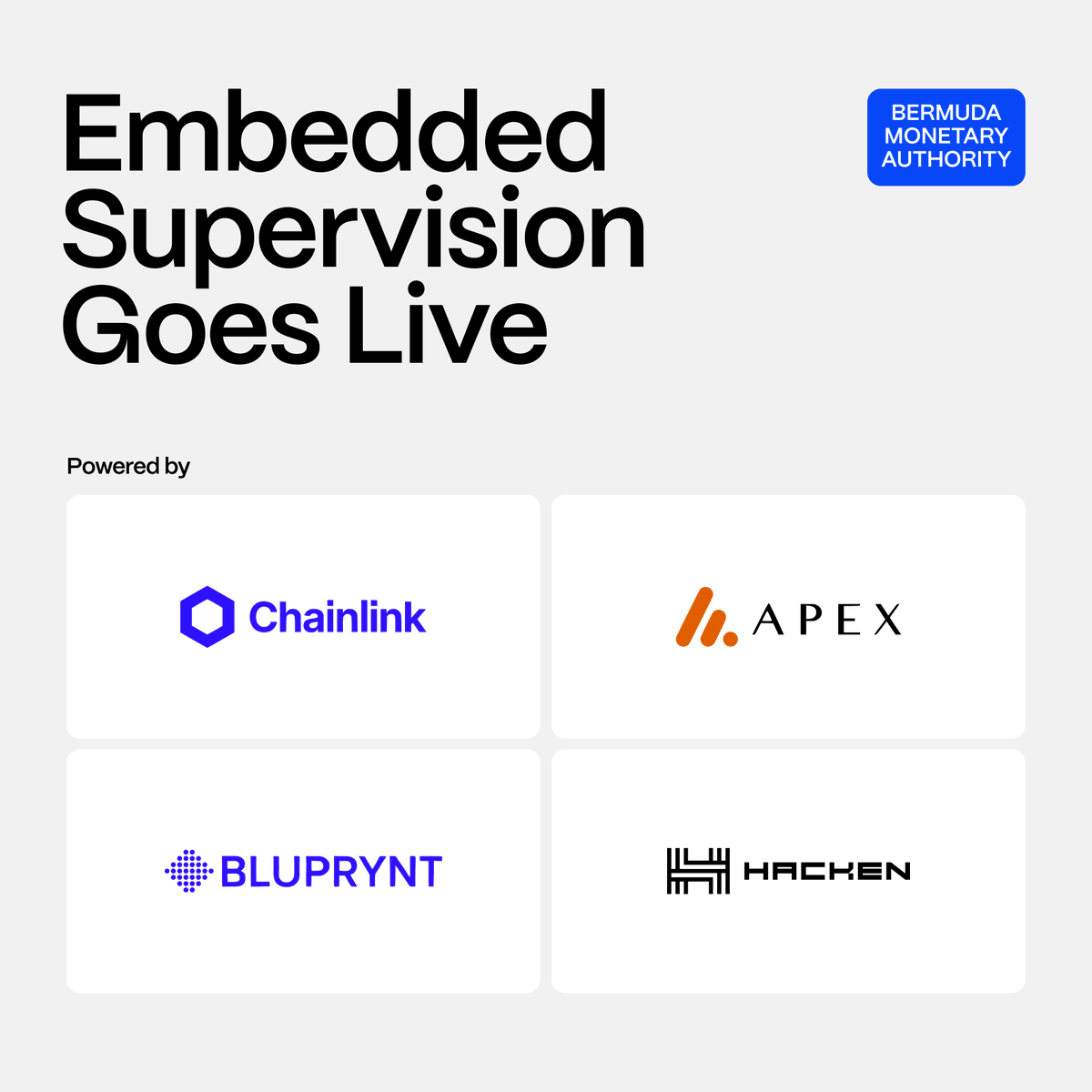
The Bermuda Monetary Authority just deployed Embedded Supervision, compliance enforced at the transaction layer, not reviewed after.
Built together with @chainlink, @ApexGlobalGroup, @blupryntco, and Hacken.
Over the past year, many people I talk to have expressed worry about two topics:
* Various aspects of the way the world is going: government control and surveillance, wars, corporate power and surveillance, tech enshittification / corposlop, social media becoming a memetic warzone, AI and how it interplays with all of the above...
* The brute reality that Ethereum seems to be absent from meaningfully improving the lives of people subject to these things, even on the dimensions we deeply care about (eg. freedom, privacy, security of digital life, community self-organization)
It is easy to bond over the first, to commiserate over the fact that beauty and good in the world seems to be receding and darkness advancing, and uncaring powerful people in high places are making this happen. But ultimately, it is easy to acknowledge problems, the hard thing is actually shining a light forward, coming up with a concrete plan that makes the situation better.
The second has been weighing heavily on my mind, and on the minds of many of our brightest and most idealistic Ethereans. I personally never felt any upset or fear when political memecoins went on Solana, or various zero-sum gambling applications go on whatever 250 millisecond block chain strikes their fancy. But it *does* weigh on me that, through all of the various low-grade online memetic wars, international overreaches of corporate and government power, and other issues of the last few years, Ethereum has been playing a very limited role in making people's lives better. What *are* the liberating technologies? Starlink is the most obvious one. Locally-running open-weights LLMs are another. Signal is a third. Community Notes is a fourth, tackling the problem from a different angle.
One response is to say "stop dreaming big, we need to hunker down and accept that finance is our lane and laser-focus on that". But this is ultimately hollow. Financial freedom and security is critical. But it seems obvious that, while adding a perfectly free and open and sovereign and debasement-proof financial system would fix some things, but it would leave the bulk of our deep worries about the world unaddressed. It's okay for individuals to laser-focus on finance, but we need to be part of some greater whole that has things to say about the other problems too.
At the same time, Ethereum cannot fix the world. Ethereum is the "wrong-shaped tool" for that: beyond a certain point, "fixing the world" implies a form of power projection that is more like a centralized political entity than like a decentralized technology community.
So what can we do? I think that we in Ethereum should conceptualize ourselves as being part of an ecosystem building "sanctuary technologies": free open-source technologies that let people live, work, talk to each other, manage risk and build wealth, and collaborate on shared goals, in a way that optimizes for robustness to outside pressures.
The goal is not to remake the world in Ethereum's image, where all finance is disintermediated, all governance happens through DAOs, and everyone gets a blockchain-based UBI delivered straight to their social-recovery wallet. The goal is the opposite: it's de-totalization. It's to reduce the stakes of the war in heaven by preventing the winner from having total victory (ie. total control over other human beings), and preventing the loser from suffering total defeat. To create digital islands of stability in a chaotic era. To enable interdependence that cannot be weaponized.
Ethereum's role is to create "digital space" where different entities can cooperate and interact. Communications channels enable interaction, but communication channels are not "space": they do not let you create single unique objects that canonically represent some social arrangement that changes over time. Money is one important example. Multisigs that can change their members, showing persistence exceeding that of any one person or one public key, are another. Various market and governance structures are a third. There are more.
I think now is the time to double down, with greater clarity. Do not try to be Apple or Google, seeing crypto as a tech sector that enables efficiency or shininess. Instead, build our part of the sanctuary tech ecosystem - the "shared digital space with no owner" that enables both open finance and much more. More actively build toward a full-stack ecosystem: both upward to the wallet and application layer (incl AI as interface) and downward to the OS, hardware, even physical/bio security levels.
Ultimately, tech is worthless without users. But look for users, both individual and institutional, for whom sanctuary tech is exactly the thing they need. Optimize payments, defi, decentralized social, and other applications precisely for those users, and those goals, which centralized tech will not serve. We have many allies, including many outside of "crypto". It's time we work together with an open mind and move forward.
The Wednesday Rex-Space was amazing as always! We thank and appreciate @hackenclub for participating
Article summary made here from one of our hosts @dobrovitsky
https://t.co/pdTyNzLL4f
Listen to Ep5 here:
https://t.co/9aqV8Q0tYZ
RexHook X-Spaces | Ep. 5
RexHook is building advanced DeFi infrastructure on Uniswap V4, turning liquidity into programmable logic through hooks - enabling dynamic strategies, custom pool behavior, and smarter on-chain execution via our hook marketplace and V4 launchpad
🎙 Poppa, Ken & David host our weekly X-Spaces every Wednesday at 17:00 UTC, covering RexHook updates, V4 hooks, and the future of programmable liquidity
This week we also have a special guest with many years in the scene and no1 experts in audits & security: Hacken!
https://t.co/SkPOs8c8BM
https://t.co/LQAY9GgGXx
Set a reminder and join the conversation:
https://t.co/PoKX7eeNvG
https://t.co/GI4QmqFWGg
🇪🇺 Economist Richard Werner makes a pointed argument: the EU was modeled on the Soviet Union.
The USSR had a parliament that looked democratic but couldn't initiate laws. Those came from the unelected Politburo.
The EU has the same structure: the European Parliament mostly approves and amends, while the unelected European Commission holds the monopoly on initiating legislation.
He also notes the timing. The Maastricht Treaty and the euro were rushed into existence almost immediately after the Soviet Union collapsed in 1991.
Werner isn't fringe. He's the economist who coined quantitative easing and predicted the 2008 financial crisis.
Agree or not, the democratic deficit argument is hard to dismiss.
Vitalik Buterin on Ethereum as the economic layer for AI
“The blockchain to me is the most natural way to allow applications and cooperation between many different people in the long term without needing to agree on who to trust. The other thing is also the economic layer. This is the layer where blockchains can support AIs.”
Vitalik believes Ethereum will play a large role in the future of decentralized AI:
“If you have more decentralized AI, that means you have different AIs (agents, programs) that are controlled by different people and need to interact with each other. And for that interaction to be possible, you need to have an economic layer. Either cooperation is based on economic incentives and economic rules. Or it’s based on central control. It’s usually one of the two, and if we can set up the economic system, that makes more decentralized interaction between AIs possible.”
Source: @okx (Apr 2026)
Read our full article on why AI agents will need Ethereum for low-risk DeFi below👇
What if your AI agent is the attacker?
Token metadata, governance proposals, price feeds, transaction memos: all active injection surfaces. We're hosting a webinar on how this works in Web3 and how to defend against it.
With case studies from Drift Protocol ($285M) and Resolv Protocol ($23M).
Registration link in the comments.
Most security tests find vulnerabilities.
Real attackers exploit the gaps between them.
Today, we're launching Hacken Red Teaming, adversary simulations built for a full hybrid stack.
Cloud. CI/CD. Validators. Wallets. Internal operations.
Tested the way attackers actually move 👇