On February 28, President Trump laid out five military objectives for the US war with Iran:
- “Destroy Iran’s missiles and raze their missile industry to the ground.”
- “Annihilate Iran’s navy.”
- “Ensure that Iran’s terrorist proxies can no longer destabilize the region or the world and attack our forces.”
- “Ensure that Iran does not obtain a nuclear weapon.”
- Prevent Iran from using “IEDs or roadside bombs, as they are sometimes called, to so gravely wound and kill thousands and thousands of people, including many Americans.”
Three-and-a-half months later, the US has achieved none of these objectives.
- According to US intelligence assessments, Iran has retained roughly 70% of its prewar missile stockpile and mobile launchers. Iran’s missile and drone production infrastructure also remains largely intact.
- US intelligence also concludes that Iran’s nuclear capacity remains broadly unchanged since last summer, with Iran still needing roughly a year to build a bomb.
- While the U.S. succeeded in significantly damaging Iran’s conventional navy, it did not weaken Iran’s capacity to impose maritime costs or disrupt ship traffic in the Strait of Hormuz.
- Iranian proxies (specifically Hezbollah) are still destabilizing the region.
- The threat from Iranian IEDs no longer exists because US troops have been out of Iraq for 15 years.
Indeed, the agreement reached this weekend with Iran only requires Tehran to reopen the Straits of Hormuz to maritime traffic ... an issue that arose solely BECAUSE of the war.
Then there are the enormous direct and indirect costs of the war.
After only three months, the war has cost the United States at least $30 billion in direct costs and the U.S. economy hundreds of billions in indirect costs.
It has killed and wounded U.S. servicemembers, damaged U.S. bases, depleted scarce munitions, raised energy prices, strained relations with partners, and left Washington scrambling to restore the status quo it disrupted. Even if there were tangible benefits to the war, the costs would more than outweigh them.
Even worse, the war empowered Iranian hard-liners, demonstrated its leverage over the Strait of Hormuz and, in turn, the global economy, and, because of the depletion of America's weapons stockpiles, has made it more difficult for the US to respond to future military crises.
This is worse than a failure. It is a strategic calamity.
Read the comprehensive report that we published at the Stimson Center earlier this month on the disaster that is the Iran War.
https://t.co/9QR5cMancN
Look, I’m sorry but I just can’t believe the Knicks came all the way back. And I bet a lot of my fellow basketball fans feel similarly. This calls into question the legitimacy of their Game Four win.
From 1966 to 2025 we dropped sterile flies over South America that ate screwworm and thus prevented them from spreading, but the le epic efficient cracked coders at DOGE thought this was a silly waste of the ~0 dollars it cost us.
Imagine if a woman president crashed the economy and started a war with no end in sight, and her biggest, seemingly ONLY concern was building a ballroom and redecorating the White House.
Miles Davis was born 💯 years ago today. 🎺 To celebrate, his estate has partnered 🤝 with Dad Grass 🍃 for the first-ever official THC-infused ‘Bitches Brew’ Leisure Drink.🥤
Food is set to become even more expensive:
World fertilizer prices have surged +44% since the start of the Iran War, to the highest since 2022.
This comes as ~33% of globally traded fertilizers pass through the Strait of Hormuz, which remains effectively closed.
This includes 23% of global ammonia, 34% of urea, the world's most widely used nitrogen fertilizer, and nearly 20% of global phosphate supply.
Furthermore, the Bloomberg Agriculture Subindex has increased ~9% since the Iran war.
The index tracks the futures prices of key agricultural commodities, including wheat, corn, soybeans, sugar, coffee, and cotton.
In the past, world fertilizer prices have acted as a leading indicator for agricultural output prices, as rising production costs eventually force farmers to reduce supply, pushing crop prices higher.
A new wave of global food inflation is imminent.
I've been doing this work a long time but nothing prepared me for what I saw on a recent reporting trip in Somalia. I was there to look into rising food and fuel prices from the war in the Middle East landing atop dramatic cuts to the international humanitarian relief system.
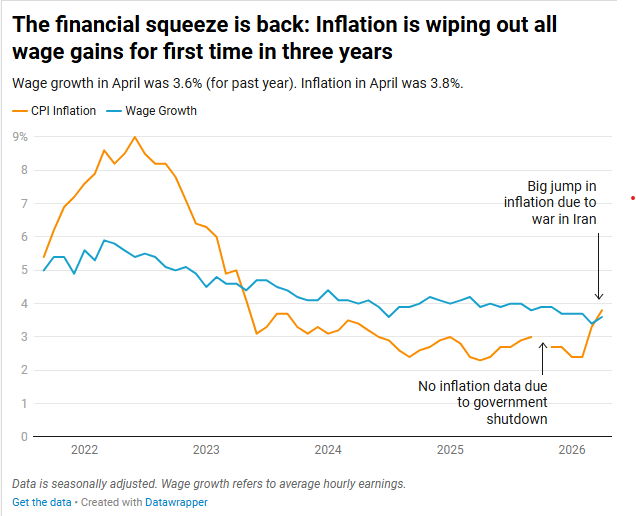
JUST IN: Inflation is now eating up all wage gains for the first time in about three years. This is painful for Americans and a true financial squeeze.
CPI Inflation in past year: 3.8%
Wage gains: in past year: 3.6%
While April CPI inflation rose to 3.8%, inflation is much higher in many basic necessities:
1. Energy Commodity Inflation: +29.2%
2. Gasoline Inflation: +28.4%
3. Airfare Inflation: +20.7%
4. Energy Inflation: +17.9%
5. Electricity Inflation: +6.1%
6. Fruits and Vegetables Inflation: +6.1%
7. Hospital Services Inflation: +5.5%
8. Motor Vehicle Repair Inflation: +5.1%
9. Apparel Inflation: +4.2%
This has driven cumulative inflation since 2020 to +29%, meaning goods that cost $100 in 2020 now cost $129 today.
Inflation remains a major issue for Americans.
The tram schedule for Roosevelt Island exists on google maps.
Why? Cause @AlexBores figured out how to code it when it didn't exist and just did it
And it still runs off his laptop.
https://t.co/Gl8CNdW5BY
A reminder that the science behind Ozempic traces back to research on the saliva of the venomous Gila monster.
The kind of strange, foundational research that would almost certainly have been cut under today’s standards.
RFK Jr.’s CDC is hiding a report that proves the COVID vaccine works, and the Washington Post just exposed it.
The report found that last winter’s COVID vaccine cut emergency room visits and hospitalizations among healthy adults roughly in half. It cleared the CDC’s full scientific review. It was scheduled for publication on March 19.
Then it got killed.
The administration’s official excuse is that the methodology was flawed.
One problem with that: a flu vaccine study using the exact same methodology was published in the same CDC journal one week earlier.
Nobody flagged that one.
Current and former officials told the Washington Post the real issue was political. The finding was too pro-vaccine for a Health Secretary who has spent years attacking vaccines.
So now ask yourself.
Why would America’s Secretary of Health rather bury lifesaving information than let American families see it?
If that’s the reason the CDC is keeping this report hidden, we cannot stand for it.
Help me spread the word.
https://t.co/ootf8SEcaR