Want happier, healthier kids?
Offer them autonomy.
Massive new meta-analysis makes it plain:
In every culture, control leaves children worse off — but autonomy helps them people engage, learn, and grow.
A 1% rise in male unemployment rate was associated with a 2.75% increase in physical violence against women in these data from 2005-2016 in developing countries: https://t.co/YHTrbJ6SHQ
Harry Dry is the best copywriter I know.
He's built a 130,000-person newsletter teaching people how to do it, and by the end of this interview, you'll be at least a Green Belt in copywriting.
Some of his rules for writing:
1) A great sentence is a good sentence made shorter.
2) Writing great copy begins with having something to say in the first place.
3) Copy is like food. How it looks matters.
4) Since the look of copy matters so much, don't write copy in Google Docs. Write it in Figma (so you can write and design at the same time).
5) Kaplan's Law of Words: Any word that isn't working for you is working against you.
6) You know a paragraph is ready to ship when there's nothing left to remove. It's like a Jenga tower. The entire thing should collapse if you remove something.
7) Make a promise in the title so the reader knows exactly what they're going to get if they click. Then, deliver on the promise.
8) The three laws of copywriting: (1) Make it concrete, (2) make it visual, and (3) make it falsifiable.
9) Make it concrete: Don't be abstract. For an example, say you're writing about habits. Don't talk about "productive routines." That's abstract. Write about "waking up at 6am to write" instead. It's concrete — and much more vibrant.
10) Make it visual: People see in pictures. This is why instead of memorizing card numbers directly, world memory champions memorize cards by turning them into pictures and then back to cards.
11) Make it falsifiable: When you write a sentence that's true or false, you put your head on the chopping block, which makes people sit up in their seat.
12) When has a falsifiable statement resonated? Galileo got sentenced to a decade of house arrest for saying that the earth spins around the sun. That's a falsifiable sentence. But nobody would've done anything if he'd said that the earth has a harmonious connection with a celestial object.
13) Write with the delete key. Using fewer words lets you be more impactful with the words you keep.
14) The job of a sales page is to make a bold claim at the top. Then spend the rest of the page backing up what you've said... with a ridiculous amount of proof.
15) If your competitor could've written the sentence, cut it.
16) Good copy is differentiated. Here's an example: Elon Musk shouldn't write "The Cybertruck is the world's best truck." Ford or Dodge can write that sentence. But only Elon can write: "The Cybertruck is tougher than an F-150 and faster than a Porsche."
17) Some days, the writing comes easily. Some days, it takes sweat. The reader doesn't care if you wrote for two minutes, two hours, or two days. The ink looks the same.
18) Great copy reads like your customer wrote it. Talk to them.
That's just an introduction to the copywriting philosophy of @harrydry.
I've shared the full interview below. I recommend you watch this one because we pull from so many visual references and do a lot of screen sharing. If you'd rather watch on YouTube, I've shared the link in the reply tweets.
I hired you for a job and I fully TRUST you to get it done.
I don't need you to account for every single hour.
Times have changed, and the workplace is different these days.
People are sick of being treated like children.
Had a fun chat with @ChrisWillX about why some people would rather be hated than unknown, why cynicism is not a sign of intelligence but a substitute for it, why everything from TikTok clips to political parties gradually become more alike, and much more. https://t.co/dfPxkFsyFr
Psychiatric diagnostic labels are often used when we don't know the biological cause of brain symptoms, such as unrelenting depression, ADHD, OCD, or psychosis.
If someone with "schizophrenia" is found to have vitamin B12 deficiency and correcting this makes the symptoms go away, researchers will say the person didn't really have schizophrenia.
If someone with "major depression" is found to have hypothyroidism and correcting this makes the depression go away, researchers will say this person didn't really have major depressive disorder.
Someday, we will be able to find the root cause(s) of everyone's brain symptoms and psychiatric labels will be a thing of the past. After all, they only represent a list of symptoms.
That day should begin soon in my mind.
The first step is to begin looking for the root causes of brain symptoms. We are actually capable of much more than we currently offer people.
We could start with many of the basic mental health assessments that we already do, but add in assessments for insulin resistance, some hormones, some vitamins, inflammatory biomarkers, etc.
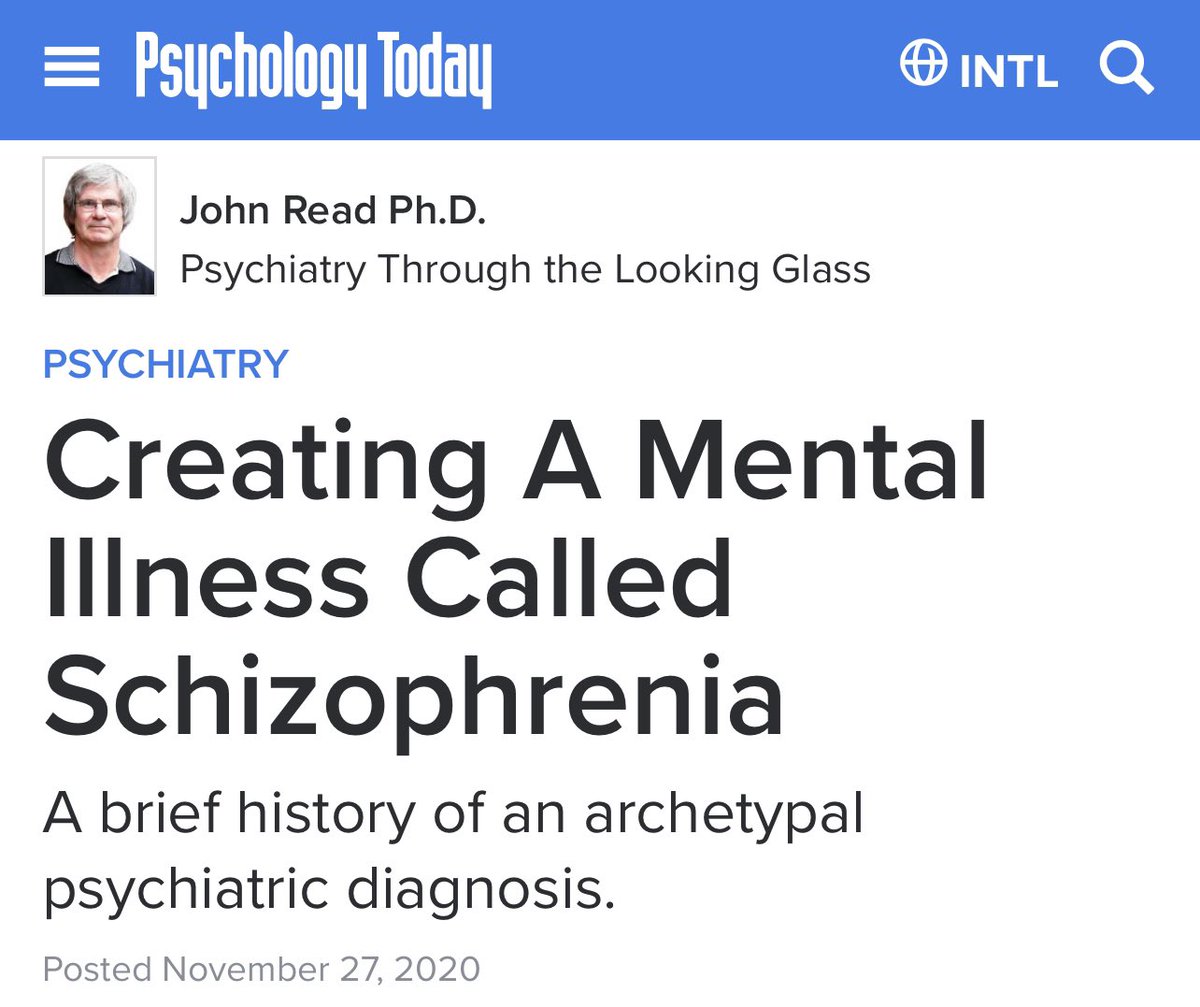
Powerful @Psychtoday piece by @readreadj: “Today, when we experience severe levels of distress and grief…we deserve better than scientifically meaningless, medical-sounding labels that wrongly imply there is something biologically defective about us.”
How to criticize with kindness – philosopher Daniel Dennett on the 4 steps to arguing intelligently, increasingly needed in our times of brute opinion-battling https://t.co/6zZ4ii00ZZ
Estrogen-only use was associated with increased dementia rate in women exposed near menopause, confirming findings from a large clinical trial but in a more contemporary population reflecting actual use.
https://t.co/yO93fsJkvQ