🫀 Pressure Half-Time (PHT) in Echocardiography
PHT is the time required for the peak pressure gradient across valve to decrease by 50% during diastole. It is derived from the deceleration slope of the Doppler velocity profile
Follow the thread 👇
📌 Tissue Doppler Imaging (TDI): Understanding S′, e′, a′ and the Tei Index
Tissue Doppler Imaging (TDI) is a valuable echocardiographic technique used to assess both systolic and diastolic myocardial function through measurement of mitral annular velocities.
Thread 👇
GHANA 🇬🇭 | JUGADOR MURIÓ POR RODILLAZO DE UN ARQUERO
😳 El arquero fue directo con la rodilla a la cara del jugador Emmanuel, que le provocó la muerte minutos después.
Diastolic function assessment uses transmitral inflow, tissue Doppler, pulmonary vein flow, and filling pressure measurements to evaluate ventricular relaxation and filling dynamics.
These measurements play an important role in identifying and grading diastolic dysfunction.
@TrackYourHeart
#MedTwitter #Cardiology #Echocardiography #HeartFailure
🫀📊 **Diastolic dysfunction: are we finally making it simpler?**
Assessing left ventricular diastolic function remains one of the most challenging areas in echocardiography. Multiple variables, load dependence, age-related changes, and often discordant findings make interpretation difficult even for experienced imagers.
A new review proposes a **simplified, tier-based approach** aligned with the 2025 ASE recommendations, aiming to improve the clinical applicability of diastolic function assessment.
🔑 **Key concepts**
✅ Diastolic dysfunction should not be viewed as a single measurement but as a combination of:
• Impaired LV relaxation
• Increased myocardial stiffness
• Elevated filling pressures.
📈 The 2025 approach starts with what may be the most clinically useful marker:
👉 **e′ velocity**, reflecting myocardial relaxation.
Additional markers such as:
• E/e′ ratio
• Left atrial size and function
• Left ventricular hypertrophy
• Left atrial reservoir strain (LARS)
are then integrated in a stepwise fashion.
💡 One of the major advances is the introduction of a **tiered framework** for estimating filling pressures, reducing the number of "indeterminate" studies that frequently complicated the 2016 algorithm.
🏃 In patients with unexplained exertional dyspnoea, the paper reinforces the value of **diastolic stress echocardiography**, recognising that elevated filling pressures often become apparent only during exercise.
🤖 Perhaps the most exciting perspective is the role of artificial intelligence.
The authors propose that diastolic dysfunction may be better understood as a **latent phenotype**, integrating dozens of clinical and imaging variables rather than relying on a few Doppler measurements alone.
Machine-learning models have already demonstrated:
✅ Improved estimation of filling pressures
✅ Better prognostic stratification
✅ Identification of high-risk phenogroups that traditional algorithms may miss.
🎯 **Take-home message**
Diastolic dysfunction is not a binary diagnosis.
Predicting lifetime cardiovascular risk and benefits of preventive treatment in patients with established atherosclerotic cardiovascular disease. Read the results of the SMART-REACH2 model in #EHJ 👉 https://t.co/YMV179rLVj
@RoccoMontone@ehj_ed
Early repolarization is more than just ST elevation.
Evolving definitions now include J wave elevation and terminal QRS slurring, highlighting the importance of recognizing subtle electrical patterns in cardiovascular medicine.
@AldecoBravo#Cardiology#Electrophysiology #MedTwitter #HeartRhythm
M-mode echocardiography remains a valuable tool for assessing left ventricular size and function.
Measurements such as LV dimensions, wall thickness, and fractional shortening continue to provide important insights into cardiac performance.
@ClevelandClinic#MedTwitter #Echocardiography #Cardiology #CardiacImaging
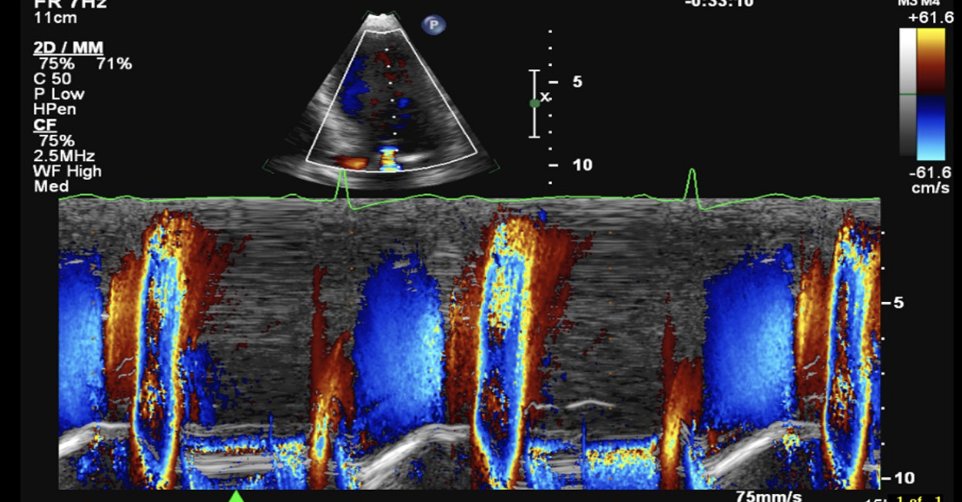
#CardioNugget™: Diastolic MR 🫀
MR occurs whenever LV pressure > LA pressure
Usually this is during systole — but in:
Complete heart block
Long PR interval
AV dissociation
Severe ↑ LVEDP
…LV pressure briefly exceeds LA pressure in diastole → causing diastolic MR.
Echo clues:
Small low-velocity MR jet
Occurs after A wave
Seen before systole/QRS
Best seen on color M-mode or CW Doppler
Board pearl:
Diastolic MR usually reflects abnormal hemodynamics, not primary MV disease.
#EchoBoards #CardioNuggets #CardioMed #DiatolicMR