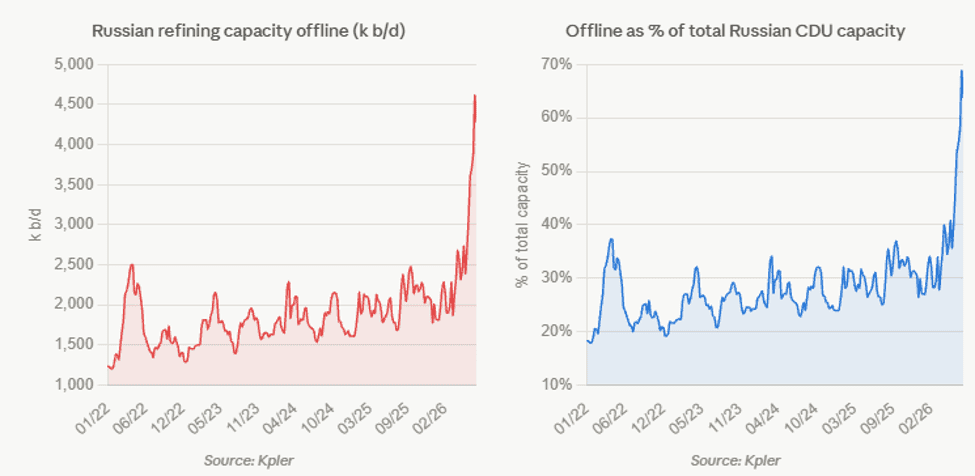
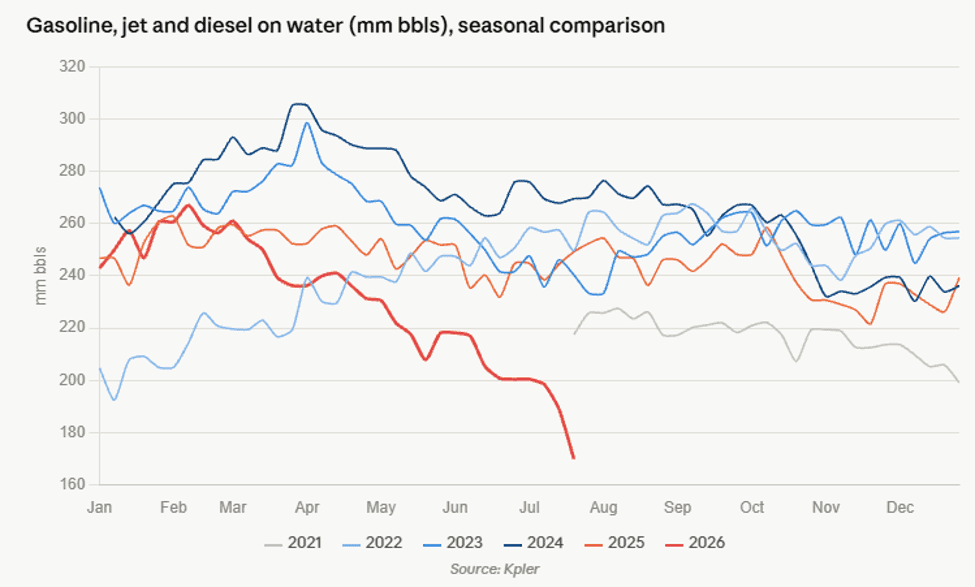
Key takeaways showing just how choked up the refined products mkt actually is.
It’s scary to think where the tape would be without PADD 3 pulling the weight. Honestly these wild crack spreads aren't even that shocking.
If Trump is going to pull off a TACO, he better move fast. There's still a solid month left of peak summer demand, and US product stocks are running ridiculously dry.
Such an interesting case study on what goes down when structural refining bottlenecks get hit with geopolitical event.
#oott #iran
Morgan Stanley: the bottleneck isn't crude—it's refining, and diesel is the epicenter.
Europe faces multi-year low inventories
But the bank says the market has already priced in much of the risk.
Tight doesn't always mean "buy."
#Diesel#Oil#Refining#EnergyMarkets#Europe #Commodities #EnergySecurity
https://t.co/kyDAcb1BoV
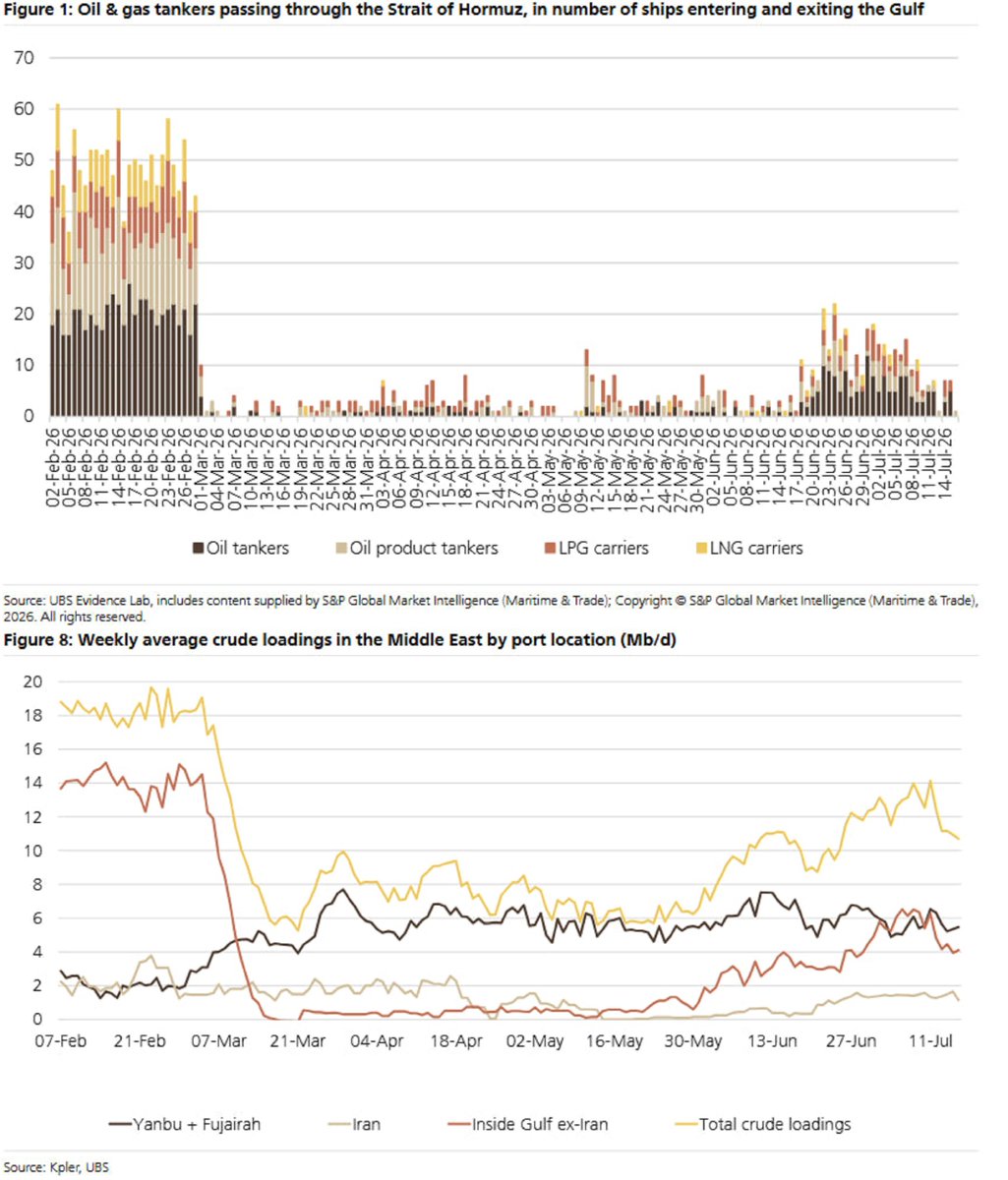
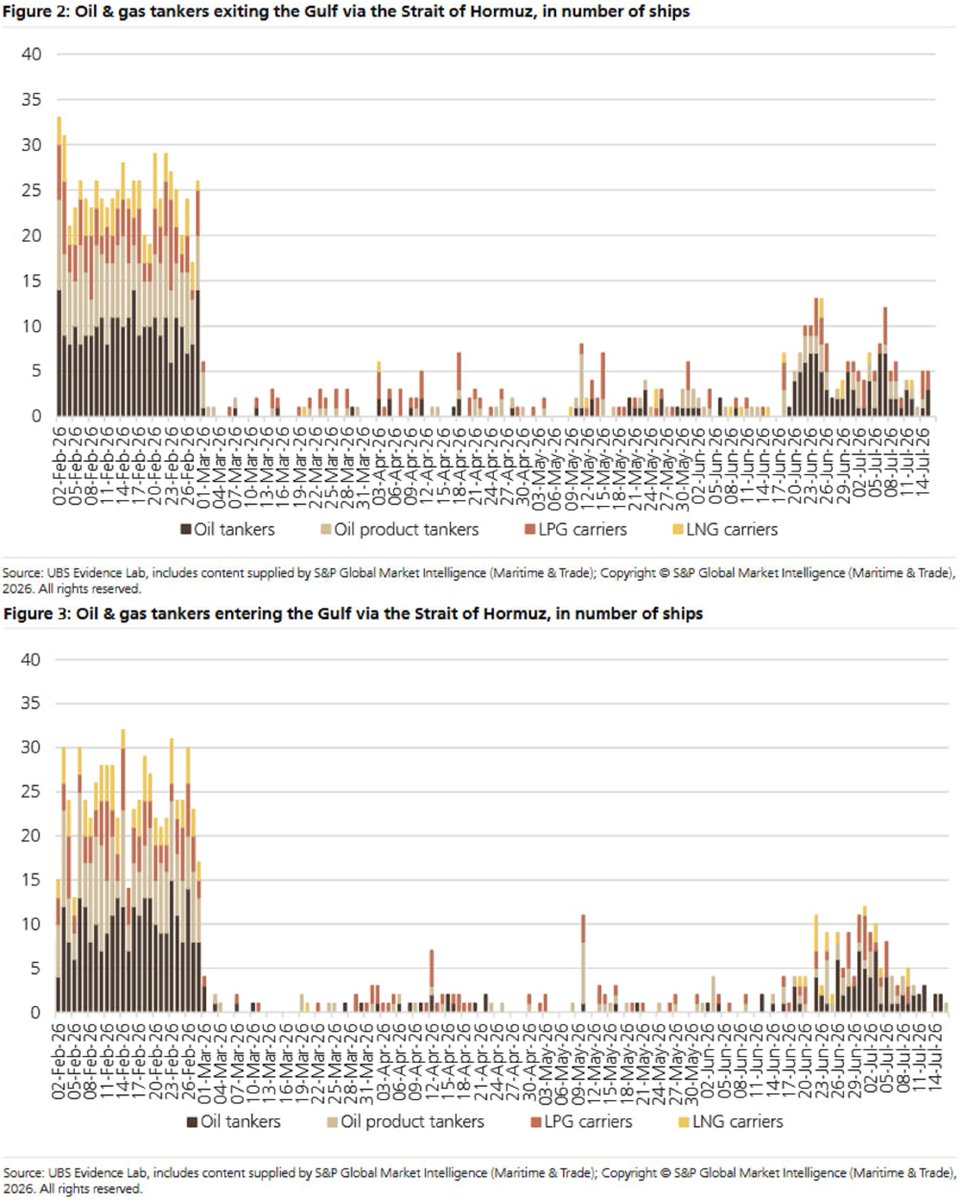
UBS just put out some clean charts baking in Kpler/Platts data, breaking down Hormuz tanker traffic by category.
With geo risks flaring back up, the recovery in both transit and loadings has hit a complete brick wall and reversed.
Crude is poised to slide down to $30/bbl, and once Trump prints his TACO, the tape is going to crater straight to $12/bbl—ultimately meeting the exact same fate as whale oil.
THANK YOU FOR YOUR ATTENTION TO THIS MATTER!
#oott #iran
Iran's IRGC says it has carried out a "surprise attack" on the US special operations command center at al-Tanf in southern Syria.
CENTCOM previously denied an earlier IRGC claim that it had attacked US forces at al-Tanf.
Iran Update Special Report, July 18, 2026: Iran is adapting to US defenses by firing high-speed, maneuverable missiles at US bases in the region, which highlights the threat that the advancement of Iran's ballistic missile program poses to US national security interests. Iranian leaders have expressed interest since at least the Iranian strikes on Israel in April and October 2024 in employing maneuverable reentry vehicles in order to improve the relatively low accuracy of Iranian missiles.
Other Key Takeaways:
An Iranian missile attack on a base in Jordan killed two US service members on July 17. Unspecified US officials told Western media that the attack took place at Muwaffaq Salti Airbase in Azraq, Jordan.
The People's Republic of China (PRC) and Russia are likely supporting Iranian efforts to target US bases in the region. US officials told the Wall Street Journal on July 18 that they are concerned that the PRC and Russia are supporting recent Iranian targeting of US assets.
Iranian Supreme Leader Mojtaba Khamenei and other senior Iranian officials, including members of the negotiating delegation, have publicly declared that the US–Iran memorandum of understanding (MoU) is no longer in effect.
Iran and the United States interpreted the MoU's fifth clause about the Strait of Hormuz in fundamentally different ways, which contributed to the MoU's collapse.
Iran struck a Kuwaiti power and desalination plant on July 18, likely in response to an alleged US strike on an Iranian desalination plant near Jask, Hormozgan Province, on July 17.
Iran launched a ballistic missile at a US base in Saudi Arabia, marking the first Iranian attack on Saudi territory in nearly three months. Iran also targeted US facilities in Bahrain and Jordan on July 17 and 18.
The United States has struck additional bridges and roads around Bandar Abbas, Hormozgan Province, since ISW-CTP's last data cutoff at 2:00 PM ET on July 17.
KAN NEWS: The United States has informed Israel that it plans to intensify its strikes on Iran in the coming days.
According to one Israeli and one American security official, ongoing strategic talks have also focused on the possibility that Tehran could “break all the rules” and directly attack Israel.
Such a move would likely trigger a major Israeli response against Iran.
For now, however, Washington is reportedly seeking to keep Israel out of the current escalation.
...a U.S. service member in northern Iraq was killed in action July 18 during a controlled detonation of unexploded ordnance from a downed Iranian one-way attack drone.....
💧Water is not just a commodity in the Gulf.
It is survival.
With almost no rainfall, entire nations drink the ocean instead.
🇰🇼Kuwait draws 90% of its water from desalination
🇴🇲Oman draws 86%
🇸🇦Saudi Arabia draws 70%
🇦🇪UAE draws 42%
The Gulf runs over 400 of these plants, producing roughly 60% of the world's desalinated water.
Iran needs almost none of it.
Rivers and dams do the work instead.
A handful of concrete facilities are the line between a nation with water and a nation without.
🇰🇼 The devastating infrastructure war continues. For the THIRD consecutive day, Kuwait reports that Iranian strikes have targeted a power and water desal plant.
Kuwaiti ministry statement suggests it was the same plant that was hit yday.
"A power and water desalination plant was subjected to a heinous Iranian attack for the second time in two days, resulting in a fire in some of the plant's facilities and affecting a large number of generating units."
The United Arab Emirates has expressed its utmost concern regarding the developments witnessed in the region over the past few days, calling for an immediate halt to the escalation and refraining from taking any steps that could exacerbate tensions and the state of instability in the region.
Trump’s Pipeline Wars: How Iran’s Gambit Exposed China
War is the continuation of politics by other means and Trump has moved that logic from the battlefield to the barrel.
The pipeline wars are his answer to Iran’s closure of Hormuz: a counter‑offensive that punishes Tehran, exposes China, and pulls Iraq, Syria, and Venezuela toward the American orbit as emerging allies.
Iran’s gambit was revolutionary bravado: slam shut the strait, choke off a third of seaborne oil, and dare America to blink. Iraq’s exports, long 90‑plus percent dependent on Hormuz—collapsed, and Baghdad discovered it was less an energy state than a client of a narrow waterway patrolled by a hostile regime and an American carrier group.
The Strait has been war‑gamed for decades. Trump tried diplomacy first. Now the world is watching what hard power looks like when the simulations go live.
His answer is to treat Hormuz as a flaw, not fate. Epic Fury broke Iran’s ability to escalate; the strategic move is what follows—build around Iran. Push Iraqi barrels toward Turkey’s Ceyhan.
Revive Mediterranean outlets. Bring back the Kirkuk–Baniyas concept: an old 1950s line from Kirkuk to Syria’s port of Baniyas, shuttered by war and neglect, now reborn as a 300,000–700,000 barrel‑per‑day artery with U.S. backing, American firms doing the studies, and sanctions eased just enough to lay steel. Iraq gets cheaper exports and diversification away from both Hormuz and Ceyhan. A post‑Assad Syria stops being a crater and starts being a corridor, earning hundreds of millions in transit fees, plus jobs and infrastructure. In practice, Syria and Iraq are being bound into an American‑centric energy system, precisely how fragile states become durable allies.
The deeper casualty is China. Beijing built its industrial machine on discounted barrels from Iran and Venezuela, moved by shadow fleets through long, vulnerable sea lanes. That is not diversification; it is dependency. Churchill warned that “safety and certainty in oil lie in variety of supply.” China concentrated risk in sanctioned regimes and contested waters, then called it strategy.
Venezuela shows the Trump doctrine at work. For years, Caracas was a major producer, enabler of state‑sponsored terrorism, and a willing ally of China.
The takedown of Nicolás Maduro was a seismic event largely ignored in polite foreign‑policy circles: a hostile petro‑regime toppled without occupation, then flipped into a grudging supplier to U.S. refiners. Oil long routed to China now flows to America, strengthening U.S. energy security and starving Beijing of friendly heavy crude.
This is Hegel’s dialectic in hard assets. Iran’s closure of Hormuz is the thesis. Trump’s strikes, pipelines, and Venezuela turn are the antithesis. The pipeline wars are the synthesis: chokepoints contested, transit states turned into allies, hostile producers pulled into an American system.
In 2026, the map matters again and Trump is redrawing it so America sits on the pipes while Iran and China sit on exposure.
Time to have a sit down with Mr Z.
(Reuters) -An oil tanker chartered by ExxonMobil for loading oil at the Caspian Pipeline Consortium (CPC) terminal off Russia's Black Sea coast was attacked overnight
MORE |🧵(1/3): The United States is striking Iranian targets further inland in southeastern and southwestern Iran. The purpose of these strikes is not immediately clear. ⬇️
US forces struck a hangar at Semnan Airport in Semnan Province, according to a local official. Semnan Province hosts several missile test and space launch sites. Iranian media reported that US forces struck more targets in Sistan and Baluchistan Province, including an IRGC base near Rask, which is approximately 130 kilometers from Iran’s southern coastline. The United States has struck at least three inland targets in Sistan and Baluchistan Province since July 14. Iranian media also reported that the United States struck unspecified sites near Kabudarahang in Hamedan Province, Khorramabad in Lorestan Province, Khondab City in Markazi Province, and Ahvaz in Khuzestan Province. A US official told Reuters on July 15 that recent US airstrikes could be seen as “shaping operations” to degrade Iranian defenses in case the US military was ordered to conduct more intensive operations.
🇸🇦Aramco just awarded Halliburton a multi-billion dollar, multi-year contract for unconventional gas development at the Jafurah Basin, 1 of the largest unconventional gas programs on the planet.
This is Saudi Arabia, the country that built its entire identity on crude oil, making a serious long-term bet on gas.
Every major producer is now racing toward the same molecule.
America for exports, China for demand, and now Saudi Arabia for its own domestic supply.
https://t.co/7wQNWJOv9c
Lloyd's List Intelligence has launched new dashboards tracking vessel movements in the Strait of Hormuz and Red Sea (Suez Canal and Bab el Mandeb)
https://t.co/EgxHa1Kt8Q
While we're all distracted with Iran, China is quietly and consistently winning. Exports to the US are almost back to where they were before the US hiked tariffs. Exports to everywhere else are through the roof. Most important, export prices are way up...
https://t.co/D5yGvHEnEm
The Telegraph, citing sources in Yemen, reports that the Houthis are preparing contingency plans to close the Bab al-Mandeb Strait in coordination with Iran if Tehran decides to escalate the conflict further.
According to the report, the Houthis are expanding ties with Somalia's al-Shabaab, including the alleged transfer of Iranian drone technology, with the goal of exerting influence over both sides of the strategic waterway. The Telegraph says the move would mirror Iran's strategy in the Strait of Hormuz, potentially allowing Tehran to threaten two of the world's most important maritime chokepoints simultaneously.
The report notes that Bab al-Mandeb carries roughly 10–12% of global maritime trade and has never been closed at the same time as the Strait of Hormuz. If both waterways were disrupted simultaneously, shipping would face major delays and significantly higher costs.
The reporting comes as regional tensions continue to rise, with U.S. strikes against Iranian targets, renewed attacks in and around the Strait of Hormuz, and Saudi-Houthi hostilities intensifying following recent strikes on Sana'a Airport.
Source: https://t.co/KDEdizn3Lm
Hormuz outbound oil flows have fallen to ~7.5 mb/d
That's half the late-June surge, which mostly cleared stranded Gulf barrels.
The buffer is gone; the disruption is now visible in flows.
#OOTT#Oil#Hormuz#Energy#Shipping#Commodities#Geopolitics#Risk
This post reminds me of a report I worte in late 2023, titled "China’s Oil Demand Has Peaked." The main takeaways from that report were:
1. China’s oil demand may have peaked on a secular basis.
2. The total number of internal combustion engine (ICE) vehicles currently on the road has declined for the first time in history, indicating a peak in gasoline demand.
3. Over the next five years, China’s annual gasoline demand may decline by an average of 35 million barrels, or 96K bbl/d.
4. Gasoline demand destruction will accelerate in 2027.
As such, I suspect China's incentive to restock crude oil is much weaker than many investors anticipate, particularly given the recent deterioration in domestic demand and Beijing's continued reluctance to step up stimulus.