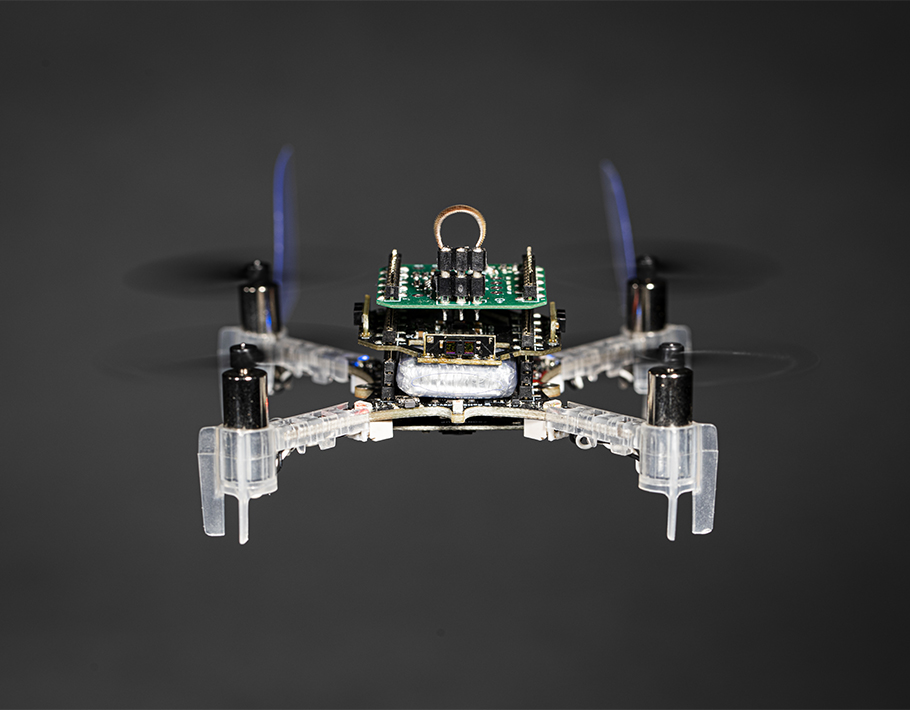
This is great. The tilt effect due to proximity to a wall is fed into a Kalman Filter as a wall distance measurement. A simple, reactive way to navigate with no additional sensors. Fitting for the inaugural issue of the Robotics Nature Portfolio Journal
🤖🚁 How can tiny drones see walls & avoid crashing without bulky sensors or cameras? We show quadcopters can leverage propeller airflow physics for exploring unknown environments!
Just published in the new @NaturePortfolio journal npj Robotics @Nature_NPJ
New article out in Science Robotics. Using origami, airflow, and automation to control the dispersal of tiny wireless sensors. A collaboration between groups led by @VikramIyerUW@ShyamGollakota , Alberto Aliseda, and myself.
Excited to share our new Science Robotics paper where we show battery-free micro fliers that use origami to change shape in mid-air and control their descent.
Paper link: https://t.co/2OrwnLBtmG
So excited about our new PEACE project here at #UWAllen, designed to support CS researchers in Proactively Exploring and Addressing Consequences and Ethics. See the blog post to hear more! (w/ @rockpang6, @yoshi_kohno, @djg98115)
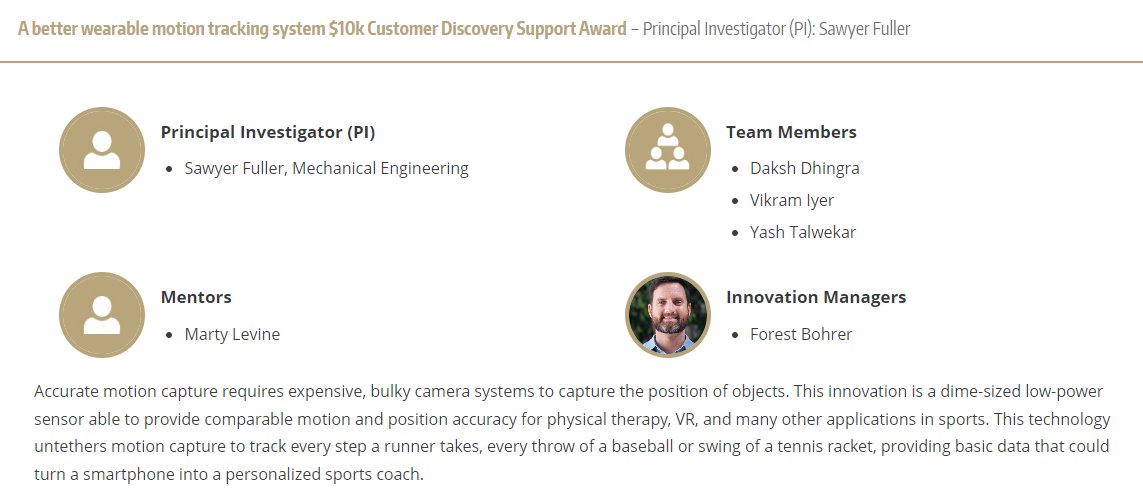
ME and @uwcse researchers received a $10k @UWCoMotion Innovation Gap Fund Award for their project: a better wearable motion tracking system. https://t.co/ZlFWvigRwj @blinkminster@VikramIyerUW
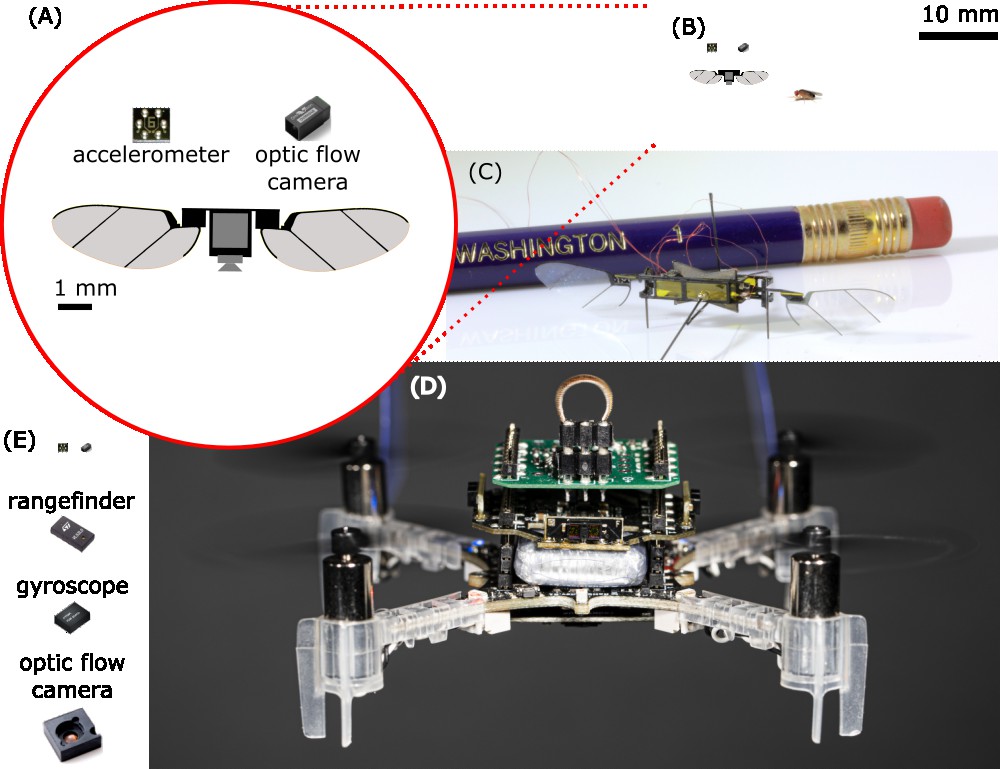
Excited to report a new article from our group coming out this week in Science Robotics: "A gyroscope-free visual-inertial flight control and wind sensing system for 10 mg robots". https://t.co/x9OVSsT0Bm #gnatrobots
Applications include early detection of forest fires, pest onset in agriculture, buried explosives, or mapping hazardous volatiles to find leaks of greenhouse gasses or the spread of airborne diseases.
This helps pave the way to creating small flying robotic insects, which will revolutionize low-altitude atmospheric "air telemetry" -- remote sensing of air composition and flow -- by doing so on a much more detailed and persistent basis than is possible now.
A gnat-inspired sensor suite could promote flight stabilization in milligram-scale robots navigating gusts of wind. @blinkminster@ME_at_UW
📄: https://t.co/sXPNUu2Djz
To do this, we take advantage of the physics of small scale, where drag-induced accelerations are larger. These results show that small scale is not only different but advantageous, even in the area of sensing and control.
Instead we used only an accelerometer, which is commercially available in packages weighing as little as 2 mg and 20 microwatts! We combine this with a tiny optic flow camera, which can be made similarly efficient and light, to estimate and control lateral velocity and attitude.
Conventional wisdom says that a rate gyroscope, which measures angular velocity, is an essential part of a flight control system. Our solution turns this notion on its head, eliminating the gyroscope entirely because it is too heavy and power-hungry (>15 mg, >1 mW).
This article was motivated by recent advances by groups around the world that are creating really small ~10 mg flapping-wing devices, about the mass of a grain of rice. We wanted to know if we could design a flight controller for a robot that small.
@BomphreyRichard @JonAMichaels I see, that makes more sense. Are there any with wings with a high aspect ratio like that that don’t spread them out? I thought I saw something like this last weekend and it looked like it was flying with wings shaped like this.