1500 agents is easy; here's 10k agents all logging in and playing minecraft together on sailboxes in realtime.
10k VMs with 10K vCPUs, 21TB of RAM, 86TB of disk.
This capacity is all available for $250/month entirely self-serve with the new Sail Pro plan (along with active-everything billing and no creation fees).
Try it out today!
employee from worlds second cheapest sandbox to worlds first cheapest sandbox:
“how are you so cheap?? how is this possible??”
the cpu sandbox race to the bottom is over now, we’re at the bottom
decided to create twitch for agents now that sailboxes support live-streaming over UDP!
give GLM-5.3 a command and watch it attempt to play minecraft in realtime. the agent lives forever at your link so you can check back at any point to see how it's faring.
I interviewed @neilmovva for @substratemag on latency-insensitive inference, alternative chips, and why massive datacenters face diseconomies of scale.
"We've always predicted that async inference is going to eat the world. That could easily be 95% or more of inference demand."
Neil's been at the frontier of inference for years, from NVIDIA to co-founding @sailresearchco. I learned a lot from our conversation - you can listen below.
We nearly doubled MFU on TPU v6e serving Gemma 4 31B, taking prefill from 32% to 63% MFU, and 2x throughput.
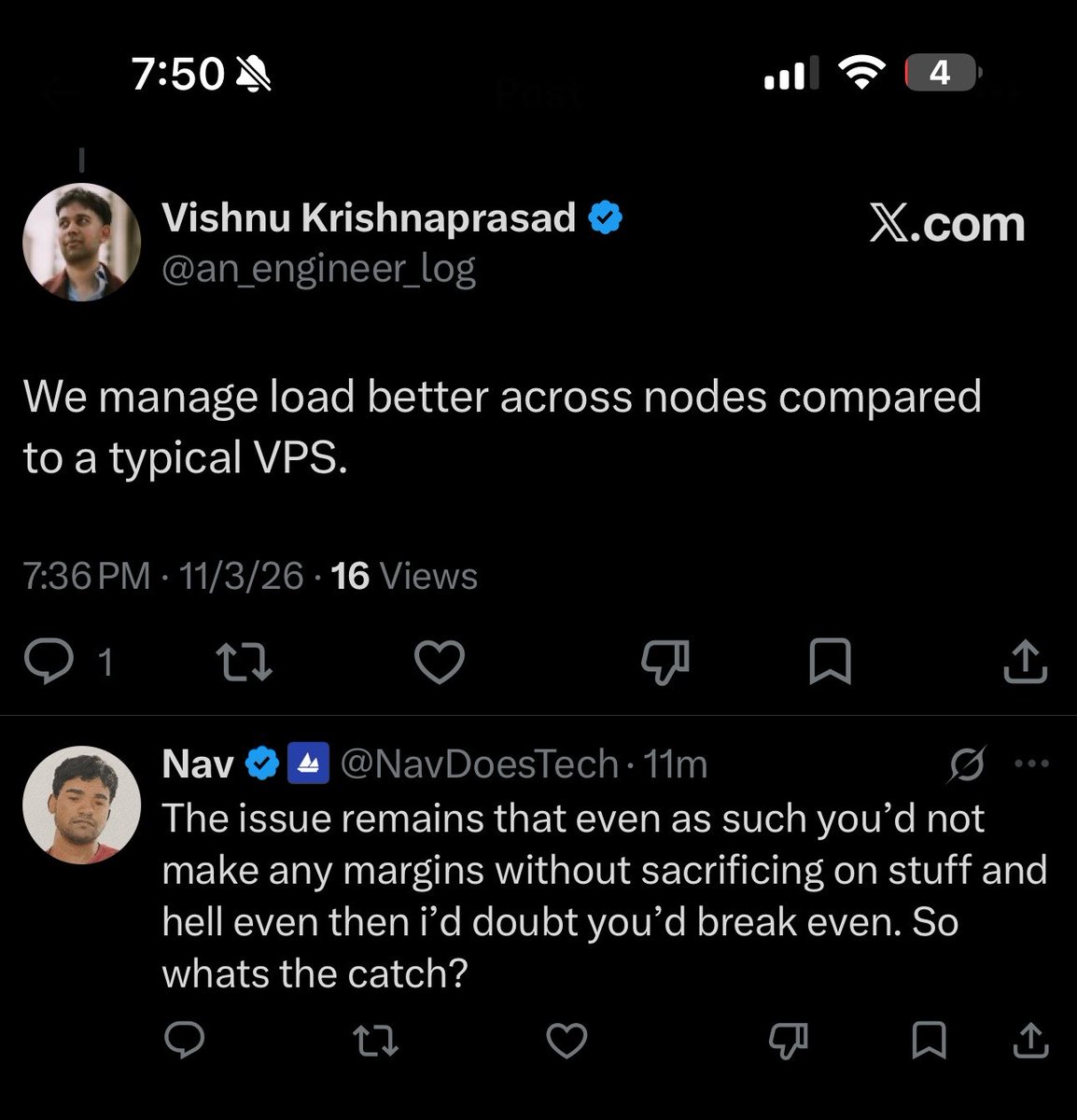
v6e has 2.5x less HBM and less than half the memory bandwidth of an H100.
@transmissions11 wrote about here and link to post: https://t.co/t4LoE0Xy0z
Neil Movva (@neilmovva) started his career at Nvidia, working on GPUs and kernels, and has an unusually deep understanding of inference, from software to chips to power.
We spend a lot of time on each of those layers, how they connect, and where the important tradeoffs are.
What makes this conversation special is how detailed it is (like a 401-level class), yet Neil makes it remarkably clear and easy to follow.
Today he runs Sail Research, a company building infrastructure for agents to make tokens as cheap as possible.
We discuss:
- Latency versus throughput
- Why there are no bad chips, only bad pricing
- The end of kernel engineering
- Buying chips and power no one else wants
- New chip architectures
- Nvidia lore + his contrarian view of the company
- Open source and the frontier labs
I learned a ton. Enjoy!
TIMESTAMPS
0:00 Intro
0:38 Building a “Token Factory”
4:21 The Future of Background Agents
13:09 Nvidia and the GPU Stack
23:27 Chips, Memory, and Transformers
36:14 The Future of AI Training Data
44:32 Chip Scarcity and Compute Arbitrage
52:44 Reinventing the AI Data Center
59:01 Power and the “Scavenger Strategy”
1:10:10 Open vs. Closed AI
🆕 Custom domains for Sailboxes. A Sailbox is already a great HTTP server, pausing when idle. Now put it on your own domain. Like this one: Play https://t.co/SJxFmqpuI5, running on a Sailbox with a custom URL.
I left @A24 to start Osmo, a storytelling studio with a software factory.
Today, we’re launching @osmo_studio to the public: an end-to-end editable video platform that turns Figma, code and reference videos into fully editable motion.
We also raised a $5M seed to build it.