The way software engineering has been done has fundamentally changed and will continue to change, but there is still need for people that understand the fundamentals of software architecture and structure. It's easier than ever to build a POC but a POC is not the same thing as production ready architecture, security, etc.
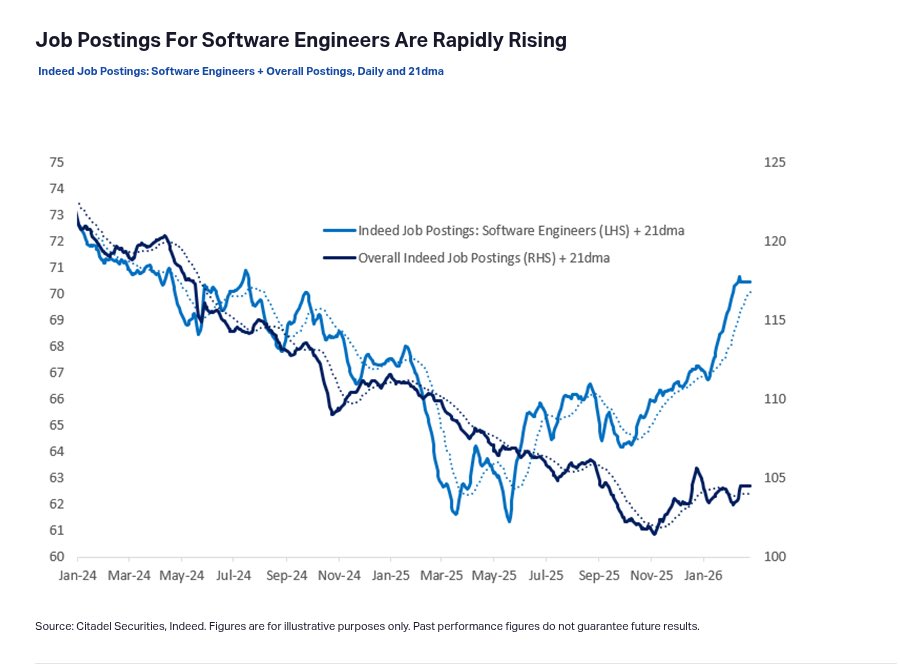
Q: How are job postings for software engineers rising rapidly despite AI agents automating coding?
A: Because there’s far more code to manage than ever before. We’re already seeing a 14x YoY increase in GitHub commits, and it’s accelerating.
AI has dramatically lowered the cost of writing code, so it’s now being used across far more businesses, applications, and use cases.
We’re at the beginning of a massive productivity boom driven by the proliferation of bespoke software throughout the entire economy.
Coding has been AI’s breakout use case this year. The fact that it’s increased demand for software engineers — rather than decreased it — should call into question the entire “AI will cause mass job loss” narrative.
The harness matters more than the model.
Models have gotten really good. Great reasoning, large context windows, better instruction following.
But, what makes *use* of those capabilities is actually the harness. It's what provides tools, memory, skills and context to the model.
ChatGPT is a harness. Claude Cowork is a harness.
Without the harness, the model is just an engine with no car. You don't get anywhere.
There will be no AI jobpocalypse.
The story that AI will lead to massive unemployment is stoking unnecessary fear. AI — like any other technology — does affect jobs, but telling overblown stories of large-scale unemployment is irresponsible and damaging. Let’s put a stop to it.
I’ve expressed skepticism about the jobpocalypse in previous posts. I’m glad to see that the popular press is now pushing back on this narrative. The image below features some recent headlines.
Software engineering is the sector most affected by AI tools, as coding agents race ahead. Yet hiring of software engineers remains strong! So while there are examples of AI taking away jobs, the trends strongly suggest the net job creation is vastly greater than the job destruction — just like earlier waves of technology. Further, despite all the exciting progress in AI, the U.S. unemployment rate remains a healthy 4.3%.
Why is the AI jobpocalypse narrative so popular? For one thing, frontier AI labs have a strong incentive to tell stories that make AI technology sound more powerful. At their most extreme, they promote science-fiction scenarios of AI “taking over” and causing human extinction. If a technology can replace many employees, surely that technology must be very valuable!
Also, a lot of SaaS software companies charge around $100-$1000 per user/year. But if an AI company can replace an employee who makes $100,000 — or make them 50% more productive — then charging even $10,000 starts to look reasonable. By anchoring not to typical SaaS prices but to salaries of employees, AI companies can charge a lot more.
Additionally, businesses have a strong incentive to talk about layoffs as if they were caused by AI. After all, talking about how they’re using AI to be far more productive with fewer staff makes them look smart. This is a better message than admitting they overhired during the pandemic when capital was abundant due to low interest rates and a massive government financial stimulus.
To be clear, I recognize that AI is causing a lot of people’s work to change. This is hard. This is stressful. (And to some, it can be fun.) I empathize with everyone affected. At the same time, this is very different from predicting a collapse of the job market.
Societies are capable of telling themselves stories for years that have little basis in reality and lead to poor society-wide decision making. For example, fears over nuclear plant safety led to under-investment in nuclear power. Fears of the “population bomb” in the 1960s led countries to implement harsh policies to reduce their populations. And worries about dietary fat led governments to promote unhealthy high-sugar diets for decades.
Now that mainstream media is openly skeptical about the jobpocalypse, I hope these stories will start to lose their teeth (much like fears of AI-driven human extinction have).
Contrary to the predictions of an AI jobpocalypse, I predict the opposite: There will be an AI jobapalooza! AI will lead to a lot more good AI engineering jobs, and I’m also optimistic about the future of the overall job market. What AI engineers do will be different from traditional software engineering, and many of these jobs will be in businesses other than traditional large employers of developers. In non-AI roles, too, the skills needed will change because of AI. That makes this a good time to encourage more people to become proficient in AI, and make sure they’re ready for the different but plentiful jobs of the future!
[Original text in The Batch newsletter.]
@levie ‘s posts are some of the best on AI. He’s one of the few that doesn’t shill AI doomsday and overplay whats going to happen. They’re also very reasonable takes on where AI usage will likely go in the near future.
The more enterprises I talk to about AI agent transformation, the more it’s clear that there is going to be a new type of role in most enterprises going forward. The job is to be the agent deployer and manager in teams. Here’s the rough JD:
This person will need to figure out what are the highest leverage set of workflows on a team are (either existing or new ones) where agents can actually drive significantly more value for the team and company.
In general, it’s going to be in areas where if you threw compute (in the form of agents) at a task you could either execute it 100X faster or do it 100X more times than before. Examples would be processing orders of magnitude more leads to hand them off to reps with extra customer signal, automating a contracting review and intake process, streamlining a client onboarding process to reduce as many straps as possible, setting up knowledge bases than the whole company taps into, and so on.
This person’s job is to figure out what the future state workflow needs to look like to drive this new form of automation, and how to connect up the various existing or new systems in such a way that this can be fulfilled. The gnarly part of the work is mapping structured and unstructured data flows, figuring out the ideal workflow, getting the agent the context it needs to do the work properly, figuring out where the human interfaces with the agent and at what steps, manages evals and reviews after any major model or data change, and runs and manages the agents on an ongoing basis tracking KPIs, and so on.
The person must be good at mapping the process and understanding where the value could be unlocked and be relatively technical, and has full autonomy to connect up business systems and drive automation. This means they’re comfortable with skills, MCP, CLIs, and so on, and the company believes it’s safe for them to do so. But also great operationally and at business.
It may be an existing person repositioned, or a totally net new person in the company. There will likely need to be one or more of these people on every team, so it’s not a centralized role per se. It may rile up into IT or an AI team, or live in the function and just have checkpoints with a central function.
This would also be a fantastic job for next gen hires who are leaning into AI, and are technical, to be able to go into. And for anyone concerned about engineers in the future, this will be an obvious area for these skills as well.
I'm still blown away how fast things can be built and modified with solid prompting and guardrails with Skills and Agents in Claude Code and Codex.
Still fine tuning the "factory" that continues to output high quality code with the correct guardrails in place to reduce bugs and security vulnerabilities.
As I talk to non-tech people, it looks more and more like software development will still be around. It will look drastically different than it has the previous 20 years but someone with expertise will still be beneficial.
Simple apps will be easily built by the less tech savvy but full system builds will still happen with engineers that understand how to design scalable systems.
I’ve found so much more fulfillment in my life when I stop looking for the easy way out and start leaning into the work.
I feel like far too often we try to come up with the new “Easy” button rather than leaning into reality and realizing that everything valuable takes work.
Not all millions are created equal. A million dollars in a service business is not the same as a million dollars in a software business (though that’s changing).
I’ve learned this lesson recently as I’ve reflected on the different business models I’ve operated. They all have their problems but you’ll make different margins depending on the problems you pick.
Running a company is just context engineering internally.
Now that skill has even more value in the agentic world. Us tech founders have been doing reps to prepare for this.
This has been my experience. The models are stronger in different areas. It’s best to test and figure out where they each work best. This will also change overtime.
I believe this is how the future will be. It will be more about digging and observing to find the problems, pain points, and inefficiencies that exist. It will be more about building the right things and ensuring they are the right things.
The bonus is we can iterate more quickly to get it right.
@big_duca Someone has to prompt the Claudes, talk to customers, coordinate with other teams, decide what to build next. Engineering is changing and great engineers are more important than ever.
Seems that Opus was updated. It’s not making as many mistakes for me today as it was yesterday.
Workflow: PRD creation with custom Claude Code skill, initial implementation with custom agents, then backend code review with Codex have been solid.
The red pill moments building a business with AI are real! It's insane what can be solidly built in so little time. So many people have no idea what's even possible at this point.
Everything has shifted so much in the last 12 months.
I've been impresses with Codex 5.3, especially for backend related coding (coding, reviews, security audits, etc). I haven't loved some of the output for frontend, at least with the tests that I've done. It didn't follow the structure, color schemes, etc as well as Claude.
Definitely feeling like Opus 4.6 is lobotomized today like @levelsio was talking about yesterday. It's making dumb mistakes and not going as in-depth as Opus 4.5 was. I'm having to give it more focused guidance.
A combo of Skills, Commands (merged in to Skills but accessible via /), and Agents has been a pretty killer dev cycle.
Adding an implementation command that instructs the top level agent to orchestrate and leverage my custom agents has been pretty great and implementing new features and also ensuring that security is checked, test classes are written, and the feature that was developed matches the PRD I created initially.







![AndrewYNg's tweet photo. There will be no AI jobpocalypse.
The story that AI will lead to massive unemployment is stoking unnecessary fear. AI — like any other technology — does affect jobs, but telling overblown stories of large-scale unemployment is irresponsible and damaging. Let’s put a stop to it.
I’ve expressed skepticism about the jobpocalypse in previous posts. I’m glad to see that the popular press is now pushing back on this narrative. The image below features some recent headlines.
Software engineering is the sector most affected by AI tools, as coding agents race ahead. Yet hiring of software engineers remains strong! So while there are examples of AI taking away jobs, the trends strongly suggest the net job creation is vastly greater than the job destruction — just like earlier waves of technology. Further, despite all the exciting progress in AI, the U.S. unemployment rate remains a healthy 4.3%.
Why is the AI jobpocalypse narrative so popular? For one thing, frontier AI labs have a strong incentive to tell stories that make AI technology sound more powerful. At their most extreme, they promote science-fiction scenarios of AI “taking over” and causing human extinction. If a technology can replace many employees, surely that technology must be very valuable!
Also, a lot of SaaS software companies charge around $100-$1000 per user/year. But if an AI company can replace an employee who makes $100,000 — or make them 50% more productive — then charging even $10,000 starts to look reasonable. By anchoring not to typical SaaS prices but to salaries of employees, AI companies can charge a lot more.
Additionally, businesses have a strong incentive to talk about layoffs as if they were caused by AI. After all, talking about how they’re using AI to be far more productive with fewer staff makes them look smart. This is a better message than admitting they overhired during the pandemic when capital was abundant due to low interest rates and a massive government financial stimulus.
To be clear, I recognize that AI is causing a lot of people’s work to change. This is hard. This is stressful. (And to some, it can be fun.) I empathize with everyone affected. At the same time, this is very different from predicting a collapse of the job market.
Societies are capable of telling themselves stories for years that have little basis in reality and lead to poor society-wide decision making. For example, fears over nuclear plant safety led to under-investment in nuclear power. Fears of the “population bomb” in the 1960s led countries to implement harsh policies to reduce their populations. And worries about dietary fat led governments to promote unhealthy high-sugar diets for decades.
Now that mainstream media is openly skeptical about the jobpocalypse, I hope these stories will start to lose their teeth (much like fears of AI-driven human extinction have).
Contrary to the predictions of an AI jobpocalypse, I predict the opposite: There will be an AI jobapalooza! AI will lead to a lot more good AI engineering jobs, and I’m also optimistic about the future of the overall job market. What AI engineers do will be different from traditional software engineering, and many of these jobs will be in businesses other than traditional large employers of developers. In non-AI roles, too, the skills needed will change because of AI. That makes this a good time to encourage more people to become proficient in AI, and make sure they’re ready for the different but plentiful jobs of the future!
[Original text in The Batch newsletter.]](https://pbs.twimg.com/media/HIIb1VGaUAAZoAB.jpg)


